3 Days in Tbilisi: Daily Itinerary + Maps
For me, Tbilisi is a city of contrasts. Georgia has been shaped by centuries of kingdoms, invasions, imperial rule, and the Soviet period. And in Tbilisi, pieces of that long history still sit right alongside modern life: old city walls exposed beneath busy streets, crumbling mansions repurposed into hip cafés and restaurants, and traditional churches alongside newer creative spaces.
For a first visit, I think three full days is ideal. Two days covers the main sights, but a third lets you explore three fairly different sides of Tbilisi at a slower pace and experience more of the city beyond the Old Town. So in this three-day itinerary, I built one day around historic Old Tbilisi, one through central Tbilisi including Sololaki and Rustaveli Avenue, and one exploring the eastern side of the river before ending in a more modern, creative part of the city.
Food and wine are also a big part of experiencing Georgia, so I made sure to build in meals at some of the places we liked most during our month in Tbilisi, including classics like khinkali, khachapuri, mtsvadi, lobio, and traditional qvevri wine.
Read on for three ready-to-go days in Tbilisi!
Have only two days or four to five days? I included suggestions below.
Planning your trip? My Tbilisi Start Here guide is the hub for all my posts related to the city, including where to stay, what to do, what to eat, and more.
Quick Plan
Time needed: 3 full days, with adjustments below for 2-day and 4–5-day trips
Best for: First-time visitors who want Tbilisi’s major sights, historic neighborhoods, Georgian food and wine, and a mix of traditional and more modern parts of the city
Day 1 — Classic Old Tbilisi: Narikala, Betlemi, Old Tbilisi, classic Georgian lunch, Abanotubani, and a sulfur bath
Day 2 — Sololaki and Central Tbilisi: Sololaki, mtsvadi lunch, Dry Bridge Market, Georgian history, Rustaveli Avenue, and an optional wine stop
Day 3 — Eastern Tbilisi: Metekhi, Avlabari, Sameba Cathedral, Fabrika, and optional Mtatsminda sunset
Pace: Moderate overall; Day 1 is the fullest, while Day 3 is the most relaxed
Walking level: Moderate to high, with steep hills and uneven streets especially on Days 1 and 3
Transportation needed: Mostly walking, plus the Rike–Narikala cable car on Day 1 and a metro or Bolt between Sameba and Fabrika on Day 3
Watch out for: Steep streets, very fast metro escalators, summer heat, and construction or temporary closures around some sights
Opening hours: Days 1 and 3 mostly work any day of the week, but Day 2 does not work as written on Mondays because the Georgian National Museum is closed. I note other opening-hour considerations in the planning notes for each day.
Day 1 — Classic Old Tbilisi and the Sulfur Baths
This day introduces you to the classic, historic side of Tbilisi, from the hilltop views around Narikala and the old residential streets of Betlemi to the busy lanes of Old Tbilisi and the sulfur bath district of Abanotubani, whose natural hot springs gave Tbilisi its name. It is a fairly full day, but most of it follows one natural downhill route.
Route
Rike Park → Cable Car → Narikala → Mother of Georgia → Betlemi and Gomi → Old Tbilisi → classic Georgian lunch → Abanotubani → Leghvtakhevi Waterfall → sulfur bath → dinner
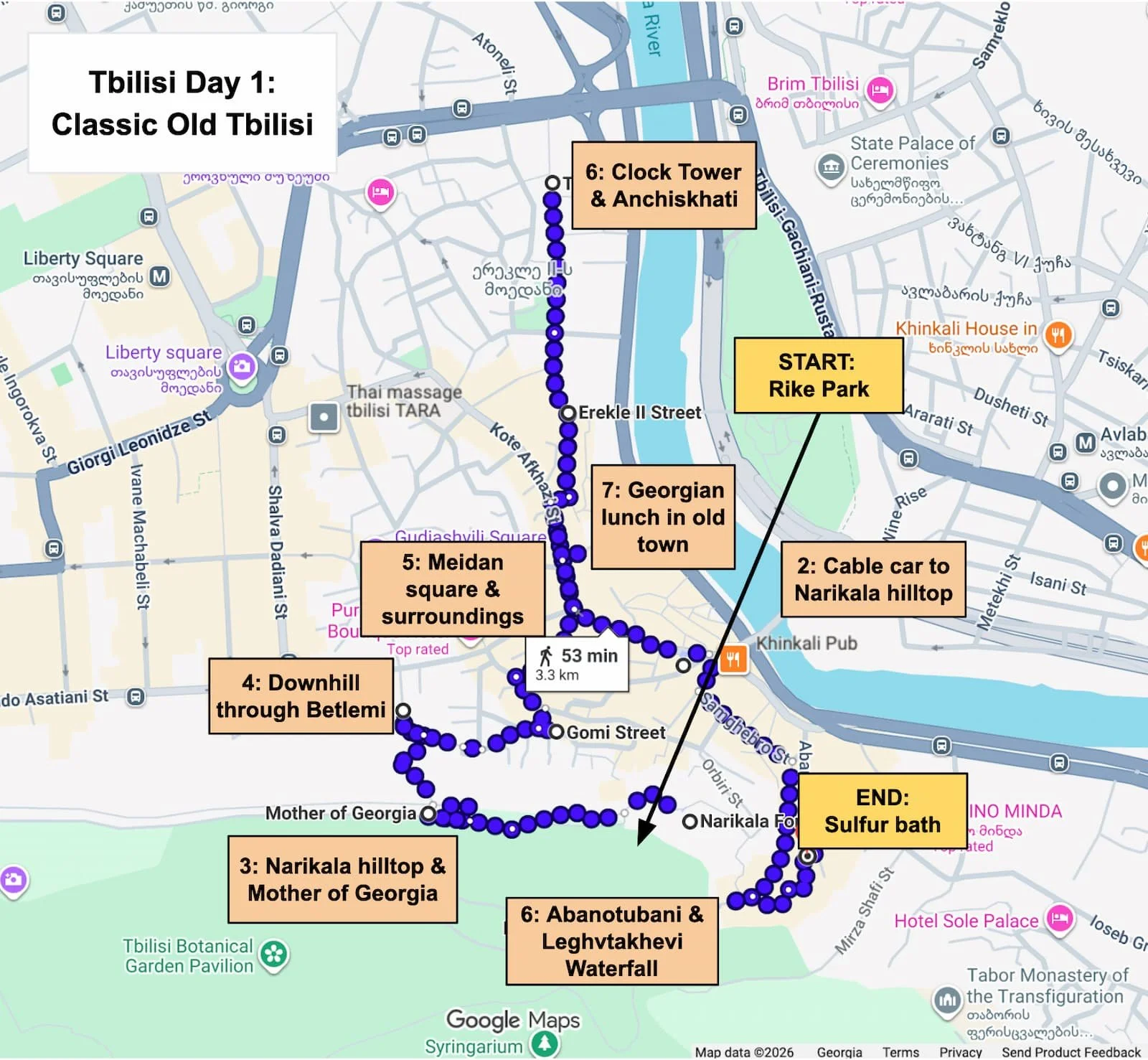
Map data © Google.
Suggested Timing
10:00–10:30: Rike Park and Bridge of Peace
10:30–10:45: Cable car to Narikala
10:45–12:00: Narikala, Mother of Georgia, and viewpoints
12:00–12:45: Walk down through Betlemi and Gomi
12:45–4:00: Old Tbilisi and lunch
4:00–5:00: Abanotubani and Leghvtakhevi Waterfall
5:00–5:30: Buffer time, coffee, or more wandering
5:30–6:00: Arrive at the bathhouse and check in
6:00–7:00 or 8:00: Sulfur bath
Afterward: Dinner nearby
Planning Notes
This itinerary generally works any day of the week: Most of the day is centered outdoors, while Chreli Abano and Khinkali Bar are currently open daily. Still, check for temporary cable car closures, construction around Narikala, and any changes to church access before you go.
Book the bath for around 6:00 PM: This gives you some flexibility if lunch runs long or you spend more time exploring, without pushing dinner too late.
Treat the rest of the timing as a guide: Georgian meals can take a while, and much of the hillside neighborhoods and Old Tbilisi are about wandering rather than following a strict schedule.
Morning — Rike Park, Cable Car, and Narikala
Allow: 1.5–2 hours
Start at Rike Park and take the cable car up toward Narikala.
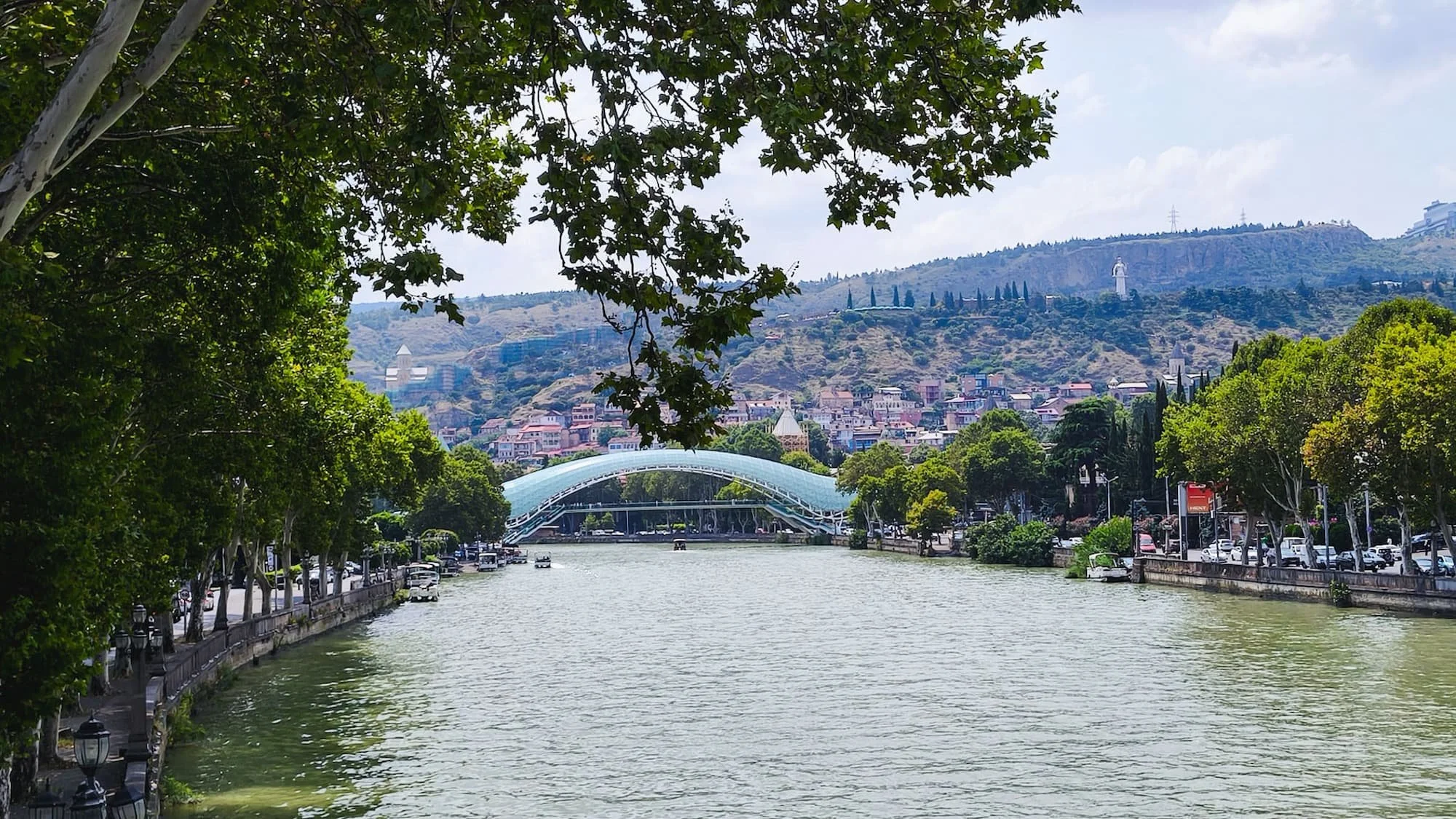
Rike Park itself is not really a major attraction, but it is a convenient starting point. Spend 20–30 minutes walking along the river, seeing the Bridge of Peace, and taking a few photos before getting on the cable car.
When we went at around 11:00 AM, the line was only about ten minutes. Although the ticket window says cash only, you can tap a contactless bank card directly at the turnstile. You only need cash if you decide to buy a transit card.
Try to stand near the window rather than beside the door. The cable car has full-length windows, so you feel slightly like you are hanging over the city. Keep that in mind if you are afraid of heights (it was slightly scary for me lol), although the ride only takes around two to three minutes.
At the top, see:
Narikala Fortress: An ancient hilltop fortress overlooking Old Tbilisi. Much of it was under construction when we visited, so the main draw for us was the setting and views.
Mother of Georgia: A huge aluminum statue holding wine in one hand for friends and a sword in the other for enemies.
Narikala viewpoints: Some of the best panoramic views over the Old Town, river, and surrounding hills.
The Botanical Garden is nearby, but it takes enough time to be its own activity. If you want to enter, you’ll have to cut some wandering time later.
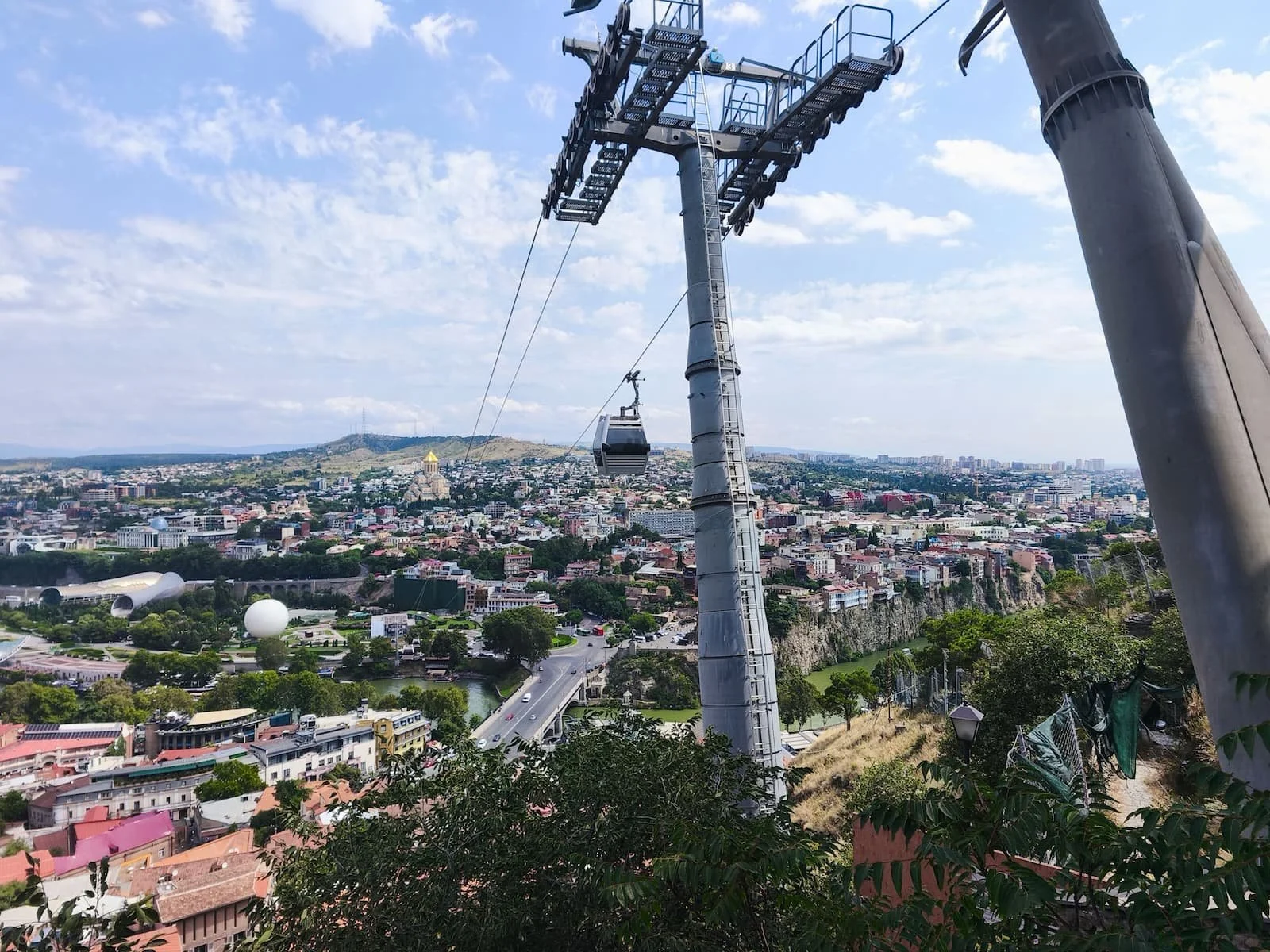
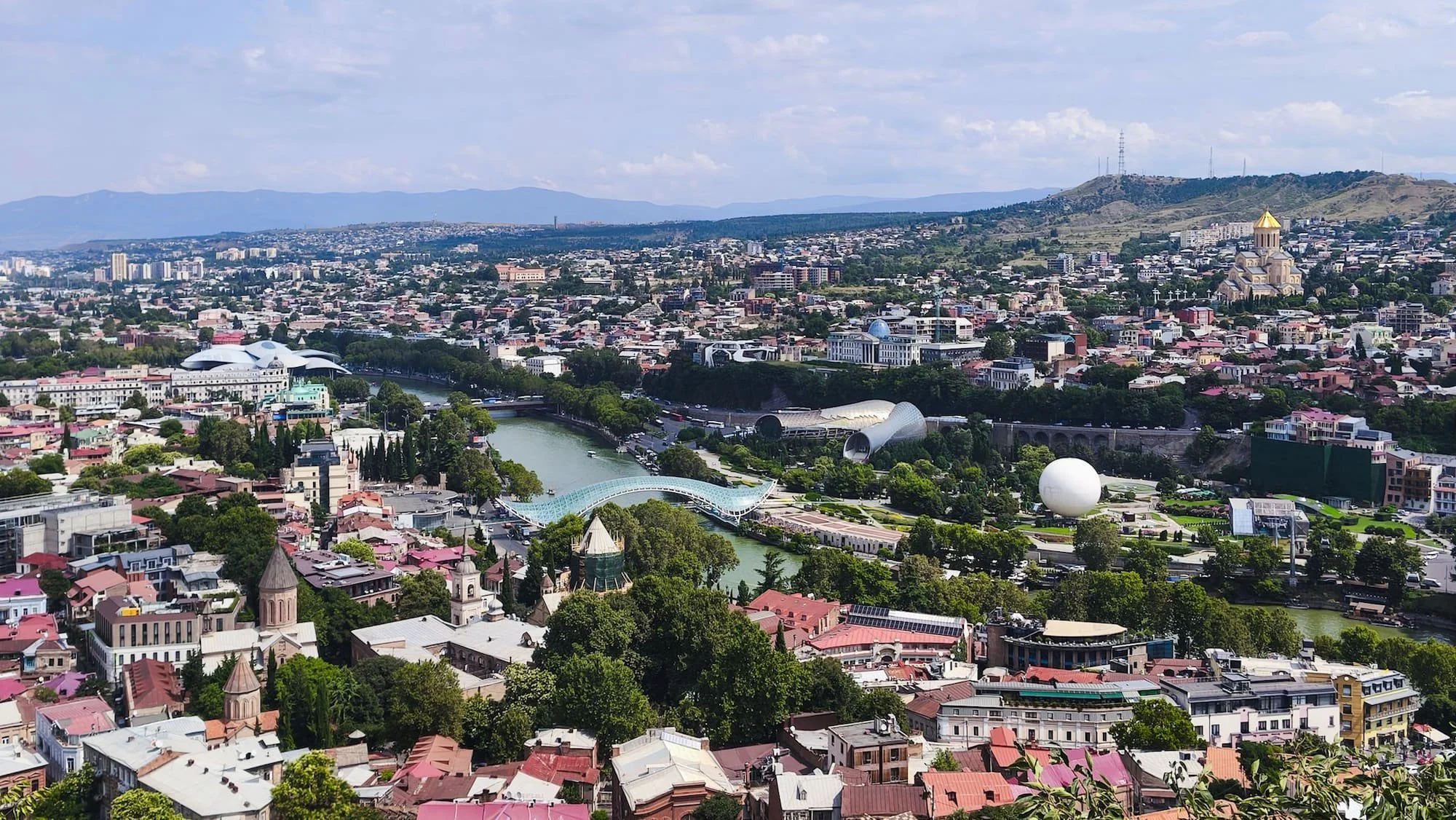
Panoramic view over Tbilisi from the hilltop, right off the cable car station.
Late Morning — Walk Down Through Betlemi and Gomi
Allow: 45 minutes–1 hour
Instead of taking the cable car back down, walk through the hillside streets of the Betlemi neighborhood toward the lower Old Town — trust me, it’s worth it.
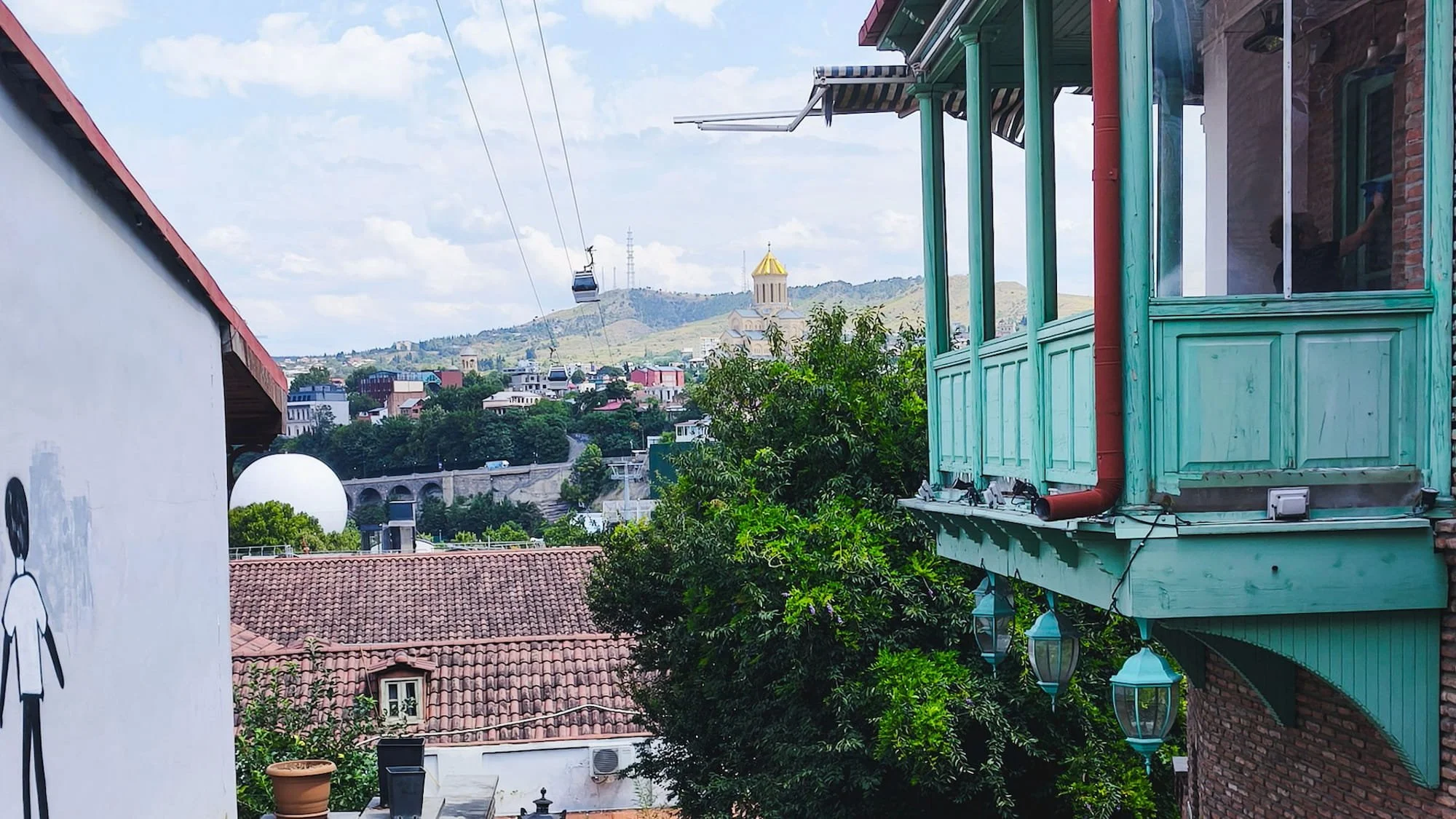
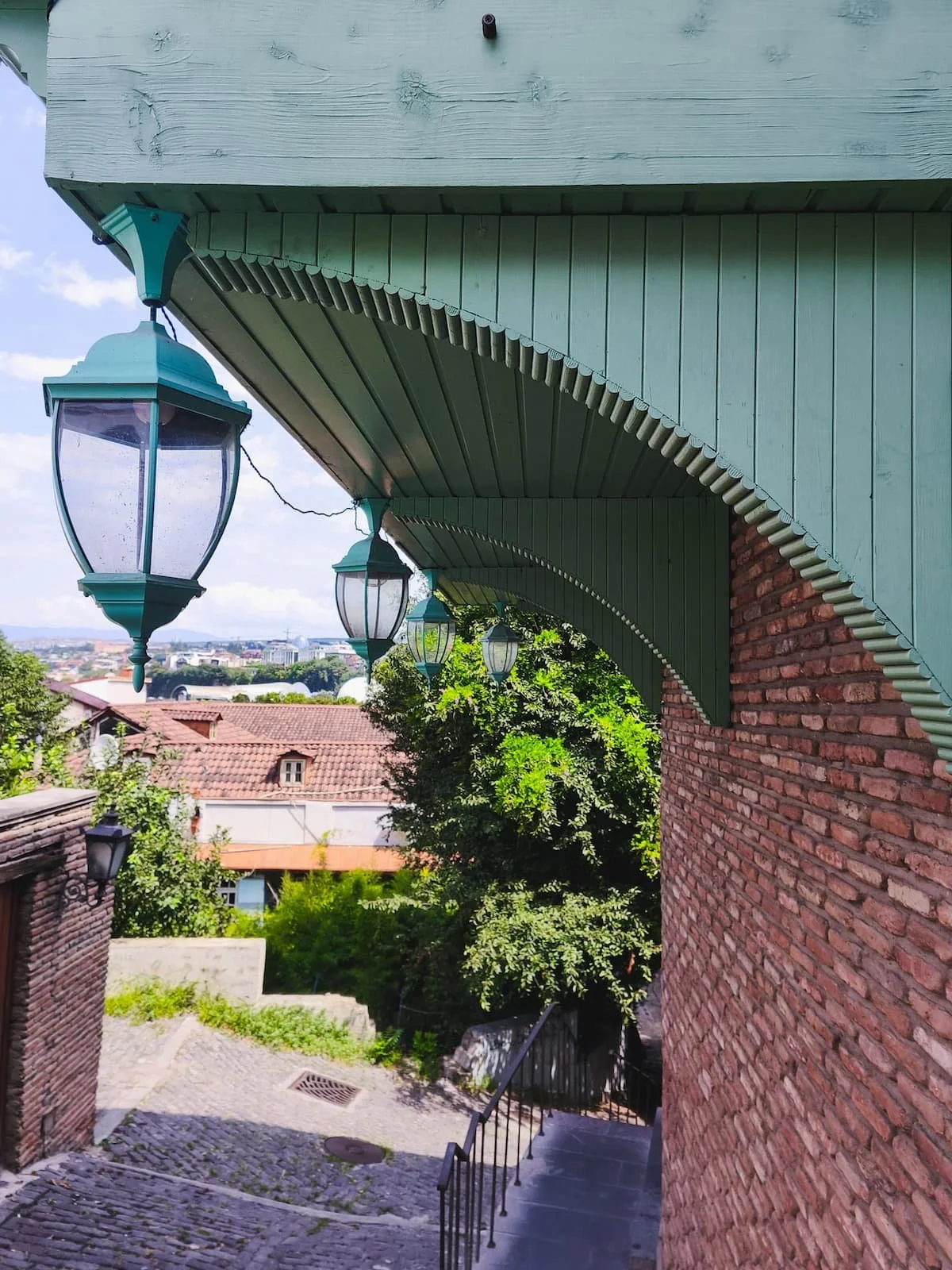
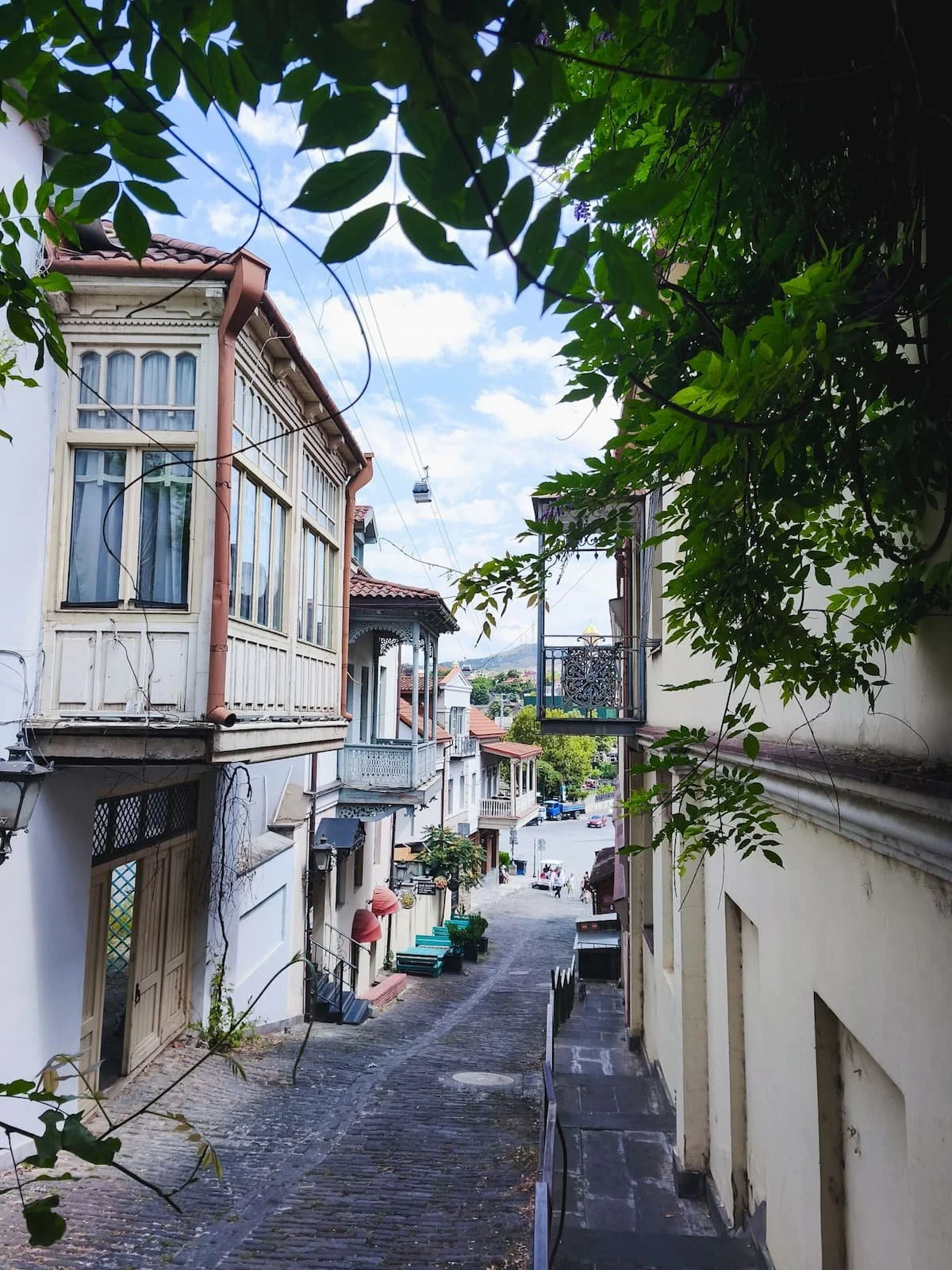
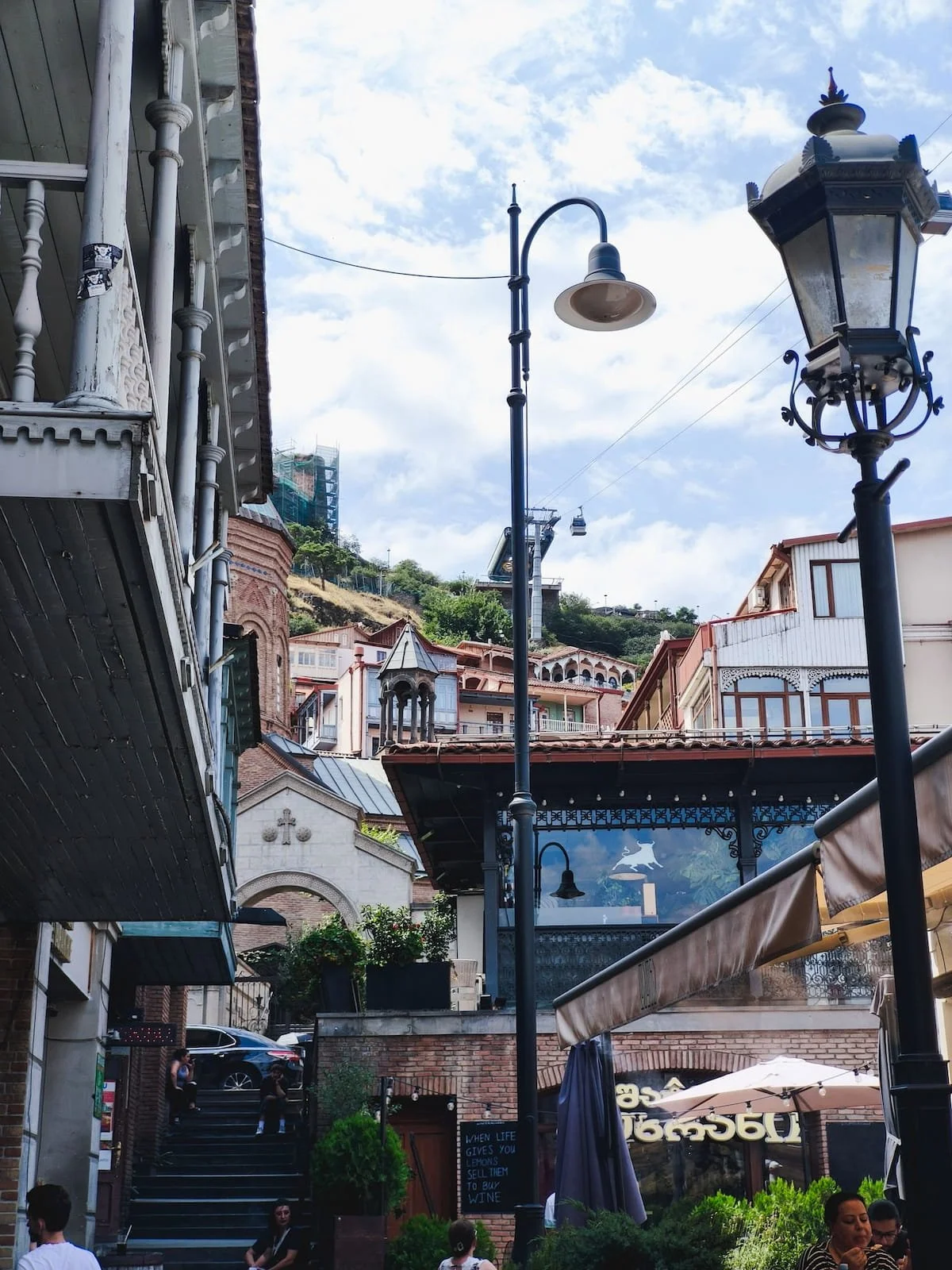
This is one of the most atmospheric parts of the day, and one of my personal favorite areas. You’ll pass steep historic streets with old houses, churches, carved balconies, courtyards, and small viewpoints. It’s a quiet residential area very different from the busy Narikala and the lower Old Town, and you can just slowly meander and take in the details and architecture of the area without the pressure of crowds.
You’ll first have to take some stairs down the steepest parts of the hill. During our visit, the stairs down closest to Narikala were closed for construction, but there was another set beside Mother of Georgia. And I’d suggest walking along Gomi street since some of the nicest details are tucked along that street.
Early Afternoon — Explore Old Tbilisi
Allow: 1.5–2 hours
Once downhill, you’ll be in the busy heart of Old Tbilisi.
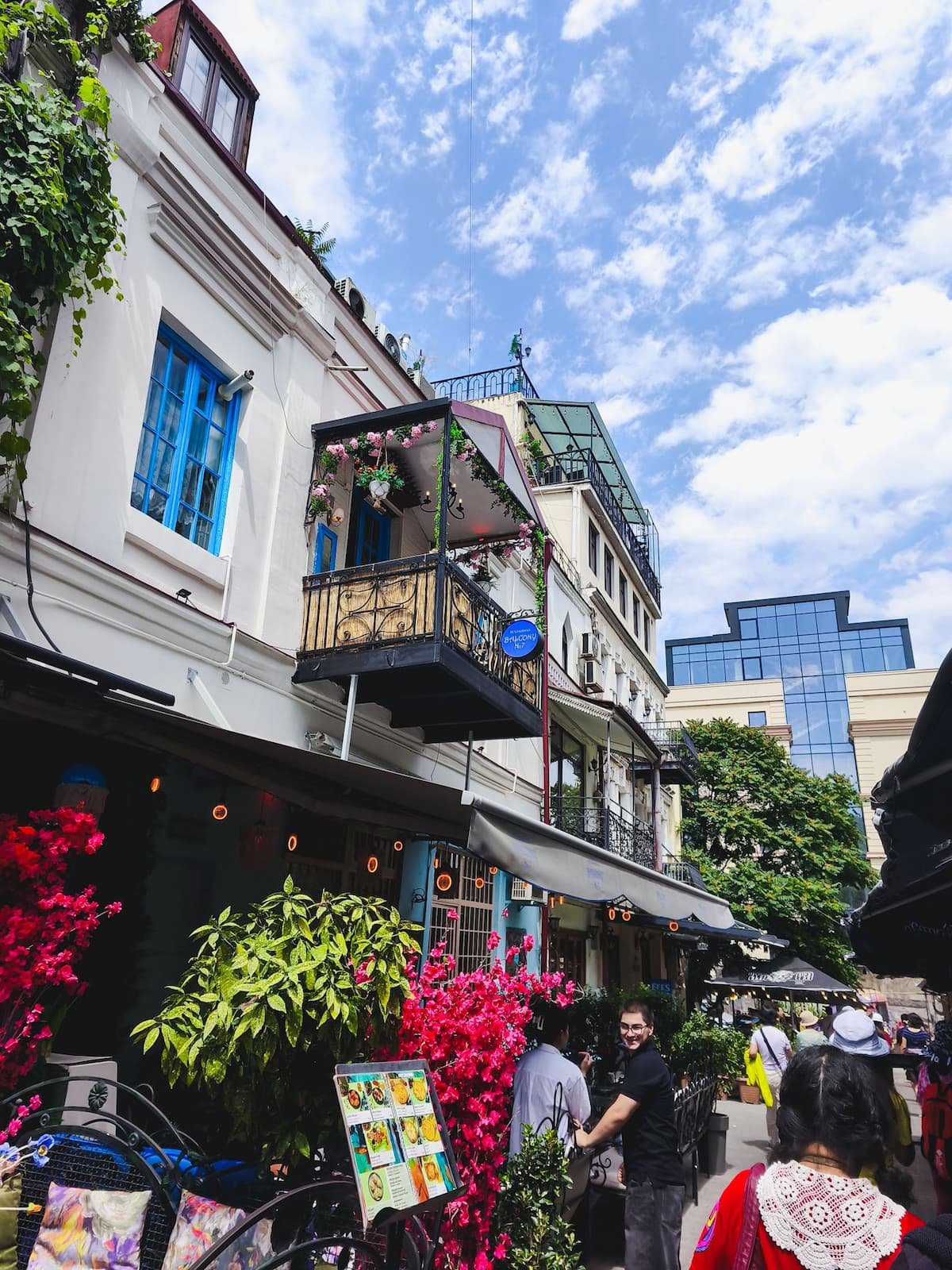
There are several sights here, but this part of the day is also about wandering through the neighborhood and taking in the colorful buildings and lively atmosphere.
Below are some of the most popular stops in the area, in the order I would visit them for a natural route:
Meidan Square: A lively square at the base of the Old Town, surrounded by restaurants, balconies, and historic buildings.
Meidan Bazaar: A small underground market selling Georgian wine, churchkhela, ceramics, and souvenirs. Worth a quick look if you are passing through.
Sioni Cathedral: One of Tbilisi’s most important Georgian Orthodox churches, with roots going back to the early medieval period.
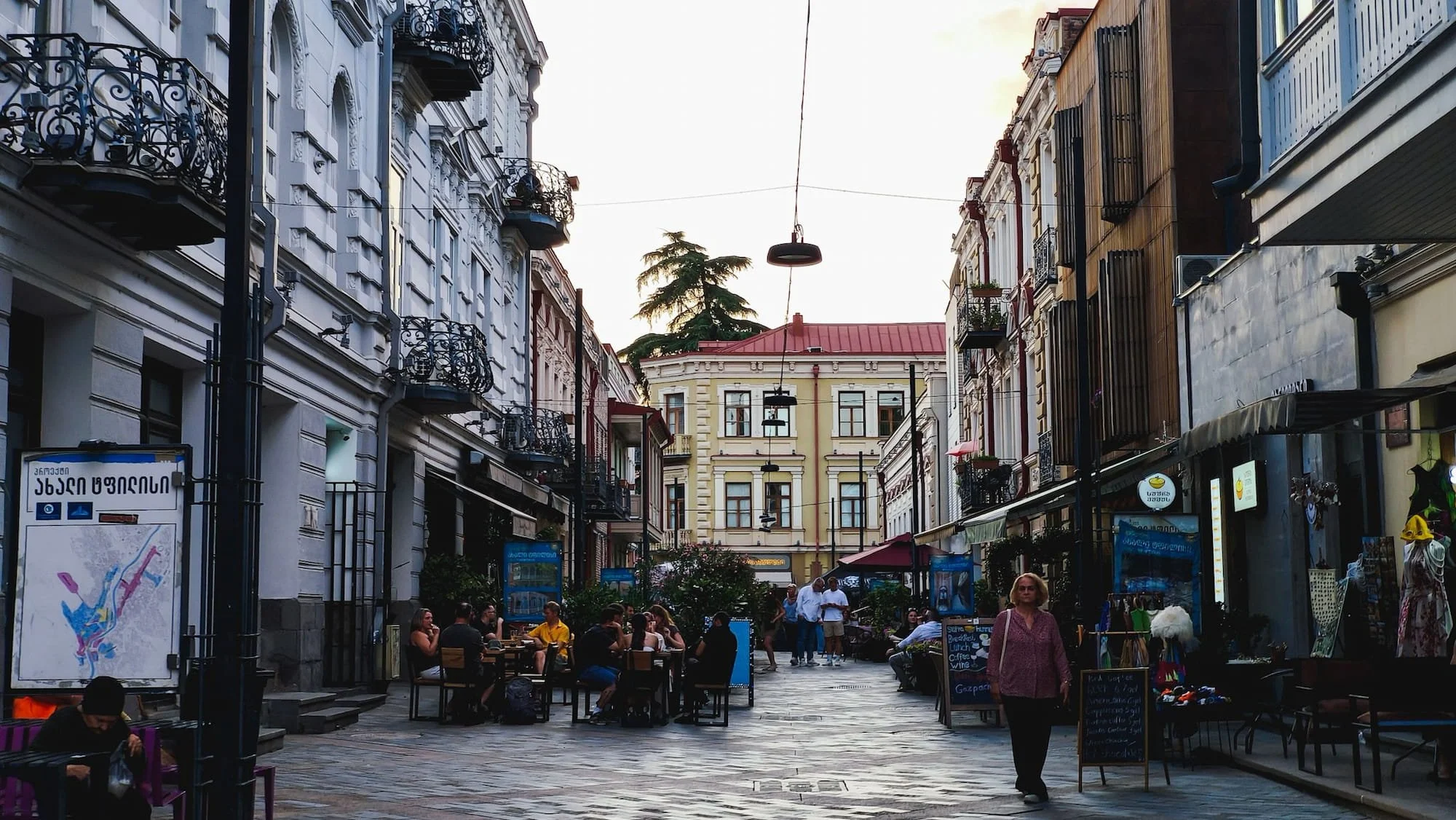
Erekle II Street: A pedestrian street lined with cafés, wine bars, shops, and colorful buildings.
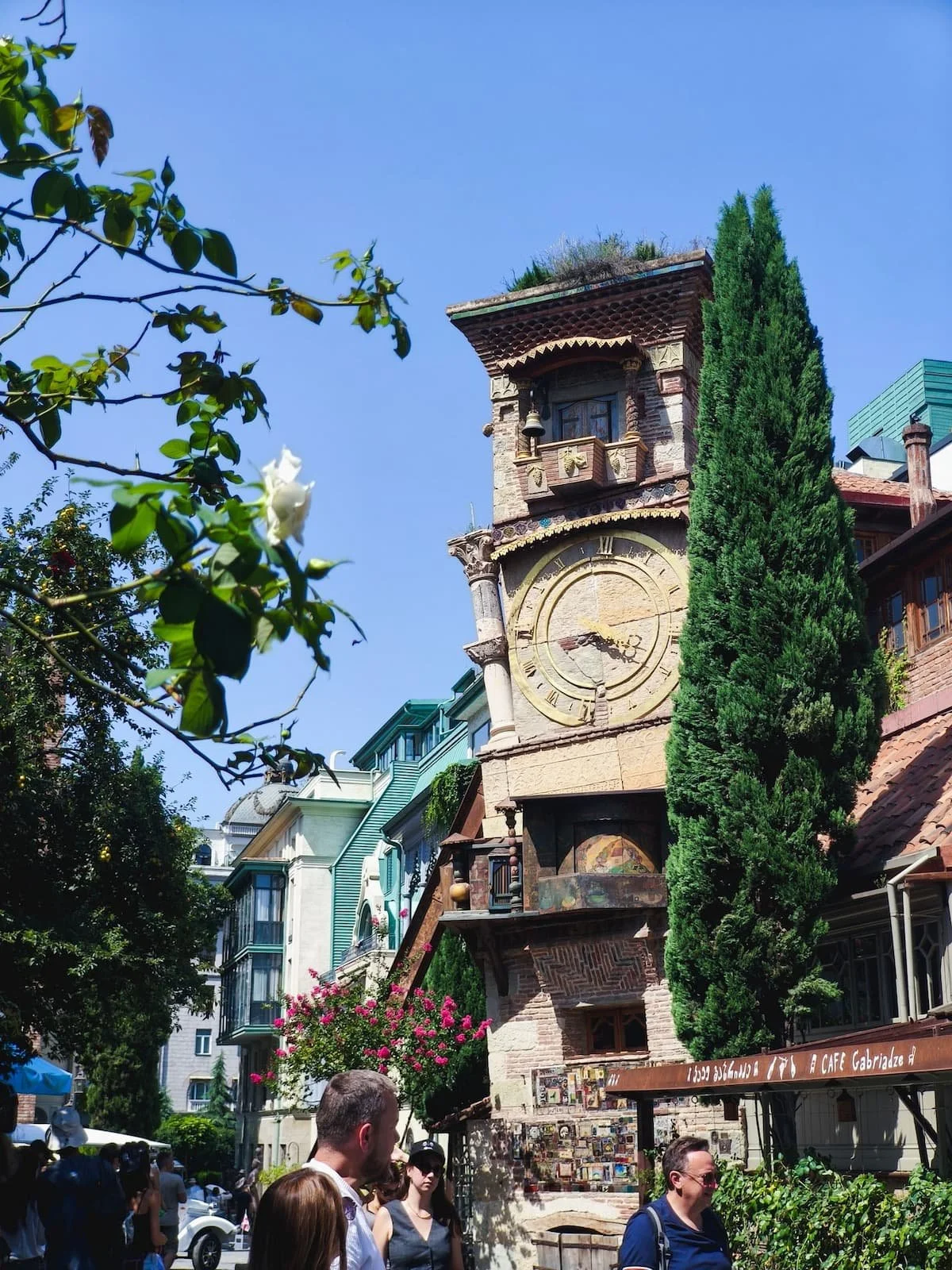
Gabriadze Theatre and Clock Tower: A deliberately crooked clock tower created by Georgian artist and puppeteer Rezo Gabriadze. A small angel rings the bell at noon and 7:00 PM.
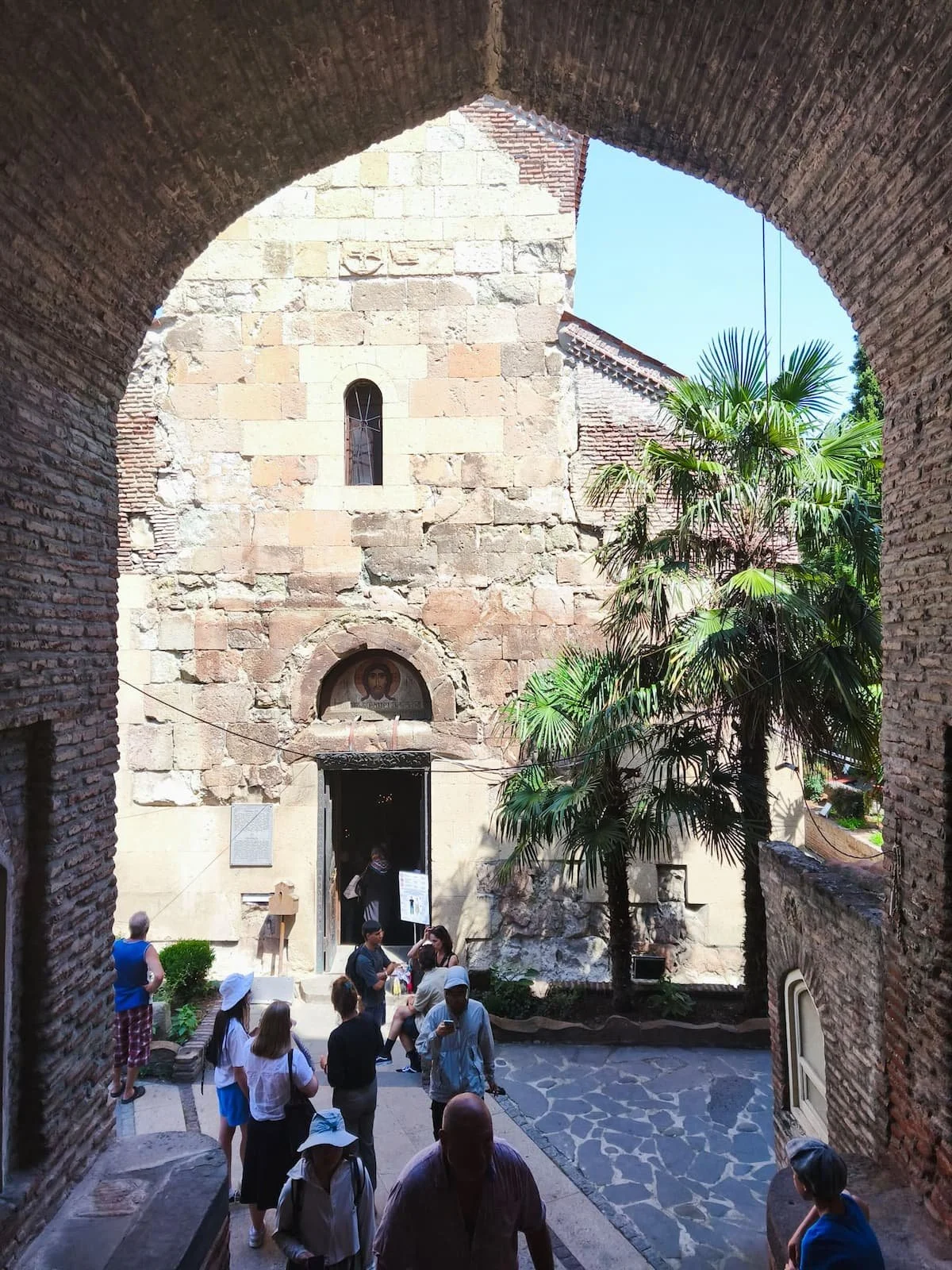
Anchiskhati Basilica: Believed to be Tbilisi’s oldest surviving church. It is much smaller and more understated than the city’s grand cathedrals. They were very strict about dress rules when we visited, and photos were not allowed.
Shardeni Street: A narrow, polished street filled with restaurants and bars. It is quite touristy, so you don’t need long here.
Lunch in Old Tbilisi
Allow: around 1.5 hours
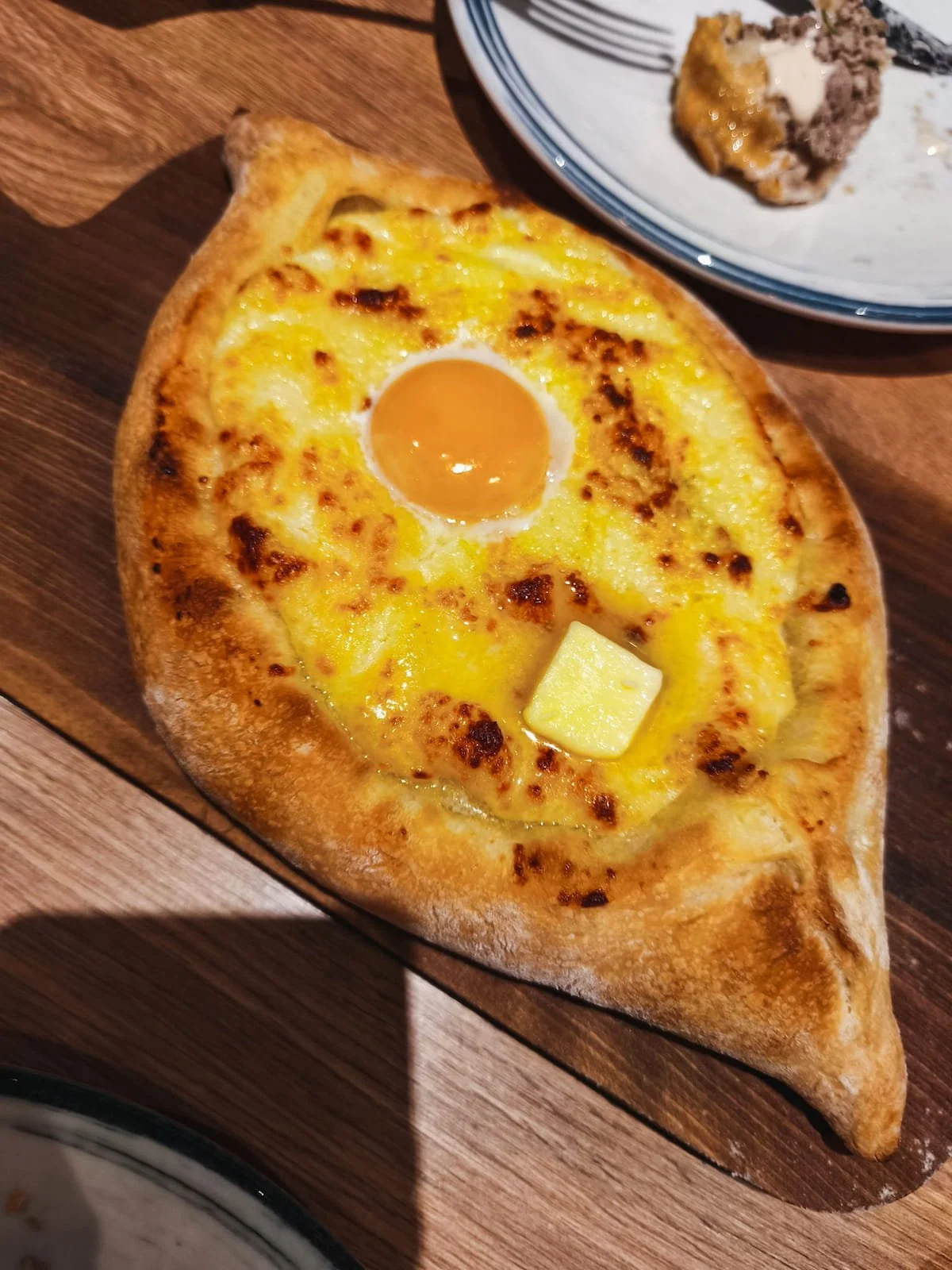
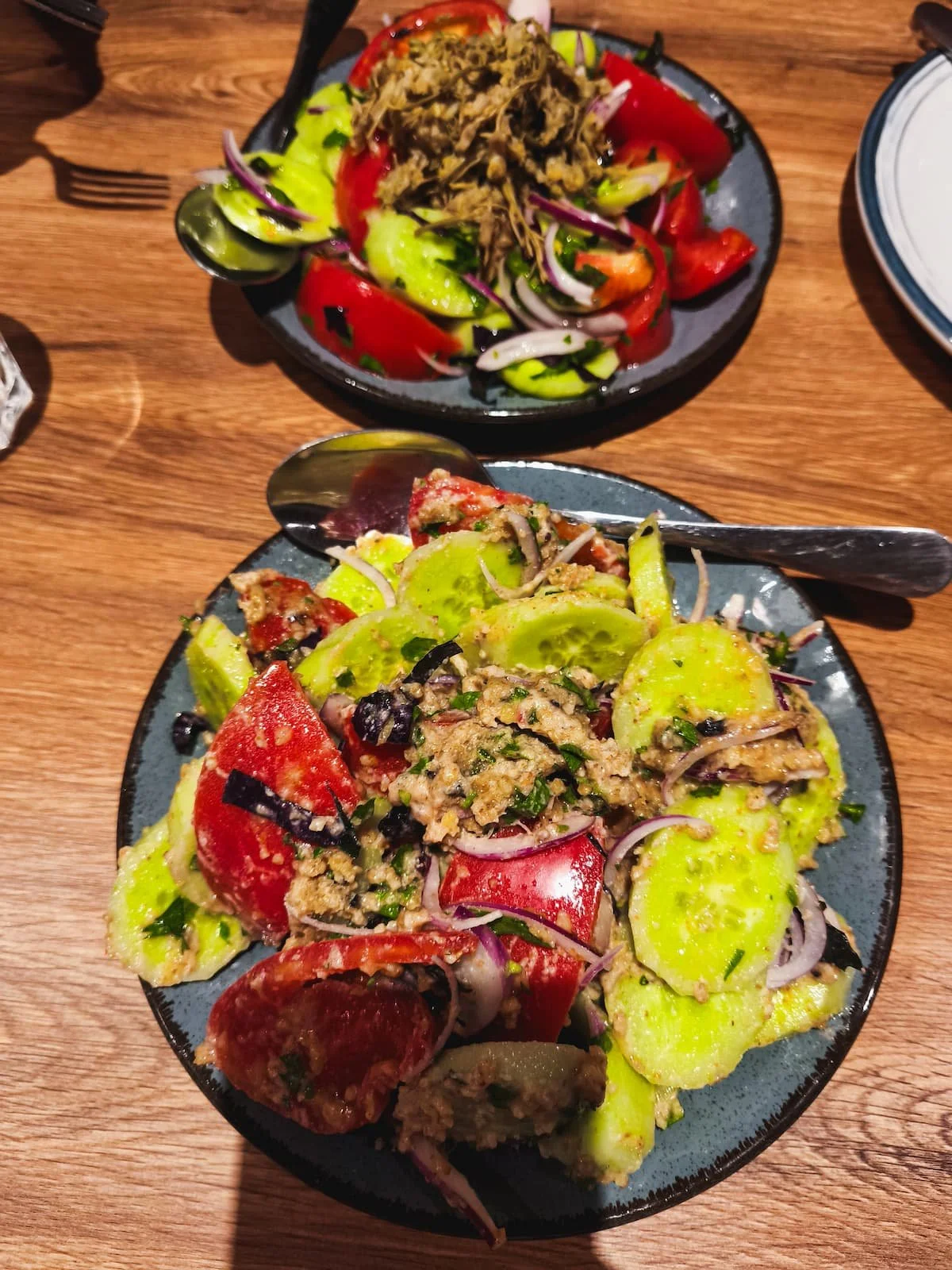
For a first Georgian meal, I would choose somewhere that lets you try the classic dishes of khinkali, khachapuri, and walnut-based dishes. I recommend Khinkali Bar.
Order:
Tomato and cucumber salad with walnuts
Fried eggplant with walnuts
Adjarian khachapuri, the boat-shaped one with egg and butter
A few types of khinkali, but definitely the classic meat version
Homemade lemonade
Khinkali are prepared to order, so this is not the place for a rushed meal. Allow around 75–90 minutes, especially if you are trying several varieties.
Mid-Afternoon — Abanotubani and Leghvtakhevi Waterfall
Allow: 45–60 minutes
Continue into Abanotubani, Tbilisi’s historic sulfur bath district.
See:
Bathhouse domes: The low brick domes covering the underground sulfur baths.
Chreli Abano: The colorful tiled bathhouse and one of the most photographed buildings in the area. We booked our sulfur bath here later in the day; see my Tbilisi sulfur bath guide for room choices, booking tips, and what to expect.
Leghvtakhevi Gorge: A walkway between cliffs just behind the bath district that follows a stream.
Leghvtakhevi Waterfall: A small waterfall at the end of the gorge.
The waterfall itself is not huge, but the gorge and bath district make the walk worthwhile. It can also be very crowded, so definitely don’t expect a quiet nature stop, but a waterfall in the middle of the city is still cool to see.
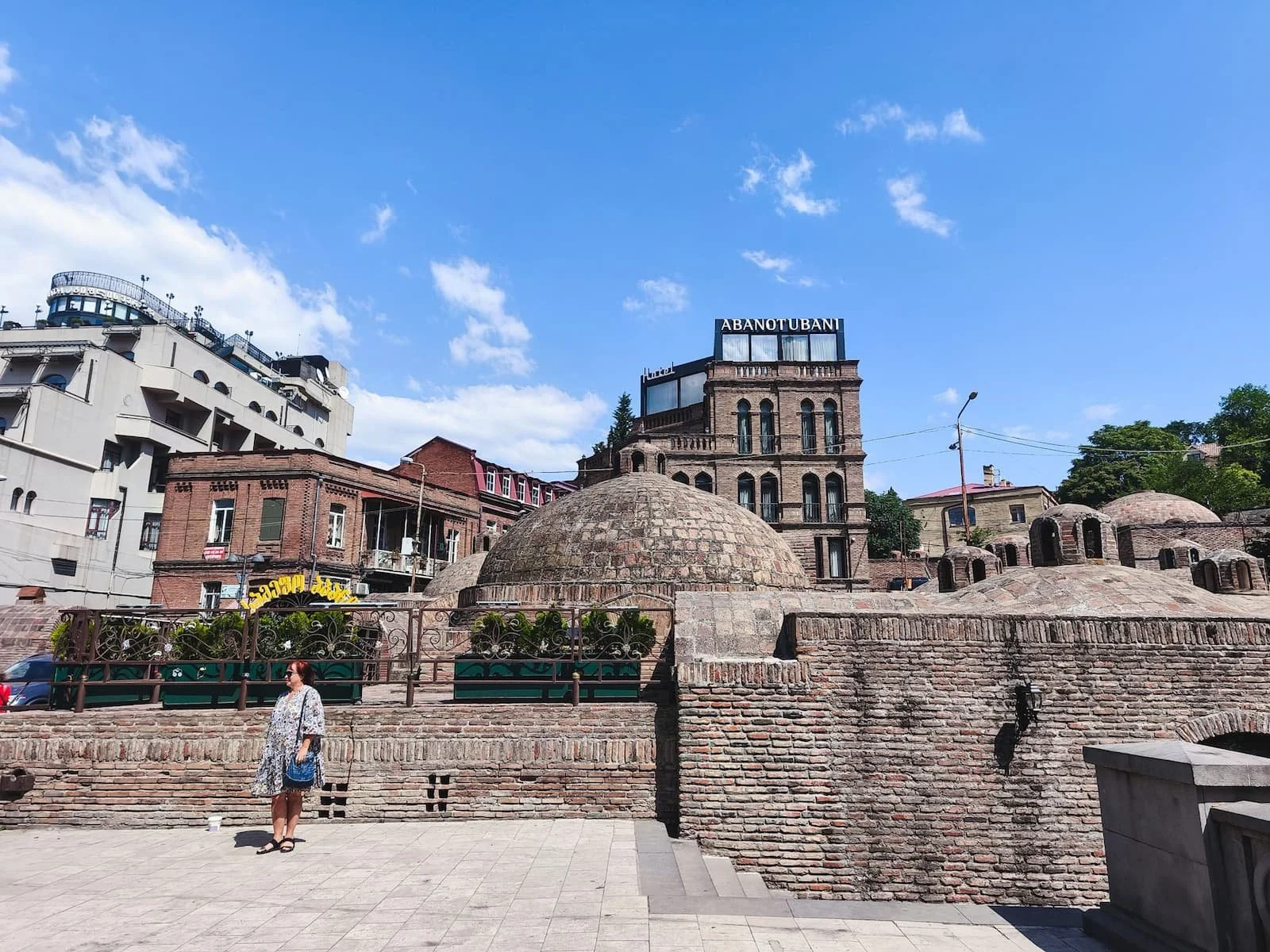
Brick domes covering the historic sulfur baths in Abanotubani.
Evening — Sulfur Bath
Allow: 1–2 hours
Finish the sightseeing part of the day with a private sulfur bath. I recommend Chreli Abano and booking a room with a hot pool, cold plunge, and sauna if your budget allows.
You can also add a traditional kisa scrub. We didn’t get the professional scrub and found a one-hour booking to be plenty, but if you add one, 90 minutes to two hours would probably feel less rushed.
Try to arrive around 15 minutes before your reservation since there may be a line at check-in.
For room choices, booking tips, what to bring, and what the experience is actually like, see my Tbilisi sulfur bath guide.
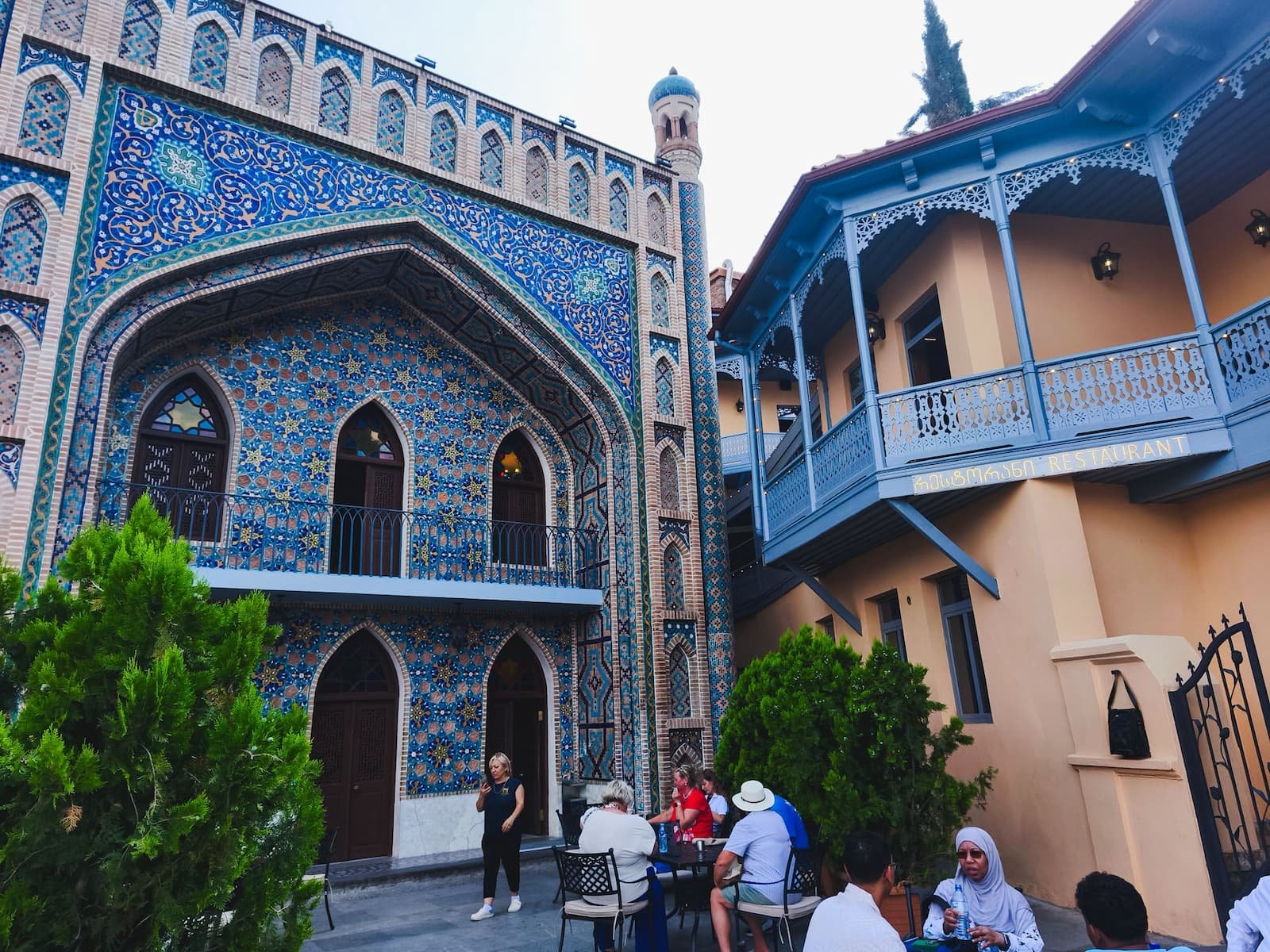
The intricate blue tiled façade of Chreli Abano.
Dinner Near Abanotubani
Stay nearby for dinner. After the bath, you will probably feel relaxed and a bit sleepy and not want to cross the city before sitting down to eat.
We went to Chef Saradjeff, which serves Meskhetian food from southern Georgia along with homemade wine, and we recommend it.
Day 2 — Sololaki, Georgian History, and Rustaveli Avenue
This day focuses on central Tbilisi and some of its layers, starting with the faded grandeur of Sololaki before moving through a traditional mtsvadi lunch, the eclectic Dry Bridge flea market, Georgian history at the museum, and the grand architecture and evening energy of Rustaveli Avenue, with an optional Georgian wine stop before dinner.
Route
Freedom Square → Sololaki → mtsvadi lunch → Dry Bridge Market → 9 April Park and Orbeliani Square → Georgian National Museum → Rustaveli Avenue → optional wine at 8000 Vintages → dinner
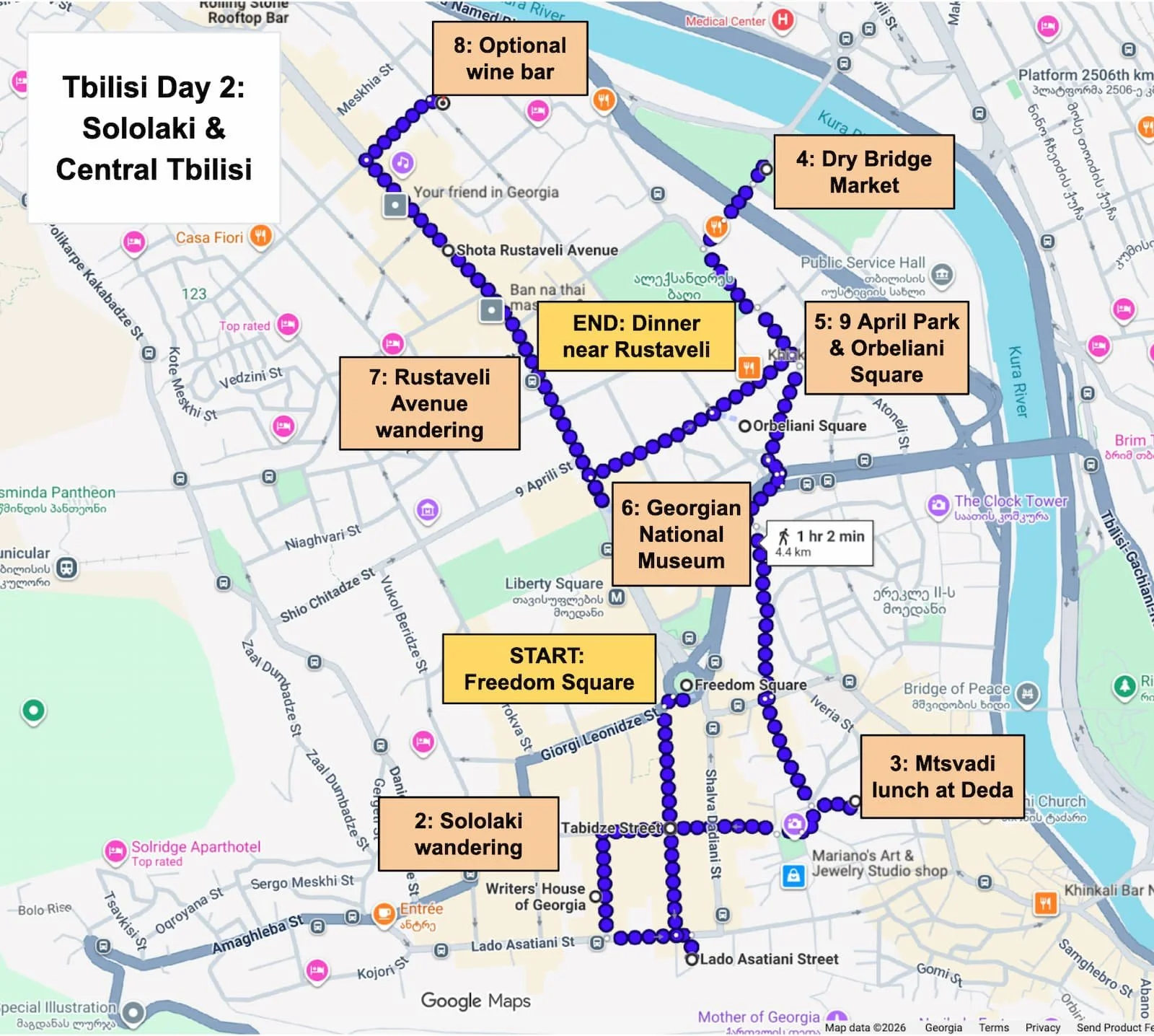
Map data © Google.
Suggested Timing
10:00–10:30: Freedom Square, old city wall remains, and optional breakfast
10:30–12:30: Sololaki
12:30–2:00: Mtsvadi lunch at Deda
2:00–2:30: Walk to Dry Bridge Market
2:30–3:15: Dry Bridge Market
3:15–3:30: Walk through 9 April Park
3:30–3:45: Orbeliani Square
3:50–5:30: Georgian National Museum
5:30 onward: Rustaveli Avenue, optional wine bar, and dinner
Planning Notes
This full itinerary does not work on Mondays: Georgian National Museum is closed on Mondays, so I’d do Day 2 on another day of the week if you want to follow it as written.
Visit Dry Bridge before the museum: The market tends to be livelier from late morning into the afternoon and may start thinning out later in the day.
Temporary 2026 note: Rustaveli Avenue is undergoing major reconstruction. You can still include its landmarks, but the walk may not have its normal atmosphere while the work is underway.
Morning — Freedom Square and the Old City Walls
Allow 15–30 minutes
Start at Freedom Square, a huge roundabout at the start of Rustaveli Avenue and the edge of Sololaki.
See:
St. George Monument: The tall golden monument at the center of the square.
Buildings around Freedom Square: A mix of historic and more recent architecture surrounding the roundabout.
Old city wall remains: Visible below Pushkin Street beside the square. I liked the strange juxtaposition of the old, slightly neglected walls, the modern road above them, and the graffiti.
For less chaos and less waiting on traffic, use the Liberty Square underground walkways rather than trying to cross aboveground.
For a quick breakfast, Bakery Underground in the walkway sells freshly baked and very reasonably priced pastries. I especially recommend the mushroom bread and khachapuri puff.
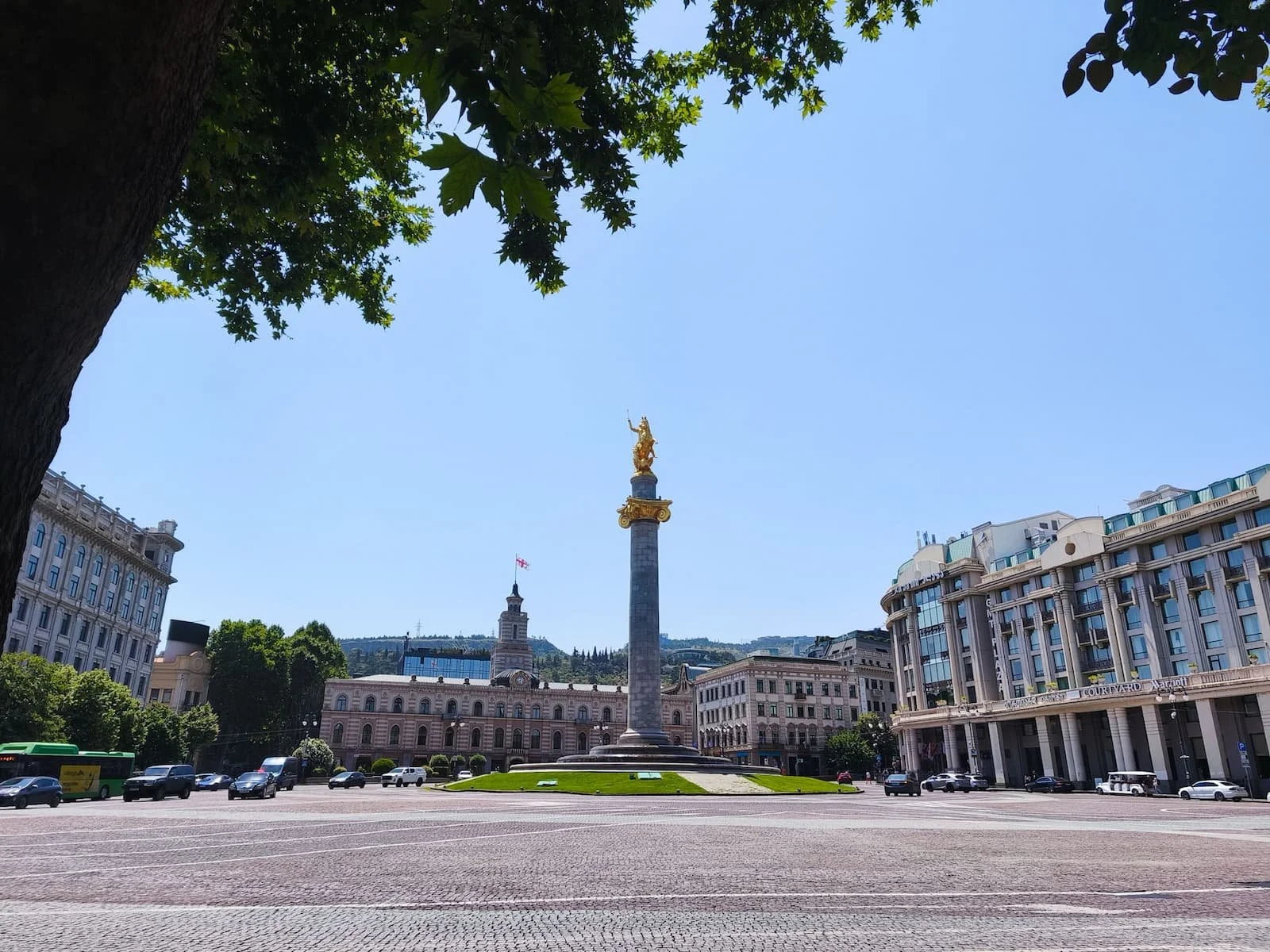
Freedom Square.
Late Morning — Wander Through Sololaki
Allow: 1.5–2 hours
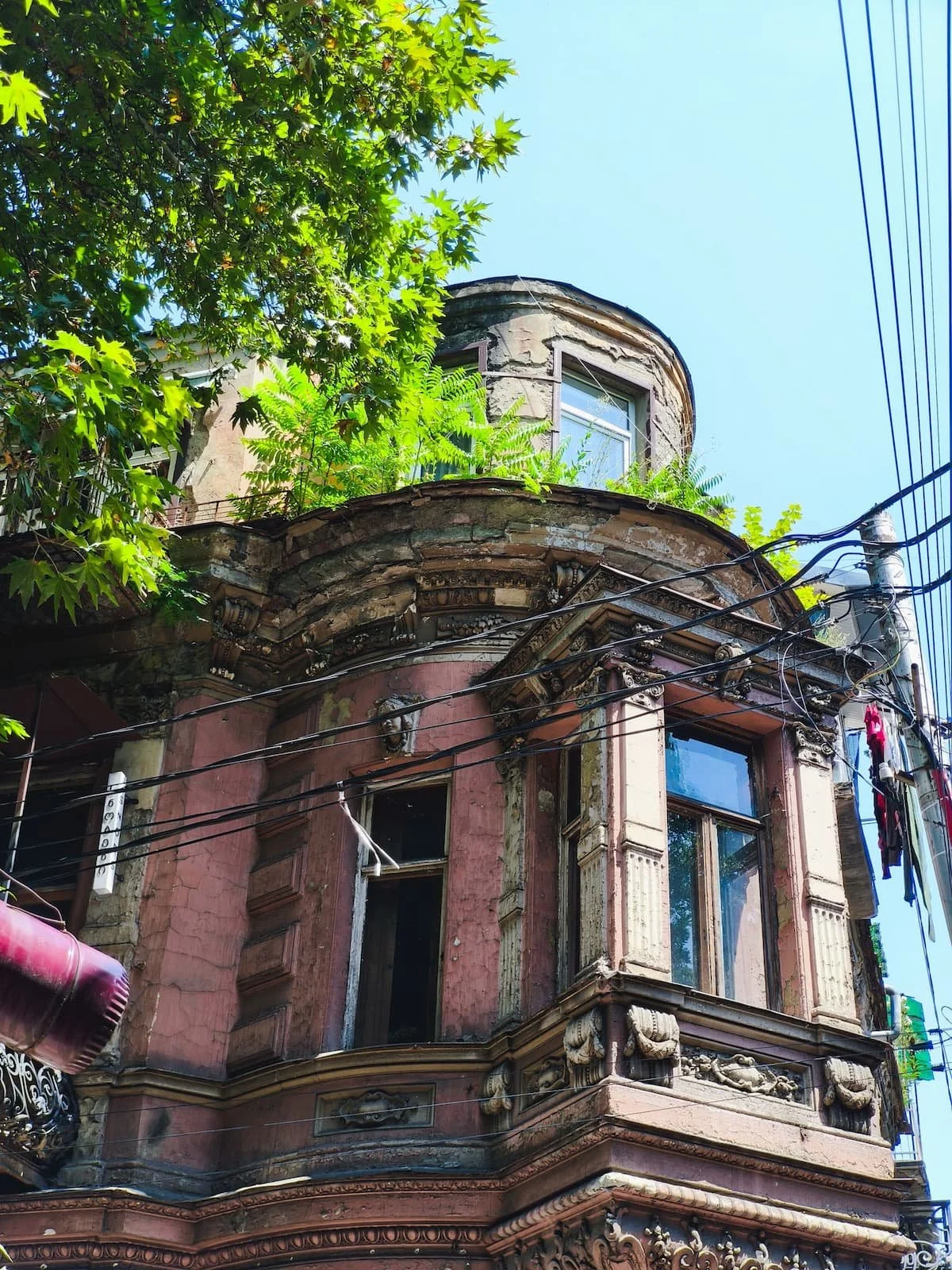
Sololaki is one of the best places to see Tbilisi’s faded grandeur, with old merchant mansions, carved balconies, colorful doors, ornate entrances, and atmospheric residential streets.
When you hear “mansion,” you might imagine something very polished and grand. These are not really like that now (well, they were in the past). For me, a lot of Sololaki’s appeal is the contrast between that faded grandeur and the newer places tucked inside it: hip coffee shops in the corners of old buildings, restaurants in crumbling courtyards, and elaborate entrance halls hidden behind worn façades.
Some residential buildings have beautiful entrances or shared courtyards visible when the doors are open. Enter only where access is clearly permitted, since these are still people’s homes.
Here are some stops that form a loose route, though I’d say the neighborhood itself is the attraction rather than any particular building:
Galaktion Tabidze Street: A lively street leading directly from Freedom Square, lined with cafés and historic buildings.
Brothers Seilanov House: Known for its painted entrance hall, although it was closed and marked private when we visited.
Lado Asatiani and Machabeli streets: Good streets for balconies, colorful doors, hidden courtyards, and ornate entrance halls.
Writers’ House: An early-20th-century mansion with a cafe in the garden. Interior access may vary, and it was closed when we passed on a Sunday.
Gudiashvili Square: A restored square surrounded by traditional balconies and decorative façades.
Lunch at Deda
Allow: 1.5–2 hours
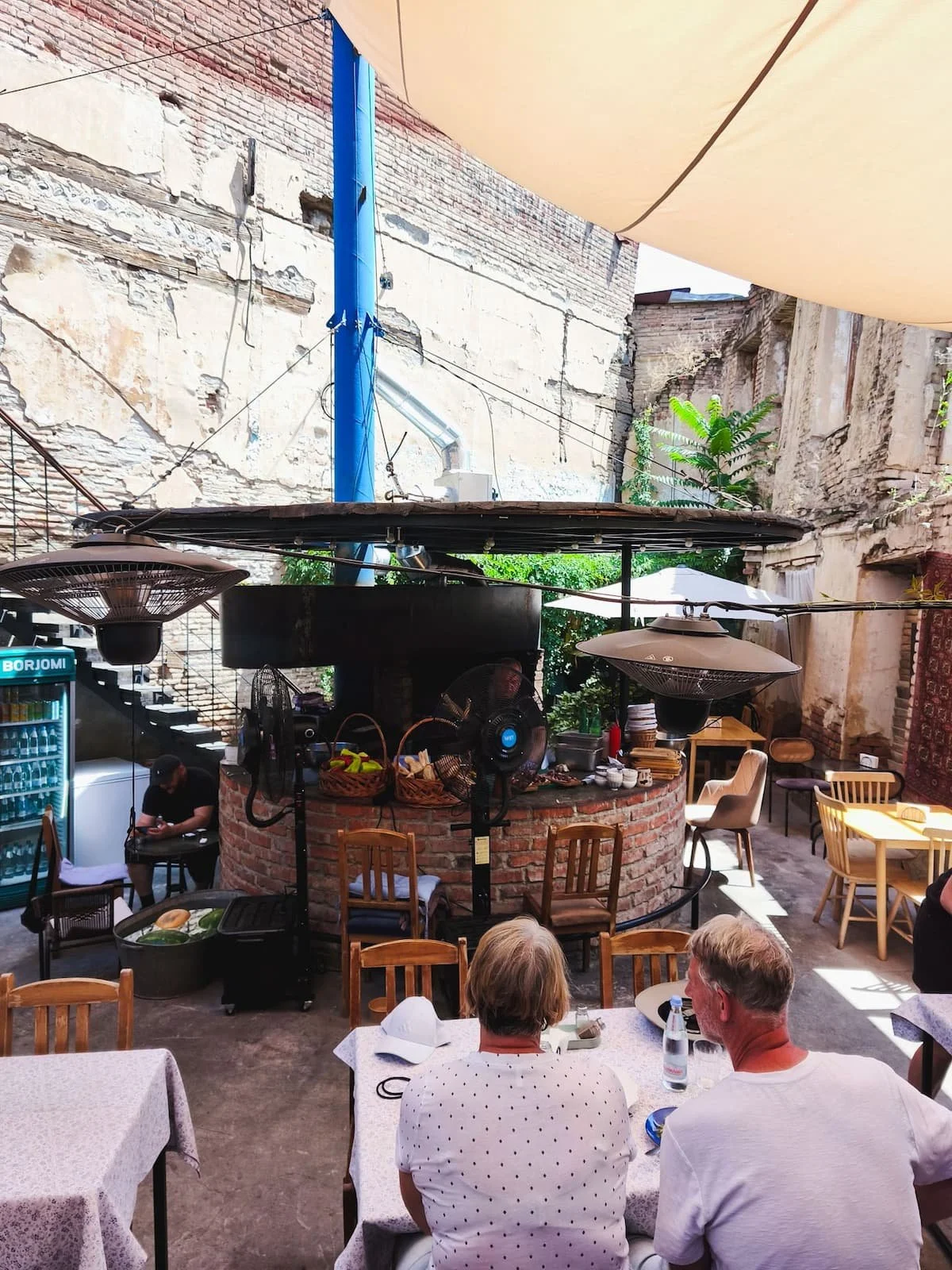
After wandering, head to Deda in the neighborhood for mtsvadi, or Georgian grilled meat.
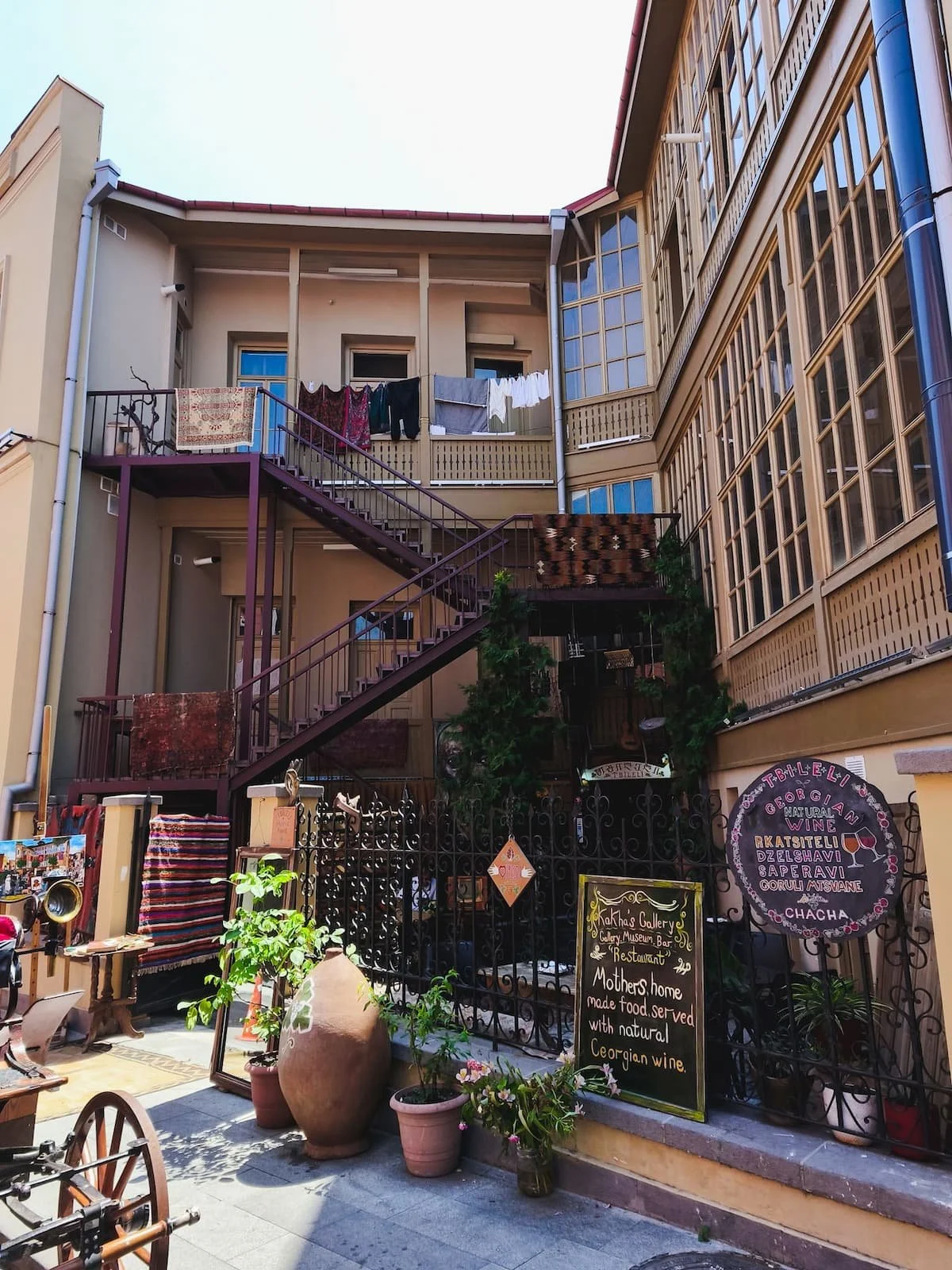
The setting of the restaurant is gorgeous. It sits inside the courtyard of a crumbling old building, with a traditional grill on one side and tiered seating on the other, filled with colorful cushions. Cute cats also wander around.
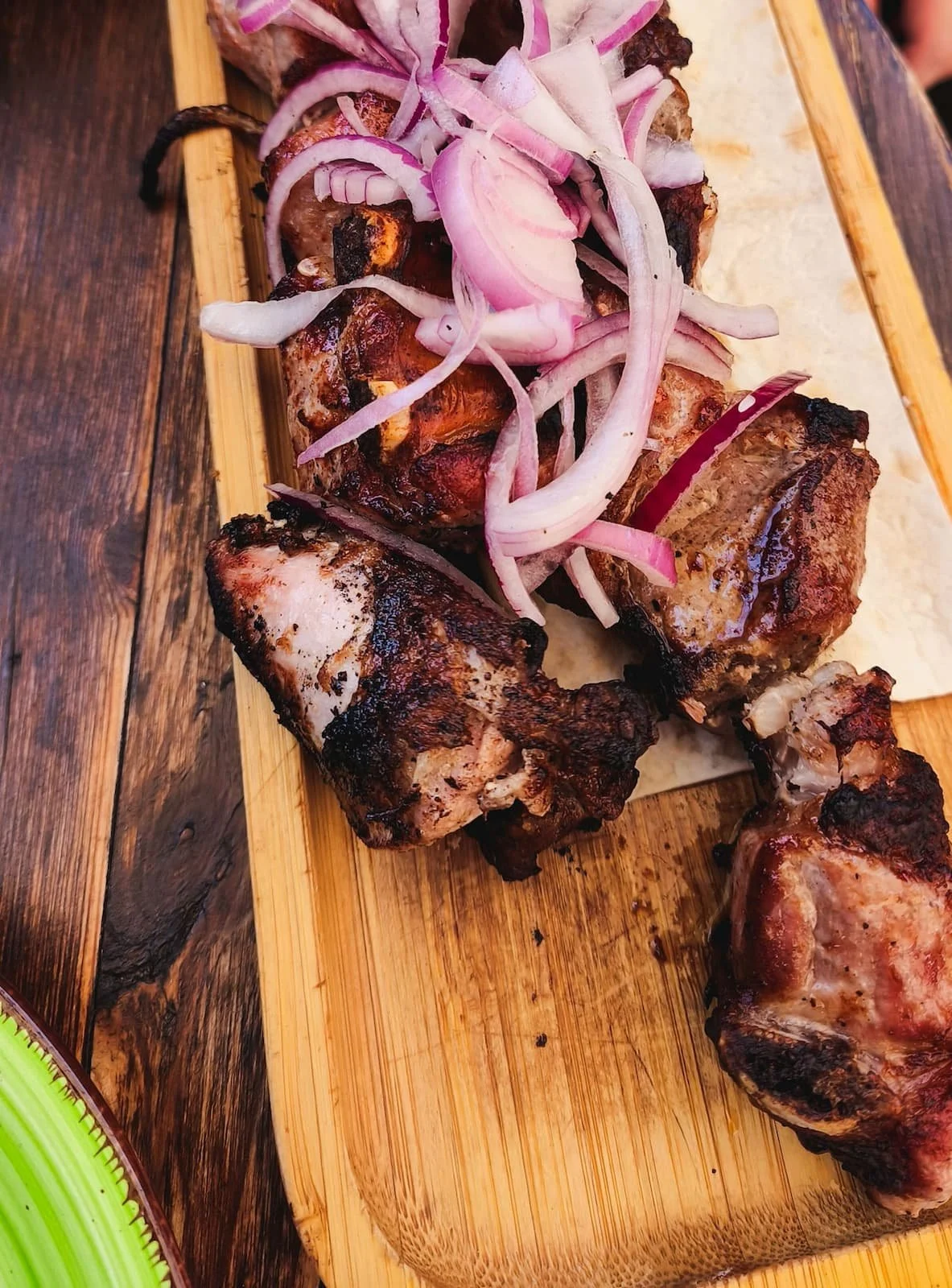
Our waiter insisted we just get the pork mtsvadi, which was their specialty, so we ordered it with bread and tomato-cucumber walnut salad. I mean, he knew best for sure — the meat was extremely juicy and smoky, and we were glad we listened to him and got enough of it. So yummy.
Early Afternoon — Dry Bridge Market
Allow: 30–45 minutes
Walking from Deda: Around 30 minutes
Next, walk toward Dry Bridge Market, Tbilisi’s best-known flea market.
Vendors sell Soviet memorabilia, old cameras, paintings, household objects, coins, rugs, and plenty of things that may or may not be genuine antiques.
The market is outdoors, so it’s better when the weather is dry. It also tends to be livelier earlier in the afternoon, when more vendors are still out. Unless you are seriously shopping, I think it’s honestly more of a quick stop to look through the interesting objects than somewhere you need to spend hours.
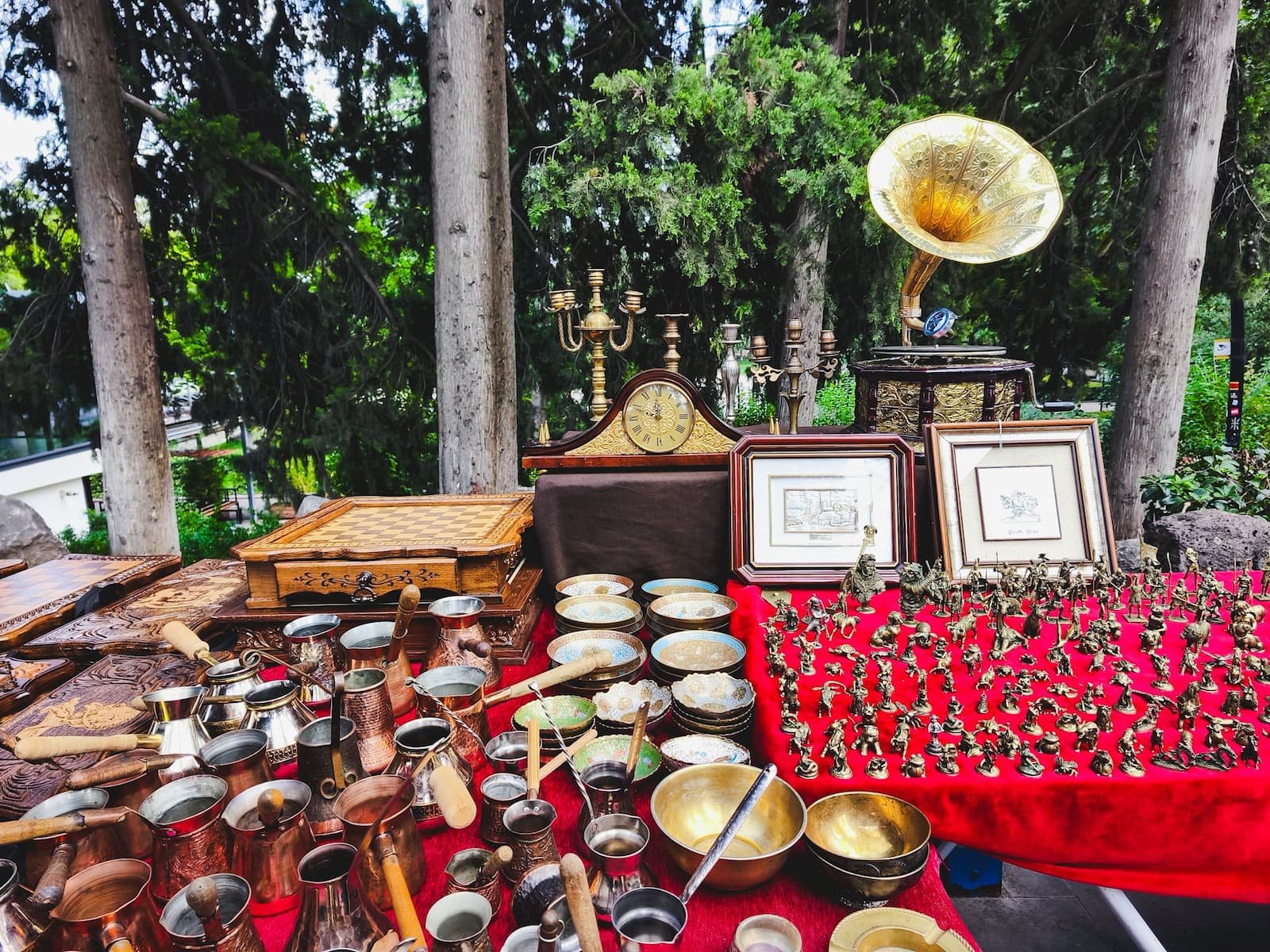
Vintage (and maybe not so vintage) collectibles at Dry Bridge Market.
9 April Park and Orbeliani Square
Allow: 20–30 minutes
From Dry Bridge, cut through 9 April Park and then Orbeliani Square on the way to the museum.
9 April Park is one of Tbilisi’s older public parks, and Orbeliani Square is a small restored area with historic buildings and ornate balconies, now full of restaurants and a relaxed atmosphere often with street musicians. Right next to it is a covered flower market surrounded by decorative façades.
Afternoon — Georgian National Museum
Allow: 1.5–2 hours
The Georgian National Museum gives you a broad introduction to Georgian history through archaeological finds, Paleolithic tools, impressive gold and silver work, and a section dedicated to the Soviet Occupation.
One thing to note is that I found it helpful to have some background on Georgian history beforehand, since the museum focuses more on the artifacts themselves than on one clear historical narrative.
If you are more interested in Georgian art, you can choose the nearby National Gallery instead. Its collection includes work by major Georgian artists, especially Niko Pirosmani.
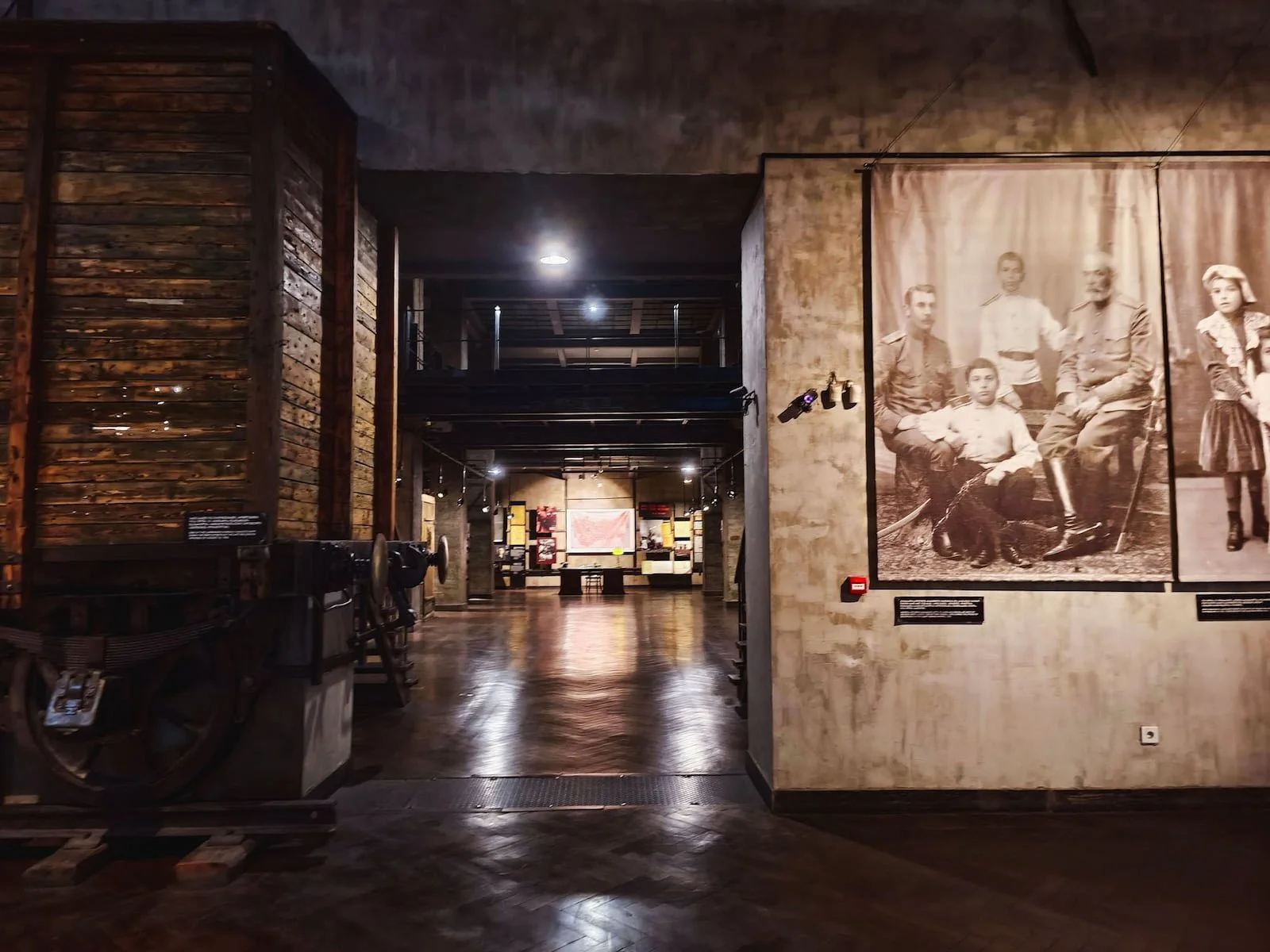
Soviet Occupation exhibition inside the Georgian National Museum.
Evening — Walk Along Rustaveli Avenue
Allow: however long you want
Finish the sightseeing portion of the day with a walk along Rustaveli Avenue, Tbilisi’s grand central boulevard.
Look out for:
Parliament of Georgia: An imposing Soviet-era building associated with significant moments in Georgia’s recent political history, probably for me one of the coolest buildings in the city.
Tbilisi Opera and Ballet Theatre: One of the avenue’s most distinctive buildings, with an elaborate Moorish-inspired exterior.
Kashveti Church: An attractive early-20th-century Georgian Orthodox church opposite 9 April Park.
But really the best part is simply walking the avenue and taking in the architecture, cafés, cultural institutions, and evening atmosphere. Continue along the avenue at your own pace, stop for coffee if you need a break, and end with dinner or a Georgian wine bar.
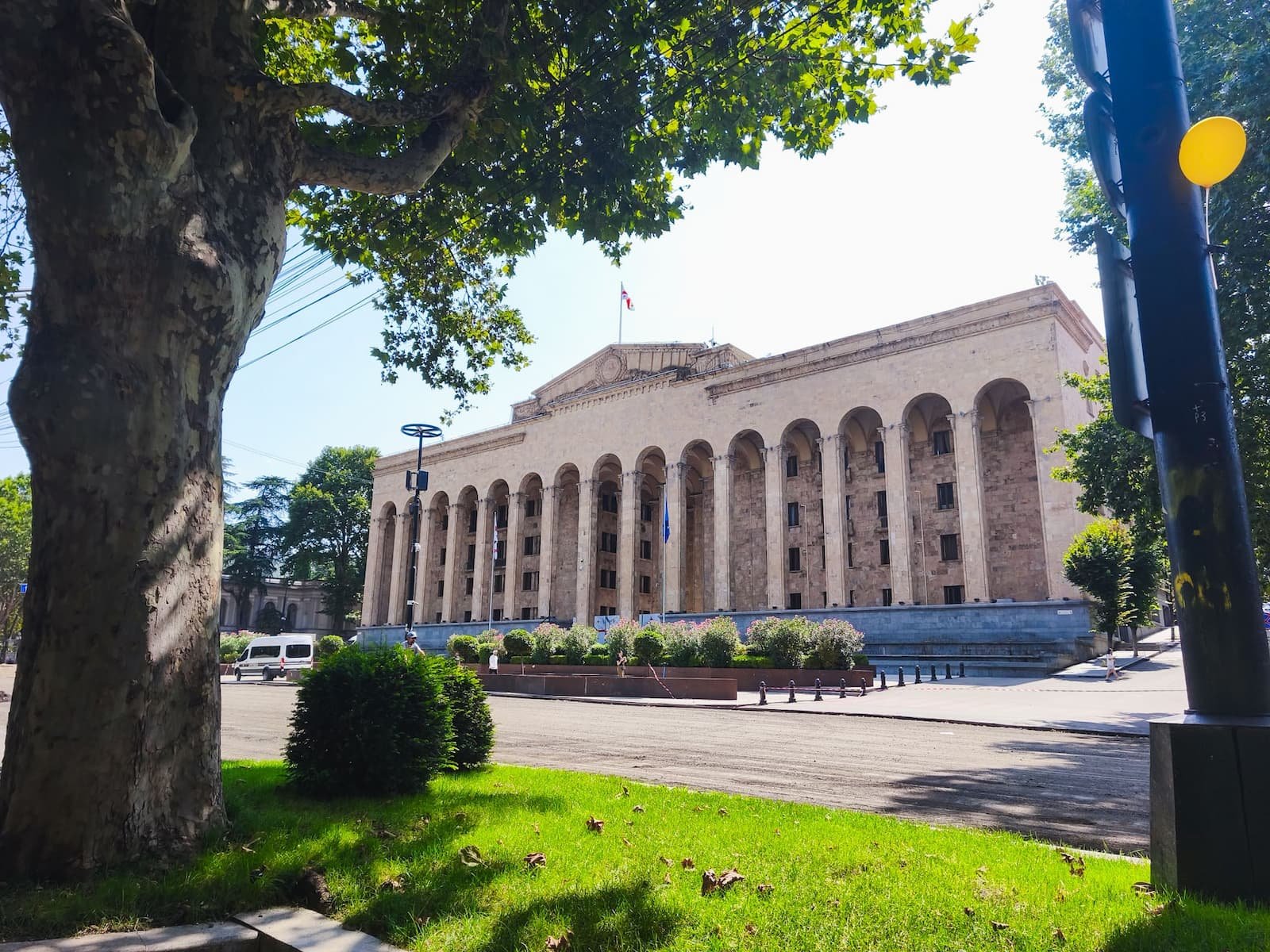
Parliament of Georgia building along Rustaveli Avenue (the road is not normally dirt — Rustaveli was under construction during our visit).
Optional Wine Stop — 8000 Vintages
Allow: 45–60 minutes
If you drink wine, stop at 8000 Vintages near Rustaveli before dinner, a Georgian wine shop and bar with a large selection of local wines by the glass and bottle.
Georgia’s traditional winemaking is such a major part of its food culture that I wanted to build at least one dedicated wine stop into the itinerary. This is a good chance to try a qvevri wine, including an amber wine if you haven’t had one yet, before heading to dinner nearby.
If you don’t drink, just continue along Rustaveli or head to dinner.
Dinner
Eat around the Rustaveli area. Here are a couple of places I recommend:
Café Daphna: Go here for khinkali and khachapuri done very well, with a few twists on the classics. Over our month stay in Tbilisi, we tried a lot of khinkali, and Café Daphna served our favorite, hands down. I’d order the classic meat khinkali, mushroom khinkali (this one is special), tomato and cucumber salad with hazelnut paste, and the lazuri khachapuri.
Salobie Bia: Choose this instead if you want Georgian soups, stews, and beans rather than another khinkali meal. I’d consider ordering the lobio with pickles and cornbread, chicken shkmeruli, and kharcho.
You can visit whichever restaurant you skip tonight after Day 3.
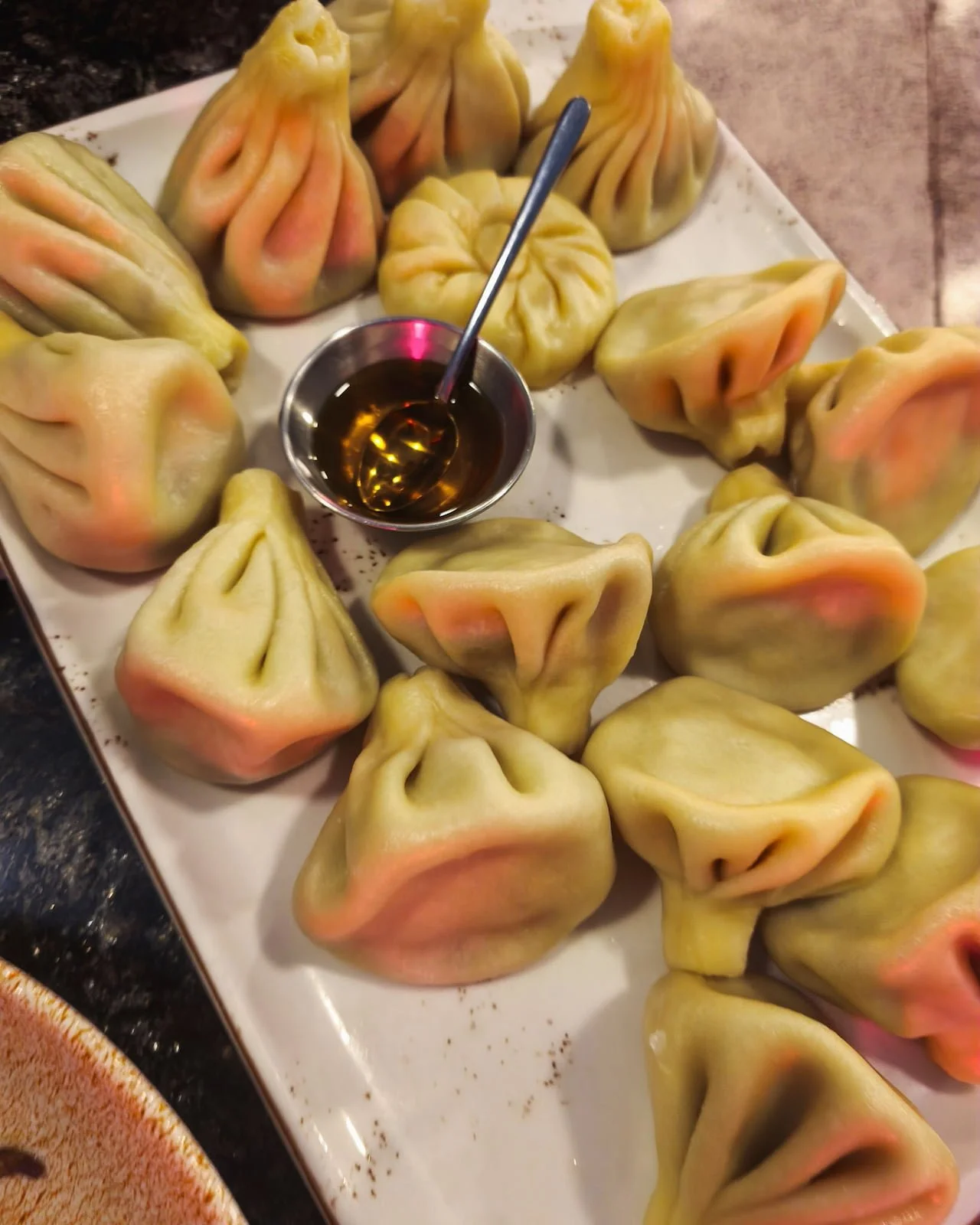
Khinkali with the richest broth and chewiest skin at Café Daphna.
Day 3 — Avlabari, Sameba Cathedral, and Modern Tbilisi
This day explores eastern Tbilisi and its different facets, starting with the cliffside church and river views at Metekhi before moving through residential Avlabari, the monumental center of Georgian Orthodox life at Sameba Cathedral, and finally Fabrika, a former Soviet sewing factory turned creative hub that feels younger and more alternative than the traditional parts of the city.
Route
Metekhi → Wine Rise and Queen Darejan Palace → Avlabari → lunch → Sameba Cathedral → Fabrika → optional Mtatsminda → dinner
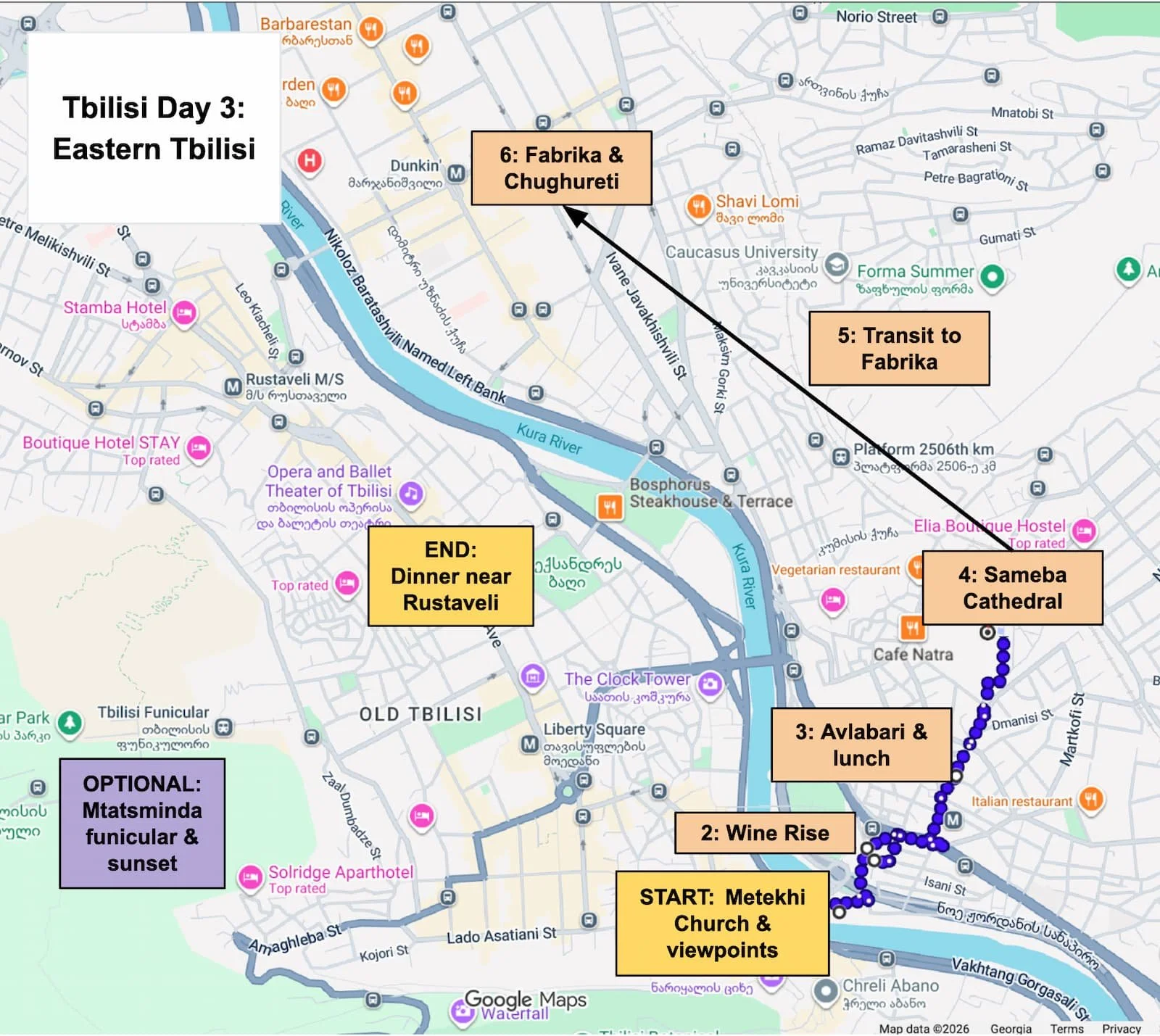
Map data © Google.
Suggested Timing
11:30–12:15: Metekhi Church and viewpoints
12:15–12:30: Wine Rise and Queen Darejan Palace
12:30–1:15: Avlabari
1:15–2:15: Lunch
2:15–3:00: Sameba Cathedral
3:00–3:30: Metro or Bolt to Fabrika
3:30–5:30: Fabrika
5:30 onward: Optional Mtatsminda and dinner
Planning Notes
This itinerary works any day of the week: Metekhi Church and Sameba are active churches open to visitors, while Fabrika operates daily as a hostel and creative complex. Mtatsminda’s funicular also runs year-round. Individual cafés, shops, and restaurants may keep their own hours, so double-check anything specific you want to visit.
You can start later today: Around 11:30 AM or noon works well since the first few stops are compact.
Take transit between Sameba and Fabrika: They do not connect especially naturally on foot, so I’d take the metro or a Bolt rather than adding a long walk.
Plan dinner around sunset: If sunset is early, go to Mtatsminda first and eat afterward. If sunset is late, have dinner first and head up closer to sunset.
Mtatsminda is optional: If you’re tired by the end of three days, you can easily finish at Fabrika or dinner instead.
Late Morning — Metekhi Church and Viewpoints
Allow: 30–45 minutes
Start at Metekhi Church, a 13th-century church perched on a cliff above the Mtkvari River on the site of a former fortress.
A lot of the appeal here is the setting. Walk around the church and gardens, stop at the different viewpoints, and take some time for photos across the river toward Old Tbilisi. The church itself is worth seeing, but since you will already have visited several churches by this point in the itinerary, I’d spend most of your time outside enjoying the views.
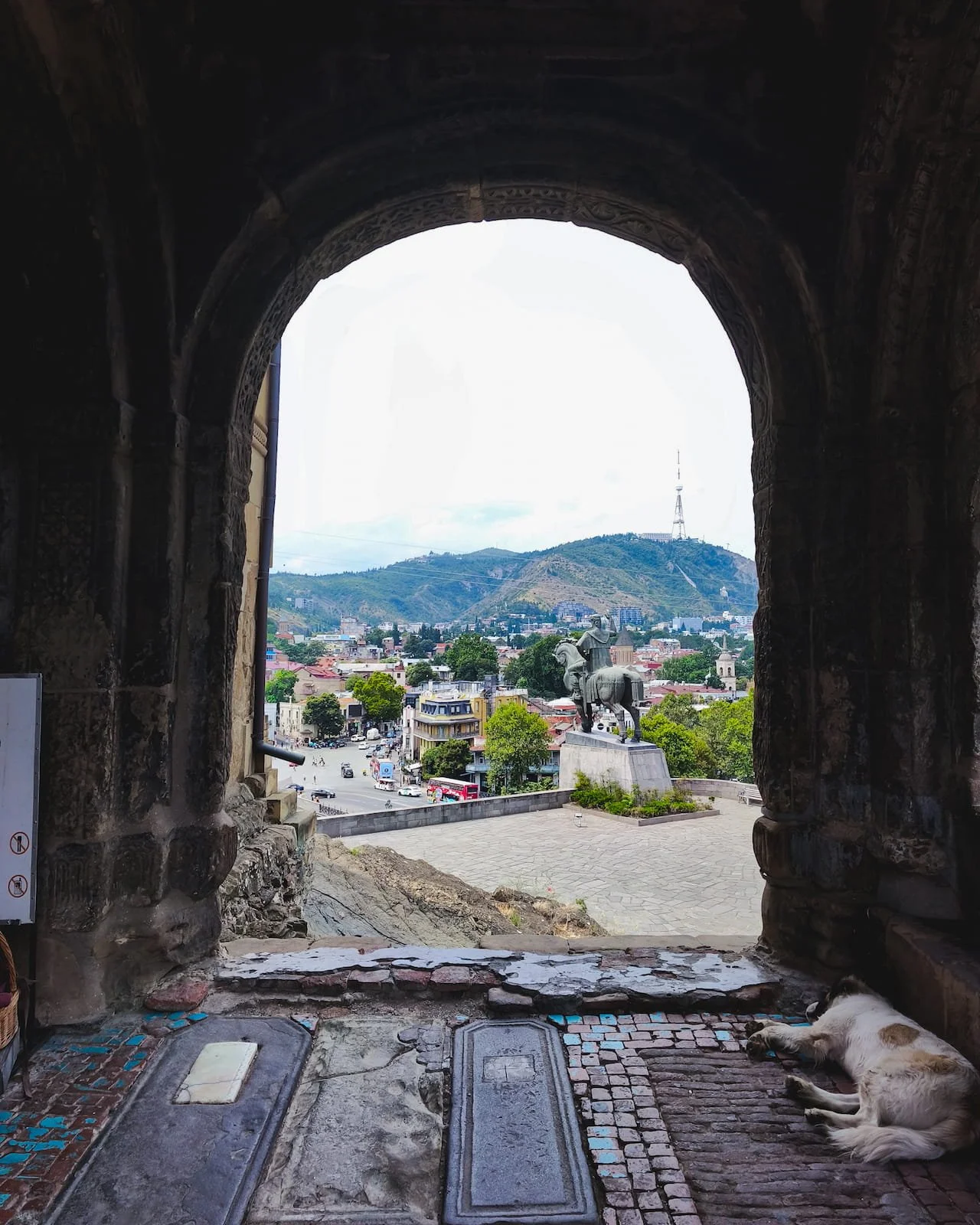
View from Metekhi Church toward Old Tbilisi (and a napping stray).
Continue Up Wine Rise to Avlabari
Allow: 10–15 minutes
From Metekhi, continue uphill toward Avlabari along Wine Rise, a steep historic street once associated with wine merchants bringing and storing wine in this part of the city.
As you climb, look up for the distinctive blue balcony of Queen Darejan Palace, built in 1776 for Queen Darejan, wife of King Erekle II. The palace was built along the old Avlabari city wall and is one of the most recognizable historic buildings on this side of the river.
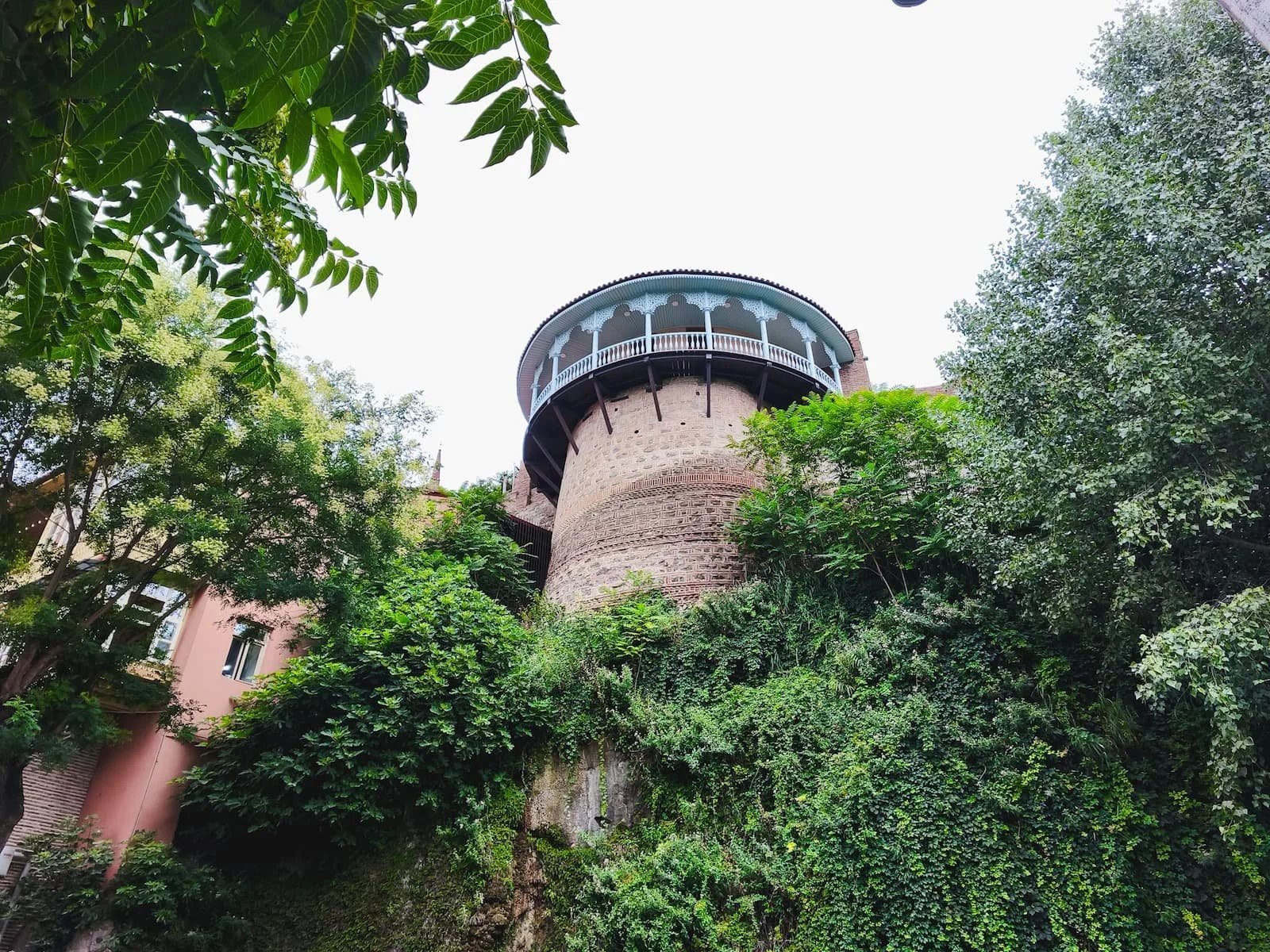
Queen Darejan Palace and its balcony seen from Wine Rise.
Early Afternoon — Avlabari and Lunch
Walk through Avlabari before settling somewhere for lunch.
Avlabari is one of Tbilisi’s older neighborhoods and is known for its Armenian heritage. It feels noticeably more residential and local than the more touristy parts across the river. If Avlabari sounds like an area you’d consider staying in, I compare it with Rustaveli, Old Tbilisi, Vera, and Chugureti in my where to stay in Tbilisi guide.
For lunch, choose between:
Café Palermo: A family-run restaurant serving generous home-style meals. Although much of the menu is Georgian, the owners are Armenian, making it a fitting stop in a neighborhood historically associated with Tbilisi’s Armenian community. Note that it is cash only.
Tiflis Fast Food: For something faster, Tiflis Fast Food makes huge shawarma sandwiches packed with carrots, lettuce, onions, pickled peppers, and pomegranate seeds. The pickled pepper was actually spicy, and one sandwich was easily large enough to share.
Afternoon — Sameba Cathedral
Allow: around 45 minutes
Continue uphill to Sameba, or Holy Trinity Cathedral, the enormous church that dominates the eastern side of the Tbilisi skyline.
Sameba is the main cathedral of the Georgian Orthodox Church, but unlike many of the churches elsewhere in this itinerary, it is very new — construction began in 1996 and was completed in 2004.
That contrast is part of what makes it interesting. The Orthodox Church is visibly present in everyday life in Georgia, from the number of active churches to how often you see people cross themselves as they pass one, and the scale of Sameba gives you a sense of its continuing importance.
Walk around the huge cathedral exterior and landscaped grounds, go inside if you want, and take in the views from the elevated complex. The cathedral itself is massive, so even if you have spent the previous two days seeing older churches, this one feels completely different.
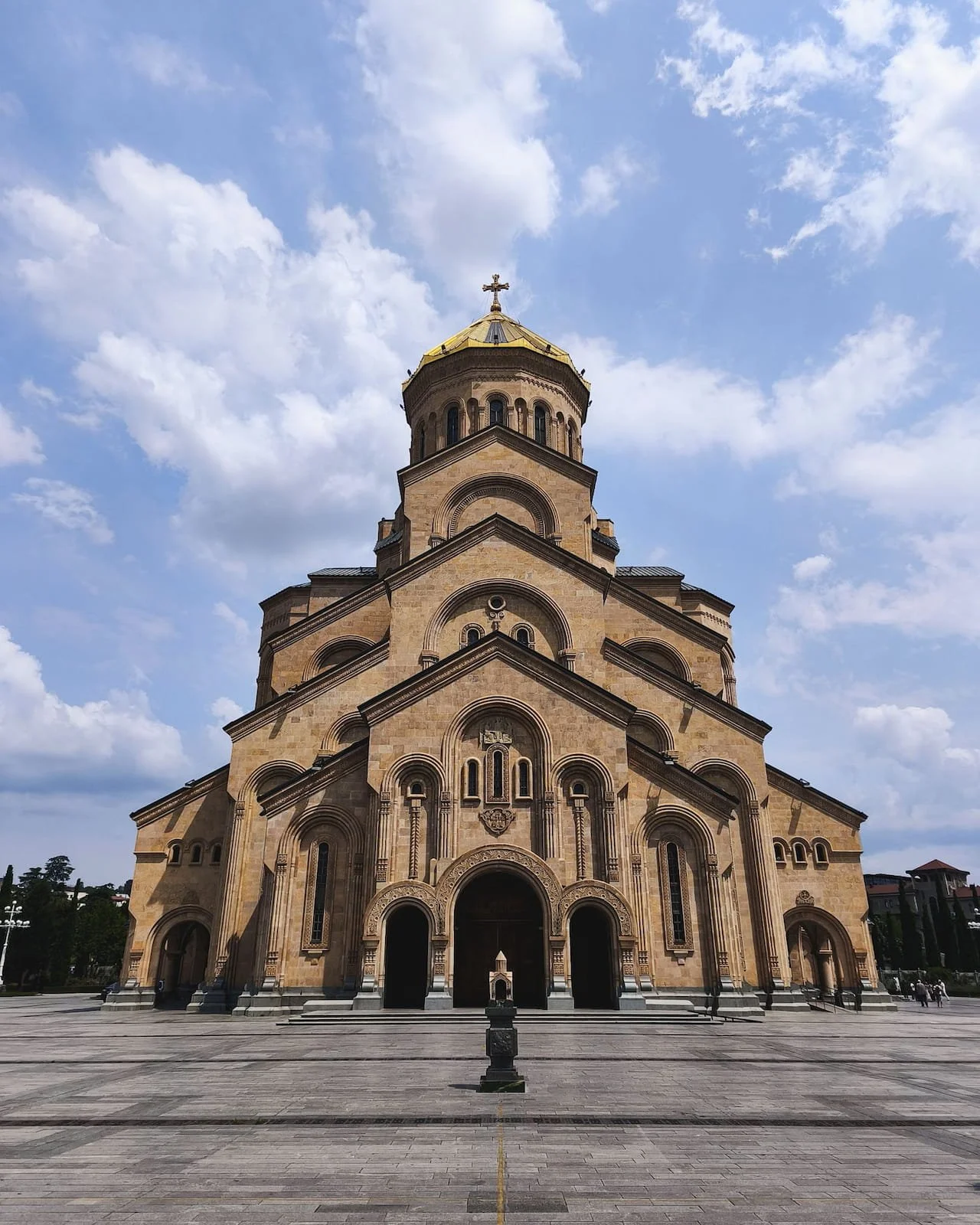
Sameba Cathedral.
Late Afternoon — Fabrika
Allow: 1.5–2 hours
From Sameba, take the metro or a Bolt to Chughureti, the district around Fabrika and nearby Marjanishvili. If you take the metro, get off at Marjanishvili and walk around 8–10 minutes to Fabrika. See my guide to transportation in Tbilisi, coming soon.
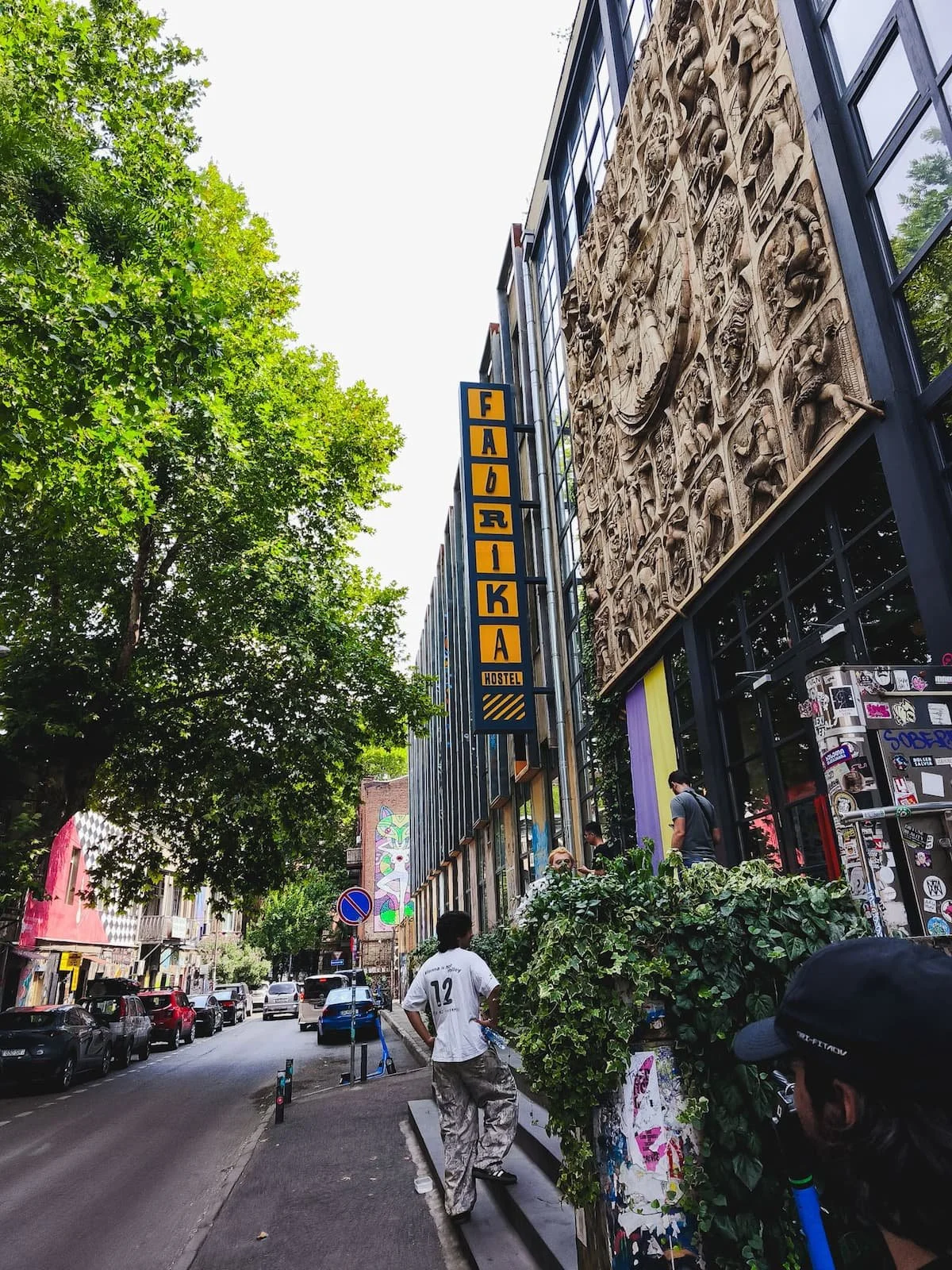
Fabrika occupies a former Soviet sewing factory that has been converted into a hostel and creative complex. Even before you go inside, the old industrial exterior stands out for the large murals and street art covering parts of the building.
Start inside the large reception area, where people work, drink coffee, and hang out. The whole space feels very designed and modern, with an alternative, slightly countercultural vibe that contrasts quite a bit with the more traditional parts of the city you’ve spent most of the itinerary exploring. We rested here for a while, enjoying the air conditioning and soft sofas, before heading out to the courtyard.
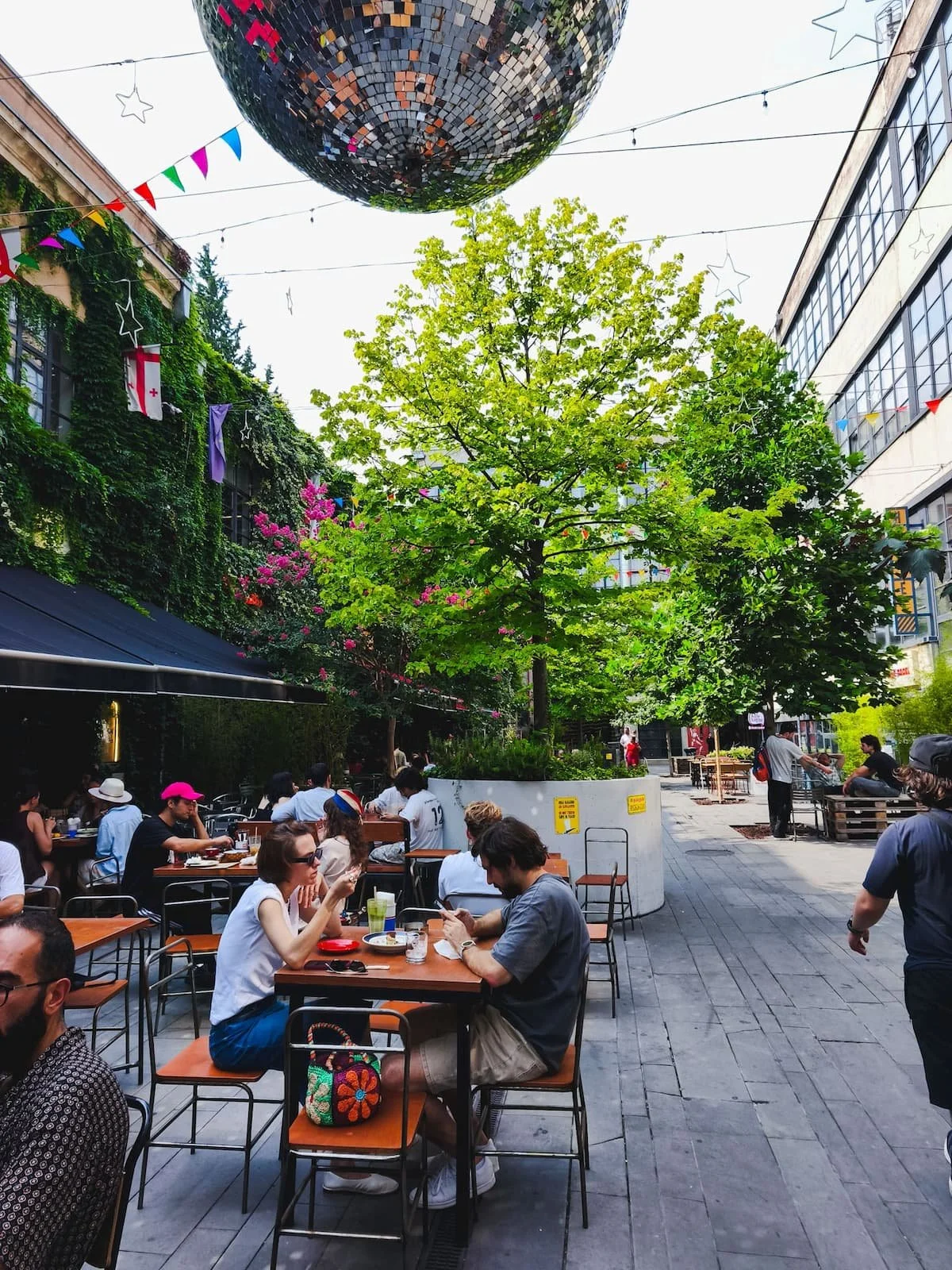
The courtyard is really the heart of Fabrika, surrounded by cafés, bars, murals, and independent businesses including pottery, art, and skate shops. Browse around, grab a beer, or just sit outside for a while.
Fabrika is more of a place to hang out than somewhere you need to spend a specific amount of time, so this is a deliberately relaxed end to the sightseeing part of the day.
Dinner
For dinner, you could stay at Fabrika and eat at FARM or one of the outdoor cafés around the courtyard.
Or, head back toward Rustaveli and go to whichever of my two recommendations you skipped on Day 2. This also works well if you’re planning to continue to Mtatsminda afterward.
Optional Evening — Mtatsminda at Sunset
If the weather is clear and you still have the energy, take the funicular up Mtatsminda for the broadest panorama over Tbilisi. Mtatsminda is especially good around sunset and into the evening, when you can watch the city gradually light up below.
Because sunset varies so much by season, the order here is flexible. If sunset is early, go straight from Fabrika to Mtatsminda and have dinner afterward. If sunset is later, eat first and head up closer to sunset.
Mtatsminda is completely optional, but if you do go, seeing Tbilisi from above as the lights come on is a pretty great way to finish your three days in the city.
Have More or Less Time?
Only Have Two Days?
Two days is enough to cover most of the major first-time highlights, but you’ll have less time for wandering.
Day 1 — Sameba + Classic Old Tbilisi
Sameba → Rike Park → cable car → Narikala → Mother of Georgia → Betlemi and Gomi → Old Tbilisi → lunch → Abanotubani → sulfur bath
Shorten the wandering time through Betlemi and Old Tbilisi a little, but I would still keep the sulfur bath.
Day 2 — Sololaki, Georgian History, Rustaveli + Fabrika
Freedom Square → Sololaki → mtsvadi lunch at Deda → Dry Bridge Market → Georgian National Museum → Rustaveli Avenue → Fabrika
Move a little faster through Sololaki and Dry Bridge, then finish around Fabrika. I would skip Mtatsminda with only two days unless city views are a major priority.
Have Four or Five Days?
With more time, keep the three-day itinerary as-is and add some of the places that are harder to fit naturally into those routes:
Explore other neighborhoods like Vera and Vake
Spend more time around Marjanishvili
Visit more museums
Visit Chronicle of Georgia and Tbilisi Sea
Add the Botanical Garden
Visit Turtle Lake
Take a day trip or one- to two-night trip to Kazbegi
Planning Notes
Keeping this fairly short since the day-by-day sections above already include the most important timing and opening-hour notes.
Getting Around
Most of the itinerary is walkable once you reach each day’s starting area, but expect steep hills, uneven streets, and stairs. You’ll use the cable car on Day 1, and I recommend the metro or a Bolt between Sameba and Fabrika on Day 3.
See my Tbilisi transportation guide, coming soon, for metro payment, fares, airport connections, and other transit tips.
What to Book in Advance
The main thing I would book ahead is your sulfur bath, especially if you want a particular private room or evening time slot. Most other stops do not require advance reservations.
For room choices, timing, what to bring, and whether to add a scrub, see my Tbilisi sulfur bath guide.
A Few Practical Notes
Wear comfortable shoes with decent grip for Tbilisi’s hills, stairs, uneven pavement, and cobblestones. Dress appropriately if you plan to enter Orthodox churches, where photography may also be restricted. In summer, carry water and expect the middle of the day to be hot.
For fuller descriptions of the sights, more neighborhoods, and additional food recommendations, see my guides to what to do in Tbilisi and what to eat in Tbilisi.
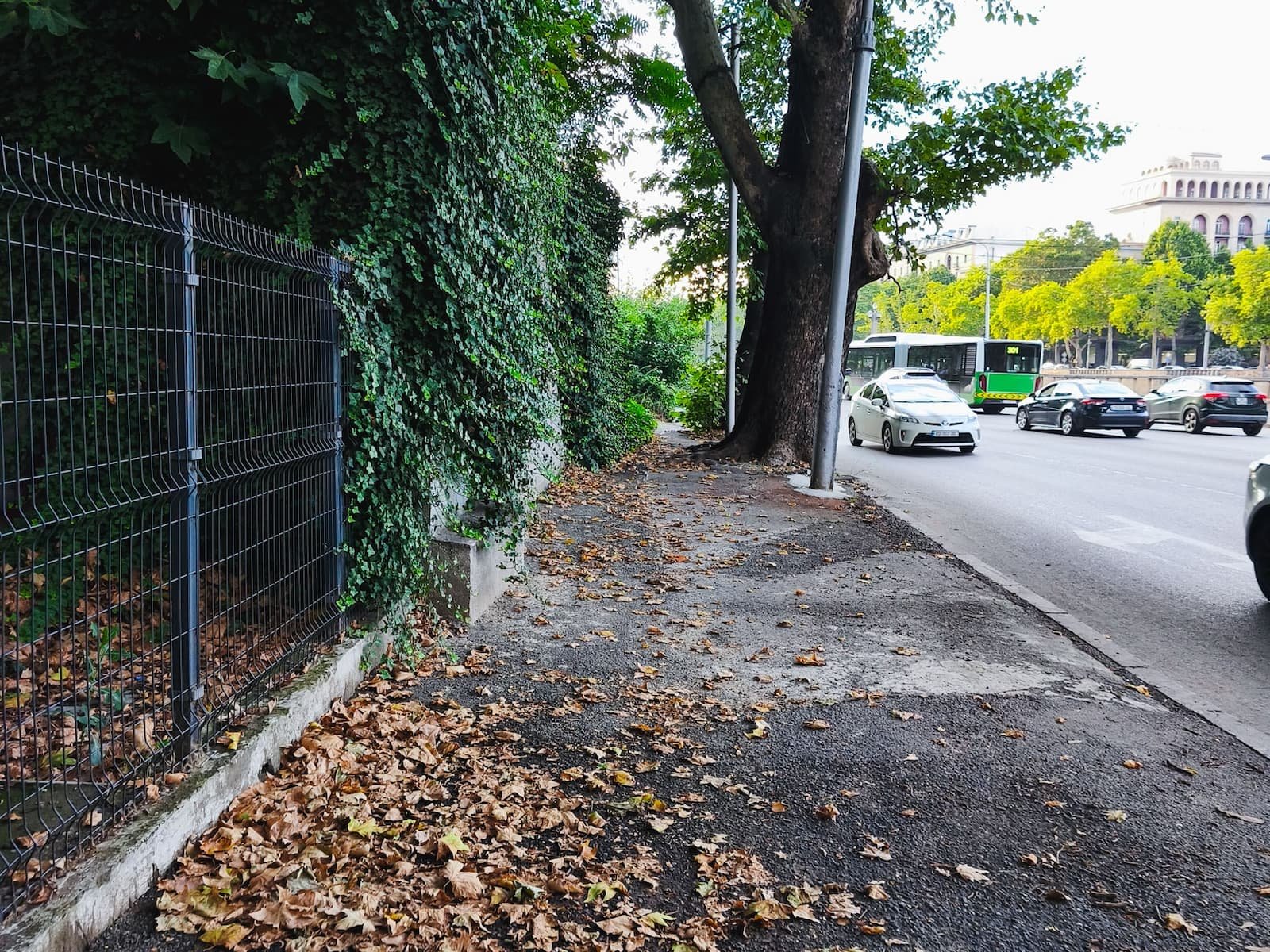
The sidewalks in Tbilisi can be uneven with roots sticking out.
Questions?
Thanks for reading! Feel free to leave a comment below or send me a message with any questions — I’m always happy to help when I can. And if you try this itinerary, I’d love to hear how it goes.
If you’re still planning your trip, check out my Tbilisi Start Here guide for all of my posts about the city, including transportation, sulfur baths, things to do and eat, and other parts of the city that did not fit into this three-day itinerary.
You may also like:
How I Plan Low-Friction Itineraries — the process I use to build routes like this one that reduce backtracking and decision fatigue
Stockholm 3-Day Itinerary — Another three-day city itinerary built around neighborhoods and geography
My Travel Approach — how I think about practical, active, low-friction travel
My 8 Items That Make One-Bag Travel Work — my core items that make moving through cities easier