How to Get from Madrid to Segovia Old Town by Train + Bus or Taxi
Less than 30 minutes on the high-speed train, Segovia is one of the easiest day trips from Madrid.
But getting from Madrid to Segovia’s old town is not quite as simple as “get on the train, get off in Segovia.” The high-speed train arrives at Segovia Guiomar, which is outside the historic center, so you’ll still need a bus or taxi to reach the Aqueduct and old town.
That extra transfer is not hard, but it does matter if you have lunch reservations, Alcázar tickets, or a specific itinerary you’re trying to follow.
So here’s the quick, practical version based on my own experience, including the little timing things I wish I had known before going.
Quick Answer
The easiest way to get from Madrid to Segovia Old Town is to take the high-speed train from Madrid Chamartín-Clara Campoamor to Segovia Guiomar, then take Bus 11, Bus 12, or a taxi into the historic center.
The main thing to know is that Segovia Guiomar is not in the old town. It is about 5 km away, so you need to build in transfer time after your train arrives.
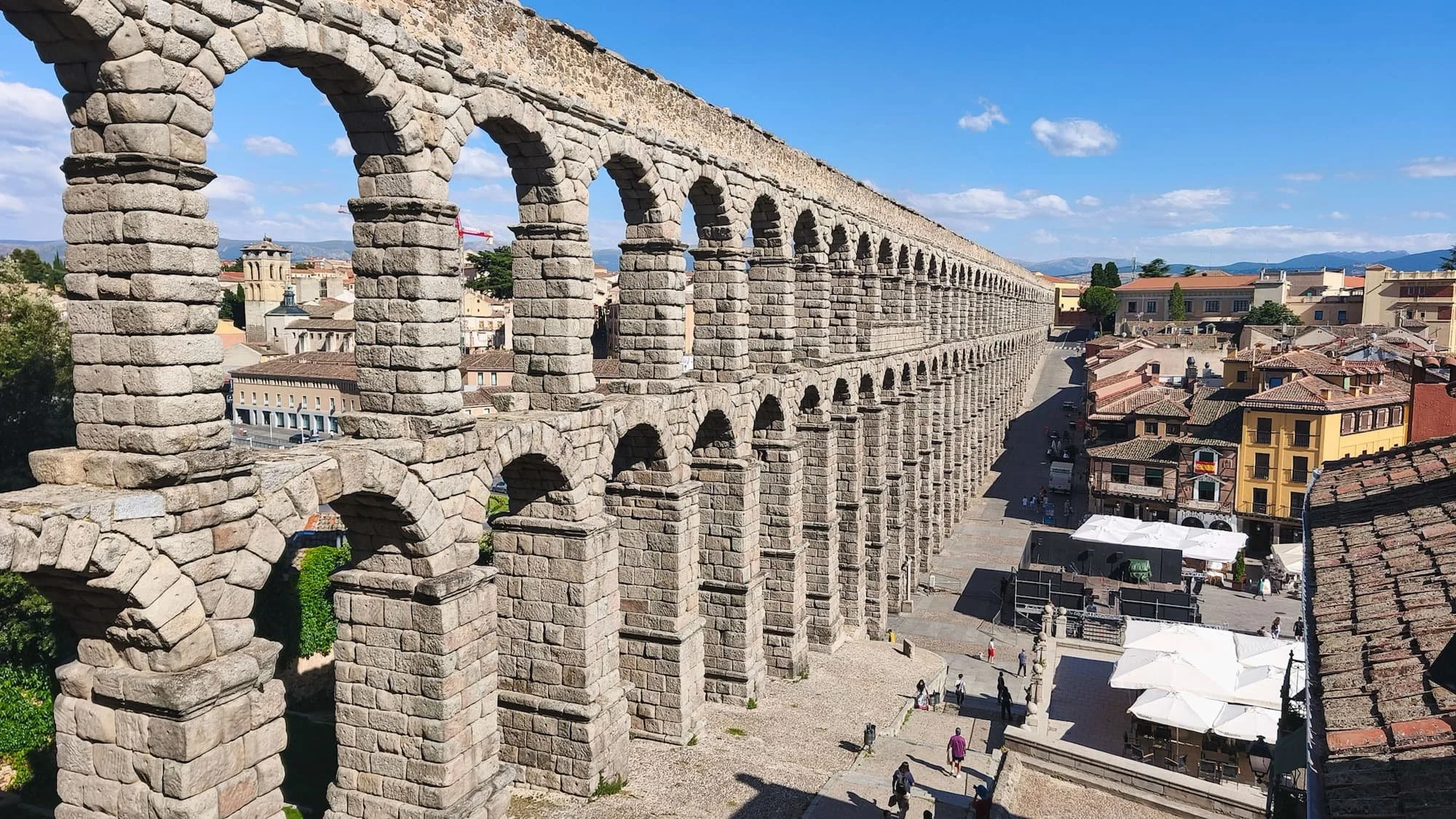
For most first-time visitors, I’d aim to start at the Roman Aqueduct / Plaza del Azoguejo. Bus 11 drops you right there, taxis can easily take you there, and it’s the most dramatic entry point into Segovia.
Best low-cost option: high-speed train + Bus 11 or 12, depending on which comes first
Lowest-friction option: high-speed train + taxi
Step 1: Book the High-Speed Train Ticket
I’d recommend booking your train tickets at least a few days ahead if you can.
I booked mine the day before, and the morning train I wanted was already full. That meant I had to take a later train and ended up with a much more rushed morning in Segovia. I’d also recommend booking the return ticket jointly for this reason.
The official train website is Renfe, but you can also book through authorized aggregators like Trainline. In my experience, Trainline worked smoothly when the Renfe website was being annoying/down, so it’s a good backup.
When choosing your train time, work backward from when you want to actually start sightseeing in Segovia Old Town, not just when you want to arrive at Segovia Guiomar. I break down estimated times more in the timing section below.
A few ticket notes:
You can show your ticket on your phone.
Seat selection is free.
If you book on Renfe, you can see whether seats face forward or backward.
Tickets are nominative, so you’ll need to enter ID/passport information when booking.
Bring your ID or passport with you, even if they may not check it. Mine was not checked, but better safe than sorry.
Step 2: Get to Madrid Chamartín-Clara Campoamor
Most visitors will need to transit to Madrid Chamartín-Clara Campoamor, since it’s not usually right next to where tourists stay.
The easiest way is usually the metro. Chamartín is on:
Line 1 / light blue
Line 10 / dark blue
One important timing note: once you arrive at Chamartín by metro, you still need to walk from the metro area to the high-speed train platforms.
I’d budget at least 15 minutes, and honestly more if it’s your first time there.
Follow signs for Chamartín-Clara Campoamor and the little train icon. Eventually, you want the high-speed train area, which may be labeled:
Alta Velocidad
AVE
Avant
One thing that tripped us up: after walking from the metro, we first ended up near the medium-distance train turnstiles. It looked like we were supposed to enter there, but our ticket didn’t work because it was for the high-speed train.
So if that happens, don’t panic. You’re probably just in the wrong part of the station.
There are usually security or information staff around, so ask if you’re unsure.
Basically: do not arrive at Chamartín five minutes before your train. The station is manageable, but the signage can be confusing, especially if you’re switching from the metro/local train area to the high-speed platforms.
We got mildly confused. Another guy with giant luggage was fully cussing. So yeah, it wasn’t just us.
Step 3: Take the High-Speed Train to Segovia Guiomar
Once you’re in the high-speed train area, check the departure boards for your platform. Sometimes the platform only appears closer to departure time, so don’t stress if it’s not listed right away.
There is a general waiting area with some seats.
When your platform is announced, you’ll need to:
show your ticket
go through a quick security checkpoint
head down to the platform
find your train car
sit in your assigned seat
The ride itself is very easy. It takes around 30 minutes, and the train is comfortable, clean, and high-speed rail is just nice.
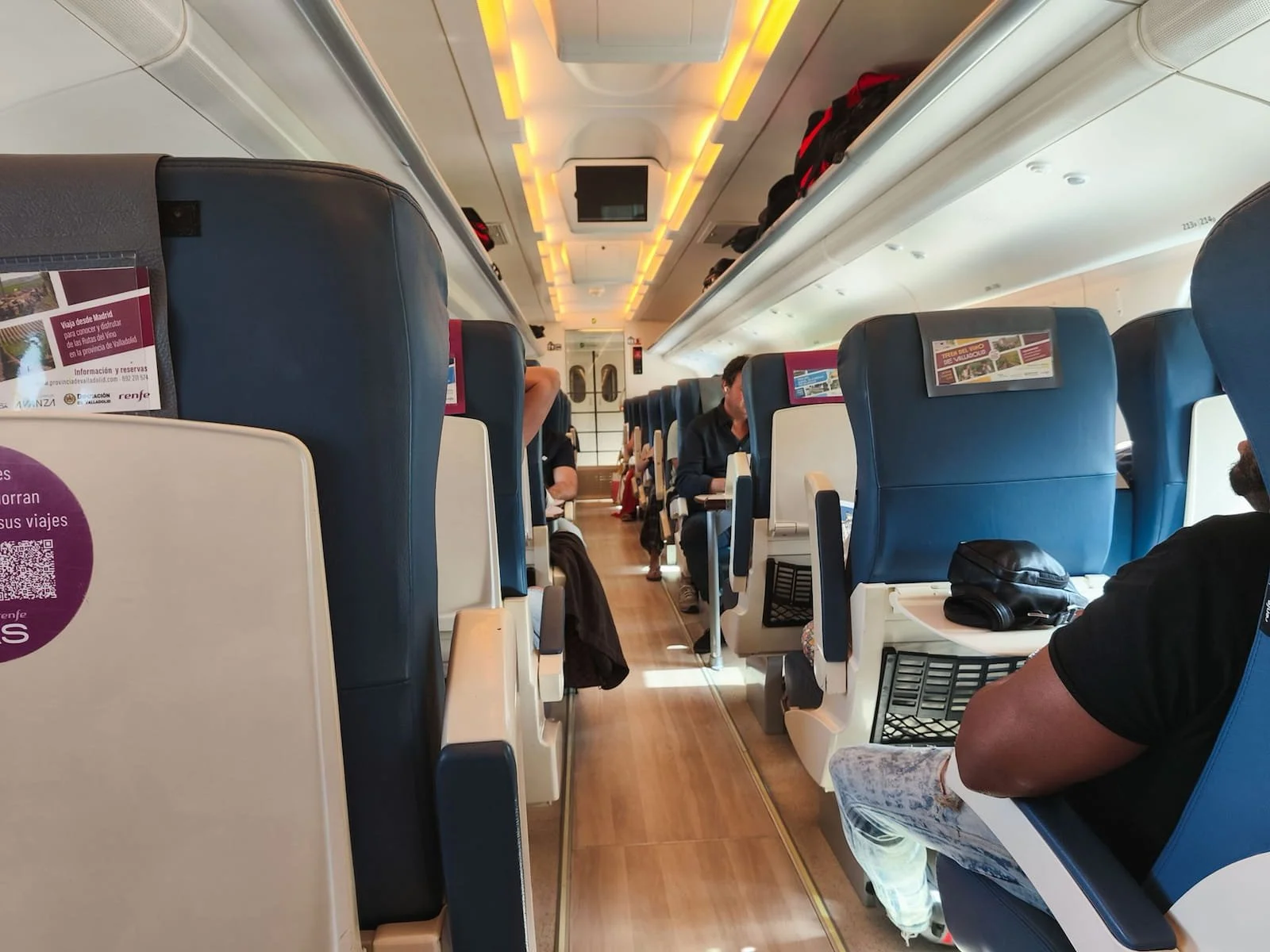
Inside the high-speed train from Madrid to Segovia.
Step 4: Get from Segovia Guiomar to the Old Town
Once you arrive at Segovia Guiomar, you have two main options:
Bus 11 or Bus 12
Taxi
Both the buses and taxis are outside the station in the same general area, so you also don’t need to decide before you arrive. You can step outside, see whether there’s a bus coming soon, check if taxis are waiting, and decide from there.

Outside Segovia Guiomar, where you can choose between the bus or taxi into the old town.
Option 1: Bus 11 or Bus 12
The public bus is the cheaper option and works well if you’re not in a rush.
The main thing to note is that buses came roughly every 30 minutes when I visited, and timing can vary — I would not plan a super tight morning around the bus arriving perfectly.
When I visited, the bus cost €2.75 per person, and you could pay by credit card on board, which was very convenient. Tell the driver how many tickets you need when you board.
Bus 11 is slightly more convenient because it drops you right by the Aqueduct.
Bus 12 also works. It drops you about an 8-minute walk from the Aqueduct, but you get Aqueduct views as you walk toward it, so it’s still a good arrival.
In practice, I’d take whichever bus gets you into the old town faster, unless you specifically want the most direct Aqueduct drop-off.
One small note: if several travelers are arriving at once, the bus can fill up, so you may have to stand. It is still a short ride, but worth knowing if you’re traveling with luggage, mobility concerns, or just really want a seat.
Choose the bus if:
you want to save money
you’re 1–2 people
your morning plans have some wiggle room
you don’t mind potentially waiting a bit
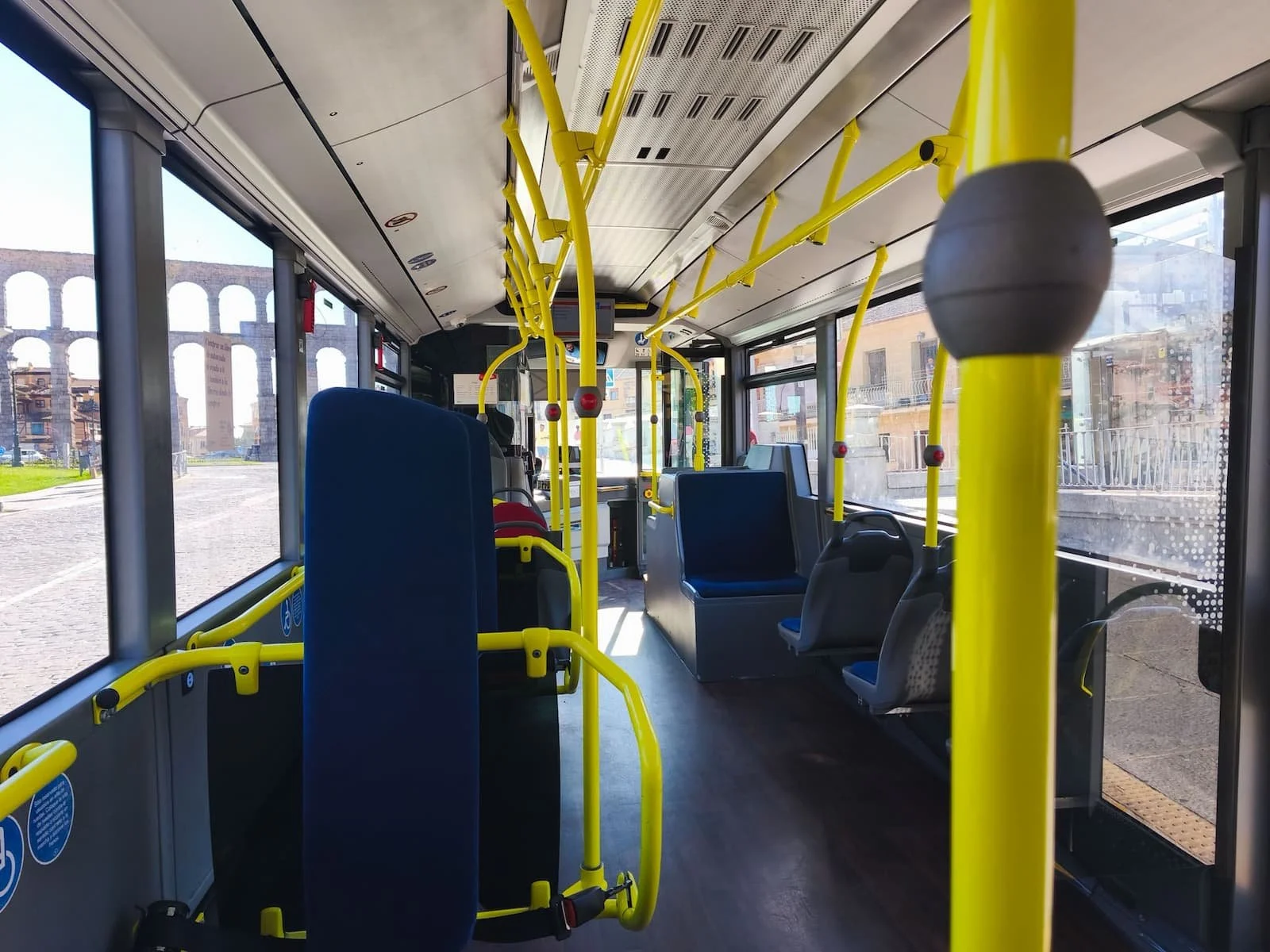
Inside the local bus between Segovia Guiomar and the old town.
Option 2: Taxi
A taxi is the easiest option if you want to avoid waiting or your timing is tight.
At Segovia Guiomar, the taxis were directly in front of the station when I visited and had official branding. You can also use PideTaxi Segovia as a backup if you need to call or request one, though I didn’t personally use it for this trip, so I’d still treat the taxi stand as the easiest first option.
They run by meter, but the sign at the station estimated around €10 on a weekday and around €13 on a weekend.
If you have a rushed morning, lunch reservation, or timed Alcázar ticket, the taxi may be worth it just to remove one layer of uncertainty.
Choose a taxi if:
you’re short on time
you’re traveling with a group
you have timed tickets or a reservation
you just want the least stressful option
Where Should You Start in Segovia?
For a first visit, I’d start at the Roman Aqueduct / Plaza del Azoguejo.
It makes the most sense because:
it’s Segovia’s most famous landmark
Bus 11 drops you right there
taxis can easily take you there
it gives you the best “oh wow, we’re in Segovia” arrival moment
it sets you up naturally to walk uphill into the old town
From the Aqueduct, you can climb the Postigo stairs for the elevated view, then continue through the old town toward Plaza Mayor, Segovia Cathedral, and eventually the Alcázar.
This is the route I use in my full Segovia day trip itinerary from Madrid.
How Much Time Should You Budget?
A realistic timing estimate for the legs of the trip:
Madrid accommodation → Chamartín: depends where you’re staying
Chamartín metro/local train area → high-speed train area: 15–25 minutes
Security + boarding: 15–20 minutes
Train to Segovia Guiomar: about 30 minutes
Guiomar → Aqueduct by taxi: 10–20 minutes, depending on how many are around
Guiomar → Aqueduct by bus: 25–45 minutes, depending on wait time
For example, if your train arrives at Segovia Guiomar around 10:40, you might reach the Aqueduct around:
10:55–11:00 by taxi
11:10–11:30 by bus
The bus ride itself is short, but buses came roughly every 30 minutes when I visited, so the wait is the variable.
As a general rule, arrive at Segovia Guiomar at least 30 minutes before you want to be in the old town if taking a taxi, or 45–60 minutes before if taking the bus.
If you have lunch reservations, Alcázar tickets, or anything else timed, I’d take a taxi.
Getting Back to Madrid
The return works the same way in reverse.
From the old town, take Bus 11/12 or taxi back to Segovia Guiomar, then take the high-speed train back to Madrid Chamartín.
Again, leave more buffer than you think you need. You’ll also need to go through security before boarding the train back to Madrid.
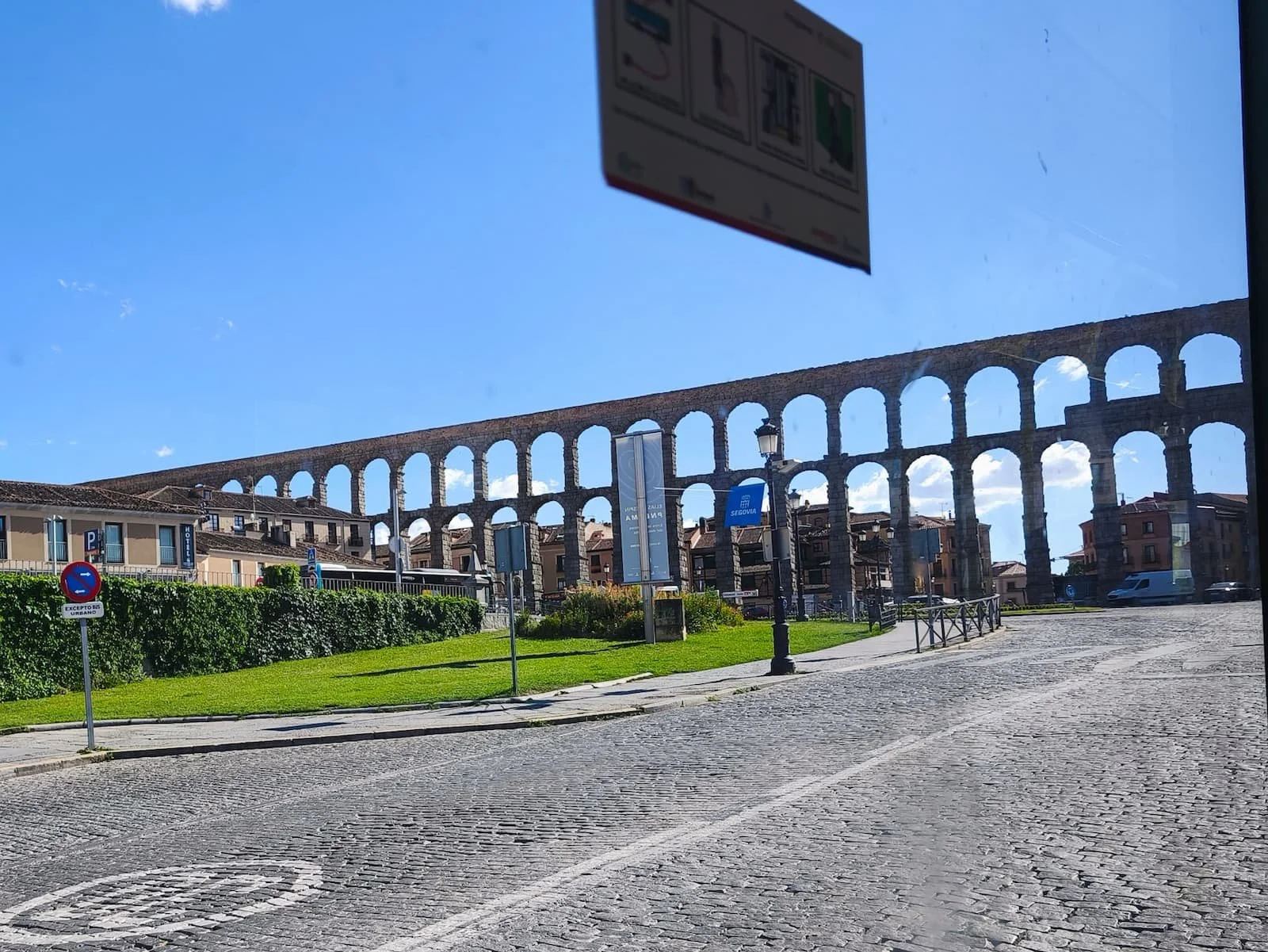
View of the Aqueduct from inside the bus when heading back toward Segovia Guiomar.
Common Mistakes to Avoid
Assuming Segovia Guiomar is in the old town
It is not. You still need a bus or taxi to reach the Aqueduct and historic center.
Cutting it too close at Chamartín
Chamartín is manageable, but the transfer from the metro/local train area to the high-speed platforms can be confusing. Give yourself more buffer than you think you need.
Treating your train arrival time as your old town arrival time
If your train arrives at Segovia Guiomar at 10:40, that does not mean you’ll be standing under the Aqueduct at 10:45. You still need to wait for a bus or take a taxi into town.
Planning the return too tightly
You still need to get from the old town back to Segovia Guiomar and go through security before boarding the train back to Madrid. Don’t cut it too close.
My Recommendation
For the easiest version of a Segovia day trip from Madrid, take the high-speed train from Madrid Chamartín-Clara Campoamor to Segovia Guiomar, then take Bus 11, Bus 12, or a taxi into the old town.
If you’re on a budget and have time, take whichever bus gets you there first. Bus 11 drops you right by the Aqueduct, while Bus 12 drops you a short walk away, but both work.
If your schedule is tight, take a taxi.
Either way, I’d start at the Aqueduct / Plaza del Azoguejo, then walk uphill into the old town from there. It’s the simplest, smoothest, and most satisfying way to begin the day.
For the full walking route after you arrive, see my Segovia 1-day itinerary from Madrid.
Related Posts + Final Thoughts
Thanks for reading! I hope this guide makes the Madrid-to-Segovia transfer feel much easier to figure out.
If you’re planning more time in Madrid, start with my Madrid Travel Guide: Start Here, where I’ve collected my Madrid logistics, itinerary notes, neighborhood thoughts, and related posts.
You may also like my guide to How I Plan Low-Friction Travel Itineraries, which is the process I use to build routes that reduce backtracking, decision fatigue, and the “wait, where are we going next?” problem.
If you try this trip, I’d love to hear how it goes. And if you’re still planning and have questions, feel free to leave a comment or send me a message.