How to Get Around Barcelona: Metro, Bus, Airport Transport + Transit Passes
Barcelona is easy to get around once you know which airport route and ticket make sense for you. The confusing part is that each option works a little differently, and the sheer amount of information online can make figuring it out overwhelming.
We mostly walked and used the metro during our trip, with buses when they offered a more direct route. This guide gives you the simplest breakdown of getting from the airport, moving around Barcelona, and choosing the right ticket or transit pass for your trip.
Last updated: July 2026
The Quick Answer
Getting around Barcelona: Walking and the metro will cover most sightseeing, with buses useful for less direct routes.
Getting from the airport: The Aerobús is easiest for most visitors staying centrally. The R2 Nord train may be better for Barcelona-Sants or Passeig de Gràcia; Metro L9 Sud works well near its route but does not go directly to the tourist center; and Bus 46 is a cheaper option for Plaça d’Espanya or parts of L’Hospitalet. A taxi or app-based ride is the easiest door-to-door option, especially with luggage or for a group.
Choosing a ticket: Use a T-casual for occasional solo travel, a shareable T-familiar for a couple or group, or the Hola Barcelona Travel Card for unlimited travel and airport metro access. Payment details are below.
Getting from Barcelona Airport to the City
Barcelona-El Prat Airport has two main terminals, T1 and T2. The best way into Barcelona depends on where your accommodation is located since the methods serve different areas.
Which Barcelona Airport Option Should You Take?
Arriving overnight? See the late-night airport options.
These are general starting points. Check the full route to your accommodation, including transfers and walking, before deciding.
Aerobús: Easiest for Central Barcelona
For most travelers staying in Barcelona’s central tourist areas, the Aerobús is the simplest way to get into the city.
It serves Plaça d’Espanya and Plaça de Catalunya, where you can walk, take the metro, or transfer to another local route to reach your accommodation.
There are two lines: A1 serves Terminal 1 and A2 serves Terminal 2.
Both run 24 hours a day, with departures as frequently as every five to ten minutes during much of the day and less frequently overnight. The full trip between the airport and Plaça de Catalunya generally takes around 35 minutes, depending on traffic. Check the official Aerobús stops and schedules for current times.
The Aerobús costs more than regular public transportation, but it has dedicated luggage space and avoids navigating multiple stations immediately after a flight.
It’s a separate service from Barcelona’s regular TMB buses and metro, which also means its ticket rules are different. I cover that in the payment section below.
L9 Sud Metro: Useful for Certain Connections
Metro line L9 Sud, or L9S, serves both T1 and T2 and connects with several other metro lines.
The main thing to know is that it does not go directly to Plaça de Catalunya, the Gothic Quarter, or most of the historic center. You will probably need to transfer if you are staying in the main tourist areas, so check the complete route to your accommodation before choosing it.
Useful connections include L1 at Torrassa, L5 at Collblanc, and L3 at Zona Universitària. Trains generally run around every seven minutes.
The metro can be particularly convenient if you are staying near the L9 Sud itself, including parts of L’Hospitalet, or if one of its transfer stations creates an easy route to your accommodation.
R2 Nord Train: Best for T2, Barcelona-Sants, and Passeig de Gràcia
The R2 Nord is part of the Rodalies de Catalunya commuter rail network and connects Barcelona Airport’s Terminal 2 with several major train stations in the city, including Barcelona-Sants and Passeig de Gràcia. These stations also have metro connections, making the train especially convenient if you are staying nearby or continuing your journey by rail.
Trains generally run every 30 minutes, so you may face a fairly long wait if you arrive just after one leaves. Check the current Rodalies timetable for the departure times.
The main limitation is that the airport train station is at Terminal 2 only. If you arrive at T1, you will need to take the free 24/7 airport shuttle to T2 first.
Bus 46: Lower-Cost Option for Plaça d’Espanya and L’Hospitalet
TMB Bus 46 connects both airport terminals with Plaça d’Espanya, with stops through L’Hospitalet.
We used this bus because we were staying near L’Hospitalet rather than in central Barcelona, and there was a bus stop close to our hotel. It was half the amount of time than taking an Aerobús or Metro.
Bus 46 makes more stops and has less dedicated luggage space than the Aerobús, but it can be practical if it stops close to your accommodation. You can also pay onboard with a contactless card, phone, or watch, which is super convenient.
Taxi or Ride-Hailing: Best for Door-to-Door Convenience
Taxis are available from official ranks outside the arrivals areas at both terminals. Barcelona’s official taxis are black and yellow, and fares are metered.
A taxi or app-based ride may be worth considering if you arrive late, have a lot of luggage, are traveling with a group, or want to go directly to your accommodation without transfers. Uber and Cabify also serve Barcelona Airport, but pickup locations can differ from the taxi ranks, so follow the instructions shown in the app.
Late-Night Airport Transportation
The Aerobús runs throughout the night. The N17 and N18 night buses also connect the airport with Plaça de Catalunya. N17 serves T1, while N18 serves both terminals. Check the official airport bus page for current routes and schedules.
How to Pay for Airport Transportation
You can buy a separate ticket for any airport route. Some Barcelona transit passes also cover certain options, which I explain in the city transportation payment section below.
| Airport option | How and where to pay | Included with transit passes? |
|---|---|---|
| Aerobús | Buy online , through the Aerobús app, from airport ticket machines, or onboard by card | Not included with standard transit passes |
| L9 Sud metro | Buy an airport metro ticket from a machine at the T1 or T2 metro station | Included with Hola Barcelona |
| R2 Nord train | Buy a Rodalies ticket from a self-service machine at the T2 train station before boarding | Included with T-casual, T-familiar, and Hola Barcelona |
| Bus 46 | Tap a contactless bank card, phone, or watch when boarding | Included with T-casual, T-familiar, and Hola Barcelona |
Aerobús also sells combination products that bundle its airport service with Hola Barcelona, but the standard Hola Barcelona card by itself does not include Aerobús. Rodalies tickets must be obtained before boarding, while TMB buses allow passengers to directly purchase a single ride onboard with a contactless bank card.
The main exception to remember is the L9 Sud airport metro. T-casual and T-familiar passes work on the R2 Nord train and Bus 46, but not at the Aeroport T1 or Aeroport T2 metro stations. For L9 Sud, buy the dedicated airport ticket or use a pass that includes it, such as Hola Barcelona.
Getting Around Barcelona by Metro and Bus
Barcelona Metro
The metro is generally the easiest way to cover longer distances within Barcelona.
We found it particularly useful for reaching Park Güell, Gràcia, and places farther from the old city. Within the Gothic Quarter, El Born, and the waterfront, walking was often easier unless we were coming from somewhere farther away.
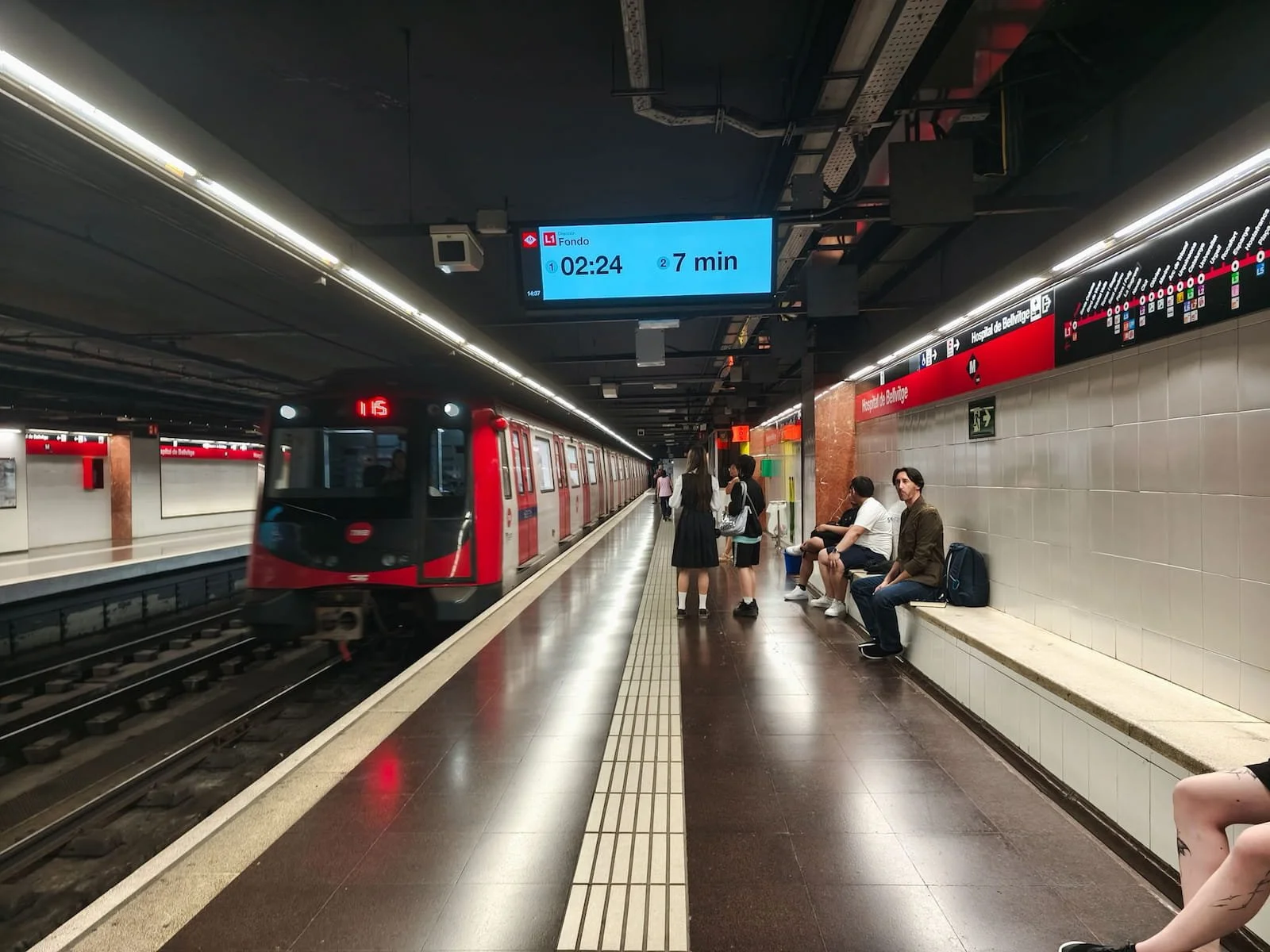
A Barcelona metro platform.
The metro normally operates:
Monday through Thursday: 5:00 AM to midnight
Friday: 5:00 AM to 2:00 AM
Saturday: From 5:00 AM, with continuous service through Saturday night
Sunday: Continuous from Saturday, ending at midnight
Check the official Barcelona metro operating hours before your trip, particularly around public holidays.
One small detail that caught us off guard is that metro doors do not always open automatically. Depending on the train, you may need to press a button or move a small lever when it stops.
Central stations and trains can also become extremely crowded, so keep your belongings closed and in front of you, particularly while boarding, exiting, or standing near the doors.
Barcelona Buses
Buses are useful when the metro route requires an inconvenient transfer, when your destination is not especially close to a station, or when you just want to stay above ground.
Press the stop button to request a stop before your destination and exit through the rear doors. If you’re the only one waiting in the bus stop, you might need to raise an arm to signal that you want an approaching bus to stop.
How to Pay for Metro and Buses in Barcelona
For regular travel within Barcelona, you can buy individual rides or choose from several transit passes. These are the options most useful for short-term visitors:
| Option | Best for | What to know |
|---|---|---|
| Single metro ticket | One occasional metro ride | Buy from a metro station machine |
| Single bus ticket | One occasional bus ride | Tap a contactless card, phone, or watch when boarding |
| T-casual | One person using transit occasionally | 10 journeys on the metro, buses, trams, FGC, and Rodalies; buy from a station machine |
| T-familiar | Couples or groups sharing occasional rides | 8 shareable journeys on the metro, buses, trams, FGC, and Rodalies; buy from a station machine |
| Hola Barcelona | Frequent transit use | Unlimited metro, TMB buses, trams, Zone 1 trains, and the Montjuïc funicular for 24 to 120 hours, plus one airport metro journey in each direction; buy online or from a station machine |
For the metro, direct contactless payment is only available at some gates. We tried paying directly with both a physical card and a phone, but neither worked at the entrances we used. Buying a pass from the station machine was much easier, and the machines accept credit cards.
Practical Barcelona Transportation Tips
Check the Route to Your Exact Accommodation
Don’t compare airport options based only on how quickly they reach “central Barcelona.” Enter your accommodation address and compare the full journey, including transfers and walking. The metro may seem like the obvious choice, but another option could be much more direct.
Don’t Worry Too Much About Fare Zones
Barcelona’s fare maps can be confusing, especially because the airport may appear in a different zone on Rodalies maps. For the routes covered here, a one-zone T-casual or T-familiar works between the airport and Barcelona on the R2 Nord train and Bus 46.
The exception is the L9 Sud airport metro, which requires an airport metro ticket or a pass that includes it, such as Hola Barcelona.
Check Your Terminal and Follow the Airport Signs
Aerobús A1 and A2 serve different terminals, while the R2 Nord train only serves T2. A free shuttle connects T1 and T2, but it adds time.
The bus area was also not immediately obvious to us after leaving the terminal, so follow the overhead signs for buses, metro, or trains, or ask airport personnel nearby if you can’t find the boarding areas.
Watch Your Belongings
Central metro stations and trains can become very crowded. Keep bags closed and in front of you, particularly while boarding, exiting, or standing near the doors.
Check for Service Changes
Before a time-sensitive journey, especially to the airport, check for current service changes.
Official Sources and Trip-Planning Links
Transportation details and fares checked in July 2026.
Related Posts
For more Barcelona planning:
Barcelona in 2 Days — a well-routed itinerary covering the historic center, waterfront, Gaudí sights, Gràcia, and Eixample.
You may also like:
Madrid Travel Guide: Start Here — all of my Madrid itineraries, logistics, and neighborhood guides in one place.
How I Plan Low-Friction Itineraries — the process I use to reduce backtracking, unnecessary transit, and decision fatigue.