Where to Stay in Madrid: Why I Wouldn’t Overthink the Neighborhood
If you're trying to decide where to stay in Madrid, my honest advice is don’t overthink the neighborhood.
I’ve stayed near Ópera, spent a month in Malasaña, and another month in La Latina. Before each trip, I spent a lot of time researching the area, the vibe, proximity to sights, everyday ease, and whether I’d actually enjoy staying there for longer than a few days.
But after spending so much time in the city though, I can honestly say: for most first-time visitors, Madrid is compact enough that the exact neighborhood matters much less than people make it seem.
Unlike cities where choosing the wrong area can add an hour of commuting every day (hello, London!) Madrid's historic center is very walkable, and the Metro makes getting around easy. Many of the central neighborhoods you’ll see recommended are within a short walk or Metro ride of each other. Even when the walk is longer (like say from La Latina to Salamanca or Retiro), it usually still feels manageable because the city is dense, lively, and well-connected.
That said, this advice mostly applies to Madrid's immediate center: roughly the area around Plaza de España, the Royal Palace, Gran Vía, Sol, Malasaña, Chueca, La Latina, Lavapiés, Barrio de las Letras, and Retiro. If you're staying much farther out, your experience may depend more on Metro access and commute time.
Within that central zone, I wouldn’t obsess over the neighborhood too much. Once you’re choosing between these reasonably central areas, the actual apartment or hotel matters more than the neighborhood name. So instead, I’d spend the additional energy on finding a good place instead.
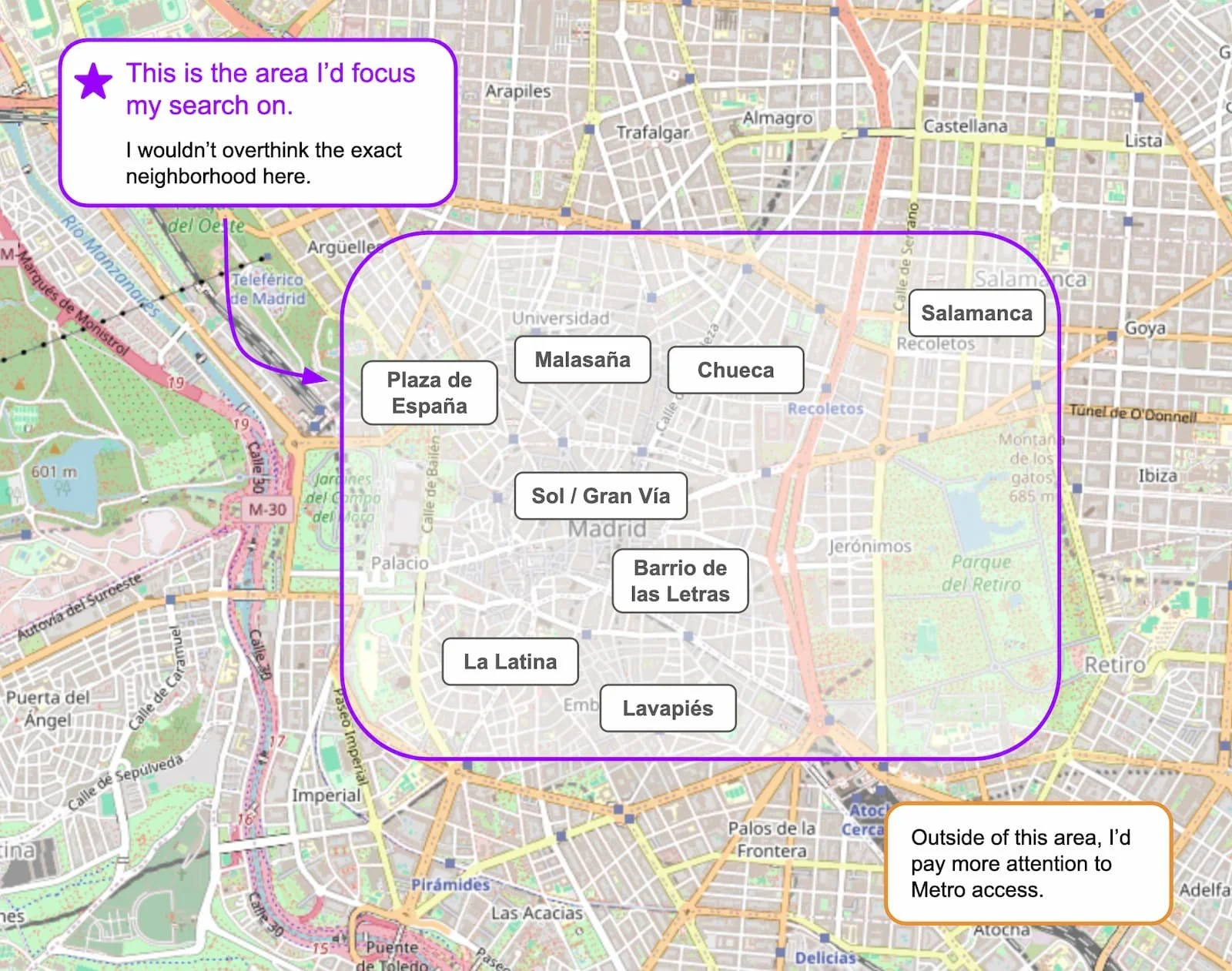
The approximate central area where I’d happily stay for a first visit to Madrid.
The neighborhoods do have different vibes
I’m not saying Madrid’s central neighborhoods all feel the same — they definitely don’t. Some are rowdier, quieter, more touristy, more upscale, or more local-feeling than others. But as an independent female traveler, the bigger thing for me is that most central neighborhoods felt safe and easy to navigate. The vibe differences felt more like small flavor changes than make-or-break decisions.
Here’s how I’d roughly describe the main central areas:
Malasaña feels young, creative, and lively, with independent cafés, small restaurants, vintage shops, and a bit of nightlife.
Chueca is central, stylish, and energetic, with lots of restaurants, bars, shops, and LGBTQ+ nightlife.
La Latina feels a little more traditional, with narrow streets, tapas bars, plazas, and a strong evening/weekend atmosphere.
Lavapiés is more multicultural and alternative, with international restaurants and generally more affordable stays, though it can feel a bit grittier than some nearby areas.
Barrio de las Letras is historic, polished, and convenient, especially if you want to be closer to the Prado, Thyssen, and Retiro side of the city.
Sol and Gran Vía are extremely central and convenient, but also busier, more touristy, and noisier.
Salamanca is more upscale, spacious, and expensive, with boutiques, nicer restaurants, and easier access to Retiro.
So if one of these areas really appeals to you, let that guide your choice. But if you’re a general traveler who mainly wants somewhere safe, central, lively, and convenient, I think most of them work well.
Price-wise, I’ve generally found Lavapiés and La Latina to be a bit more affordable, while Malasaña, Chueca, Gran Vía, and Salamanca tend to be pricier. Of course, this depends heavily on the exact apartment or hotel, the season, and how early you book.
But your actual lodging might matter more
When comparing places to stay in Madrid, I’d focus more closely at the specific apartment or hotel — since the neighborhood doesn’t matter as much, your comfort inside where you return to at night might impact your visit more.
Take noise, for example. A crowded, central, or nightlife-heavy neighborhood might not mean your apartment or hotel will be loud. My stays in both Malasaña and La Latina were right by busy plazas. Based on the location alone, you could expect them to be noisy. But both ended up being very quiet because the apartments faced interior courtyards or quieter sides of the building.
So if you’re worried about noise, I’d pay much more attention to recent reviews than the neighborhood label itself. Look for comments about street noise, interior-facing rooms, and whether past guests mention needing earplugs to sleep.
The same applies to the actual comfort of the space. My apartment in Malasaña made it easier to get to the restaurants and areas I liked, but it had almost no natural light, which meant I could’ve slept until noon every day (and sometimes did lol). By contrast, my apartment in La Latina was an attic with tons of natural light. Even though I had to walk farther to get to some of my favorite places, I felt much more comfortable at home. So if you’re someone like me who needs natural light, don’t discount that just for a “better” neighborhood.
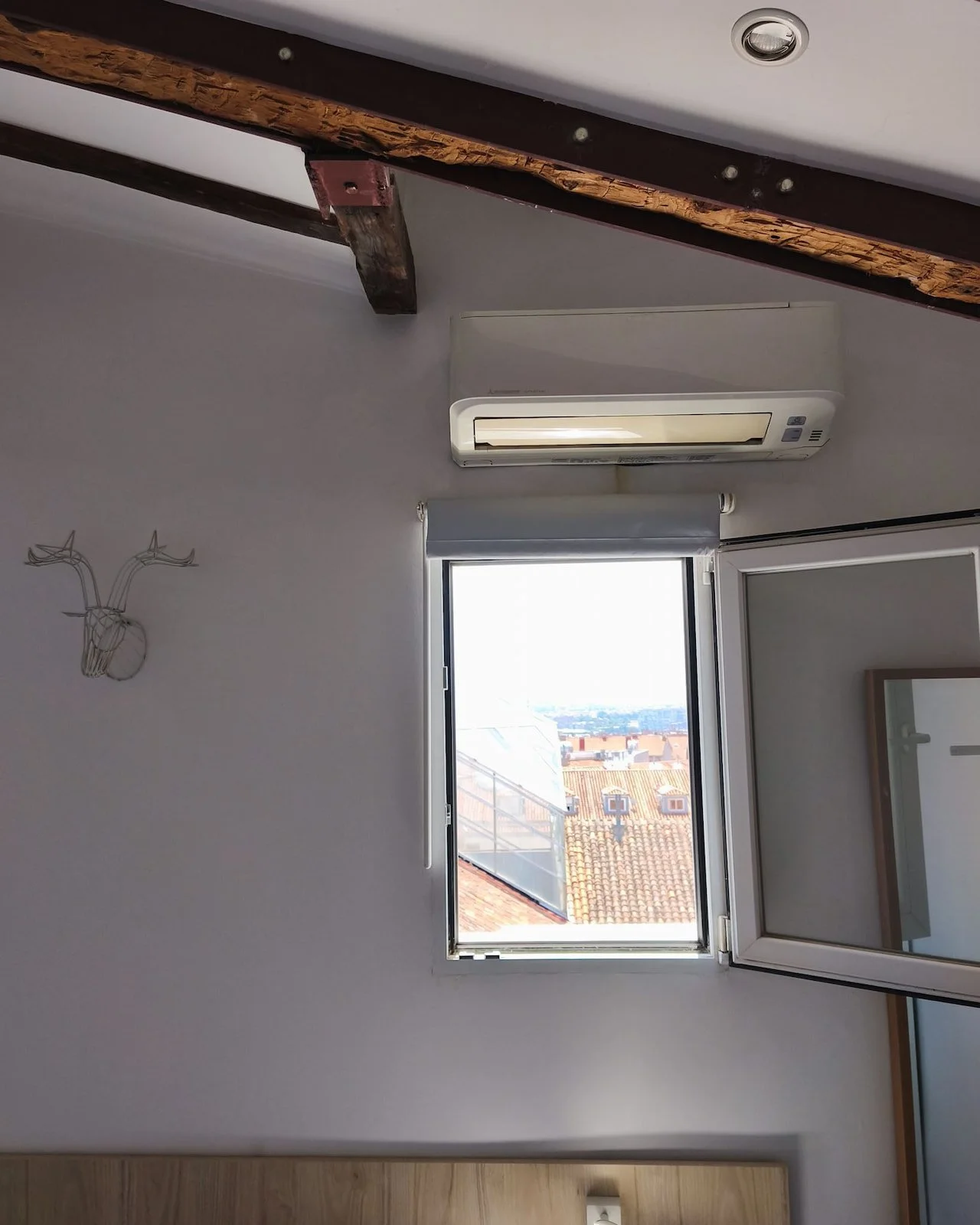
Having this natural light (and view over the rooftops, which isn’t really showing up here haha) mattered way more to me than being in a slightly more convenient neighborhood.
Other things I’d look for are air conditioning (this is a huge one in Madrid summer, please please do not assume a fan will suffice), elevator access since a lot of older buildings are walk-ups, and whether the specific street and building feel secure.
For more on how I evaluate apartments before booking, see my post on 5 Airbnb tips I learned across 100+ stays.
When location does matter
When you know you’ll use something or go somewhere often, I do think it can be worth staying closer to it.
For example, if I were planning to run several times during my trip, I'd probably stay closer to Retiro. Retiro Park is my favorite place to run in Madrid, and being nearby makes early morning runs much more convenient. From neighborhoods farther away, it's certainly possible to get there (I did), but it might get tiring doing that 3-4 times a week.
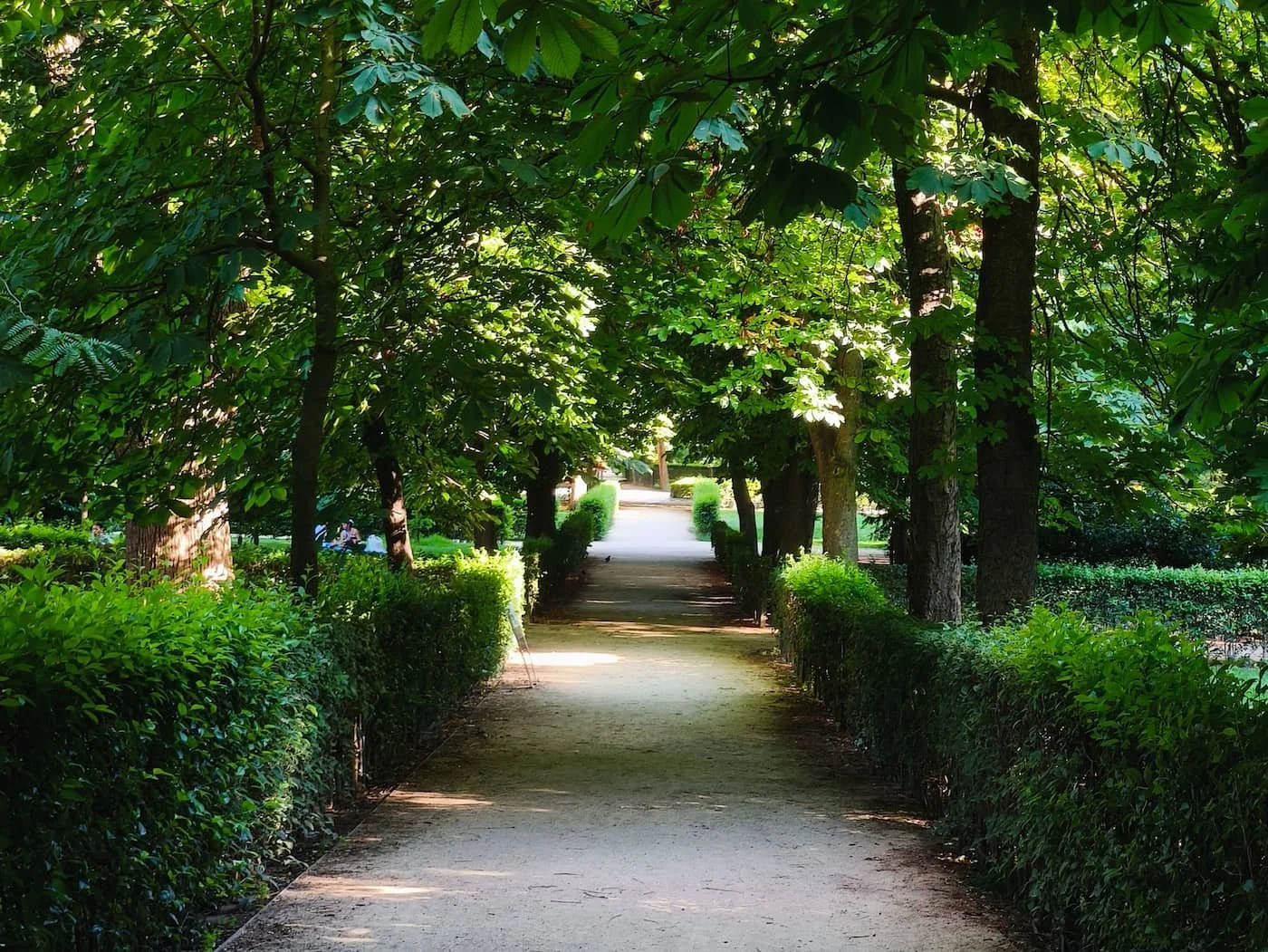
Retiro is the one area I’d prioritize if I knew I wanted to run regularly during my stay.
The same logic applies to other personal priorities. If you know you want to go out in Malasaña or Chueca often, staying nearby will make nights easier. If you're planning multiple museum visits, Barrio de las Letras or the Retiro side may be more convenient. Personally, I love Chinese food in Madrid (so authentic and affordable), and many of the places I like are closer to Malasaña, so when I stayed in La Latina for a month, I did find myself walking over there more often.
But even then, it rarely felt like a major problem. One reason I don't stress too much about neighborhoods in Madrid is that walking between them is often part of the experience. The streets, plazas, cafés, storefronts, and architecture make the walk feel less like a commute and more like another way to enjoy the city.
If you’re still figuring out which sights and areas you care about most, start with my guide to what to do in Madrid first. Once you know what you’re actually excited about, it’s easier to decide whether location should influence where you stay.
My recommendation
So, all that said, for a first visit, I wouldn’t stress too much about picking between central neighborhoods. If two places are equally good, let the neighborhood break the tie. But if one apartment or hotel has better reviews, better light, air conditioning, a quieter setup, or a much better price, I’d choose that almost every time — even if it’s not in my “ideal” neighborhood.
Madrid is one of those cities where you'll likely spend a lot of your time exploring on foot anyway. As long as you're staying somewhere central, you'll have an easy time experiencing the city regardless of where you technically stay.
If you’re still planning your trip, start with my Madrid Travel Guide: Start Here, where I’ve collected my Madrid logistics, itinerary notes, neighborhood thoughts, and related posts. You may also like:
What to Do in Madrid: if you’re figuring out which sights and areas you care about most
Madrid 1-Day Itinerary: a full walking route through the main first-time highlights.
Madrid 3-Day Itinerary: well-planned itinerary that leaves room to wander, with suggestions for 2 days or 4-5 days.
Slow Traveling Madrid: a glimpse into my routines and real monthly costs staying a couple of months in Madrid
And if you’re still deciding between neighborhoods, feel free to leave a comment or send me a message. I’m always happy to help if I can.