4 One-Bag Workouts for Staying Active While Traveling
AFFILIATE DISCLOSURE: This post contains affiliate links. Links marked with (*) may earn me a small commission if you purchase, at no extra cost to you. (I only recommend things I personally use and love!). As an Amazon Associate I earn from qualifying purchases.
As someone who likes to stay active while traveling, I’ve spent a lot of time figuring out what workouts are actually realistic on the road, especially working with small spaces, busy days, and minimal gear.
If you’re trying to stay active while traveling without relying on a gym, these are the 4 workouts I consistently come back to: running, jump rope, yoga, and walking/hiking. Each one works in different situations (outdoors, small indoor spaces, short time windows), and together they cover almost every travel scenario.
Below, I break down when each one makes sense, how to make it work in a new destination, and simple workout templates you can actually use while traveling.
This post is part of my One-Bag (30L) Packing List for Indefinite Four-Season Travel — if you want the full system (clothing, essentials, and the exact items I’m currently using), you can check it out there.
If you’re short on time, you can jump straight to the workout breakdowns or templates for each option below:
Running
Why it’s great for one-bag travel
Running delivers a huge cardio payoff for almost no gear, and you can do it practically anywhere in the world. Even better, it doubles as sightseeing – you’ll cover more ground than walking while still experiencing a place at street level.
Minimum gear needed
Running shoes (worn on travel days to save bag space).
Where you can do it
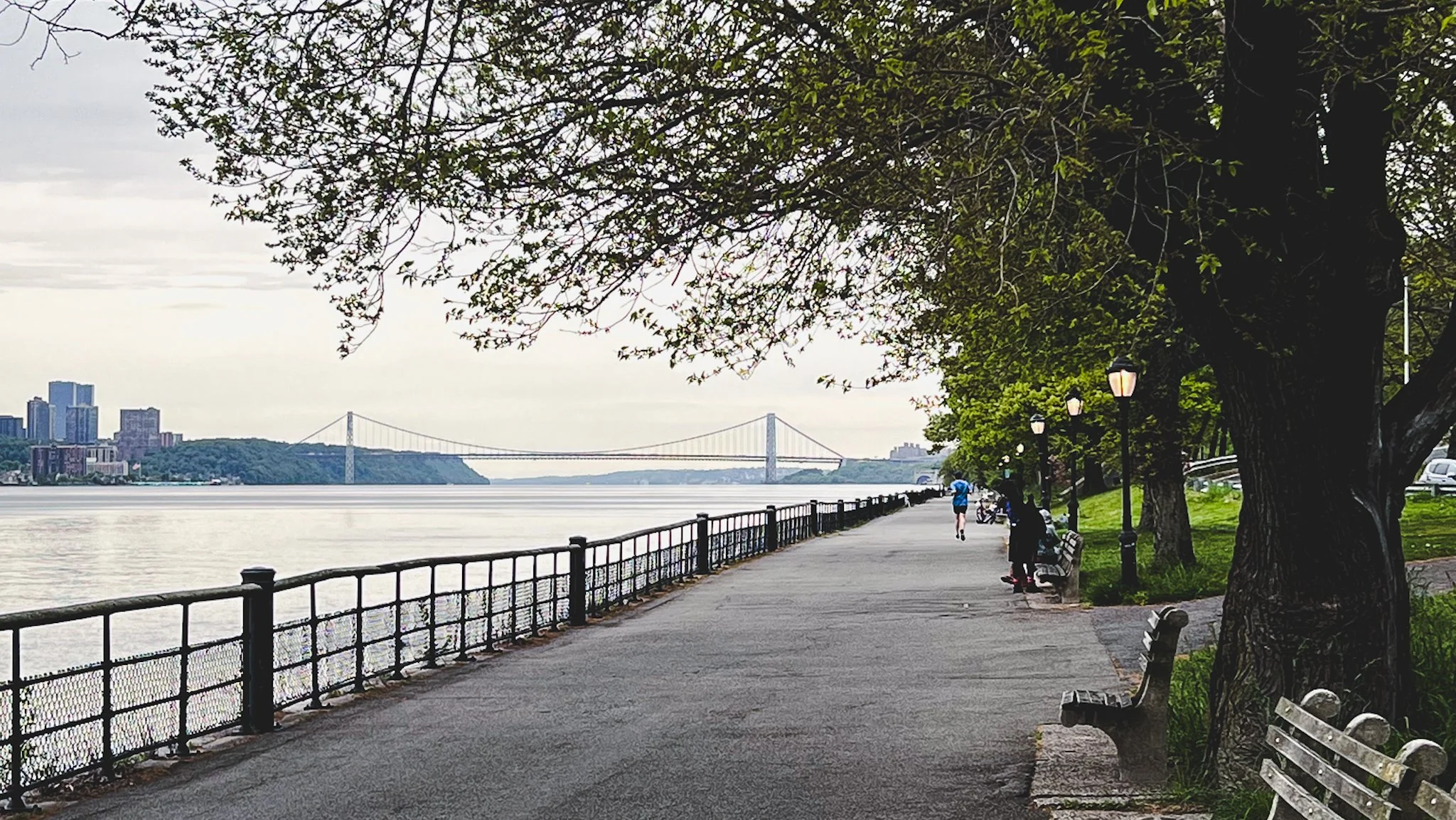
Outdoors: City streets for easy runs, waterfront paths for scenic miles, parks or tracks for structured workouts.
Indoors: Hotel or apartment gym treadmills (if available) — helpful in extreme weather or if you prefer a more controlled environment.
Best for
Cardio and endurance.
Interval training and speed work.
Exploring neighborhoods beyond tourist zones.
Not ideal for
Those who prefer low-impact exercise.
Those uncomfortable running alone outdoors in unfamiliar areas.
Trips where air quality, extreme heat, or icy conditions make outdoor running unsafe.
How running while traveling feels different than at home
Running on the road isn’t just your usual workout in a new location — it requires a bit more flexibility.
You’ll need to research routes in advance, especially for long or structured runs.
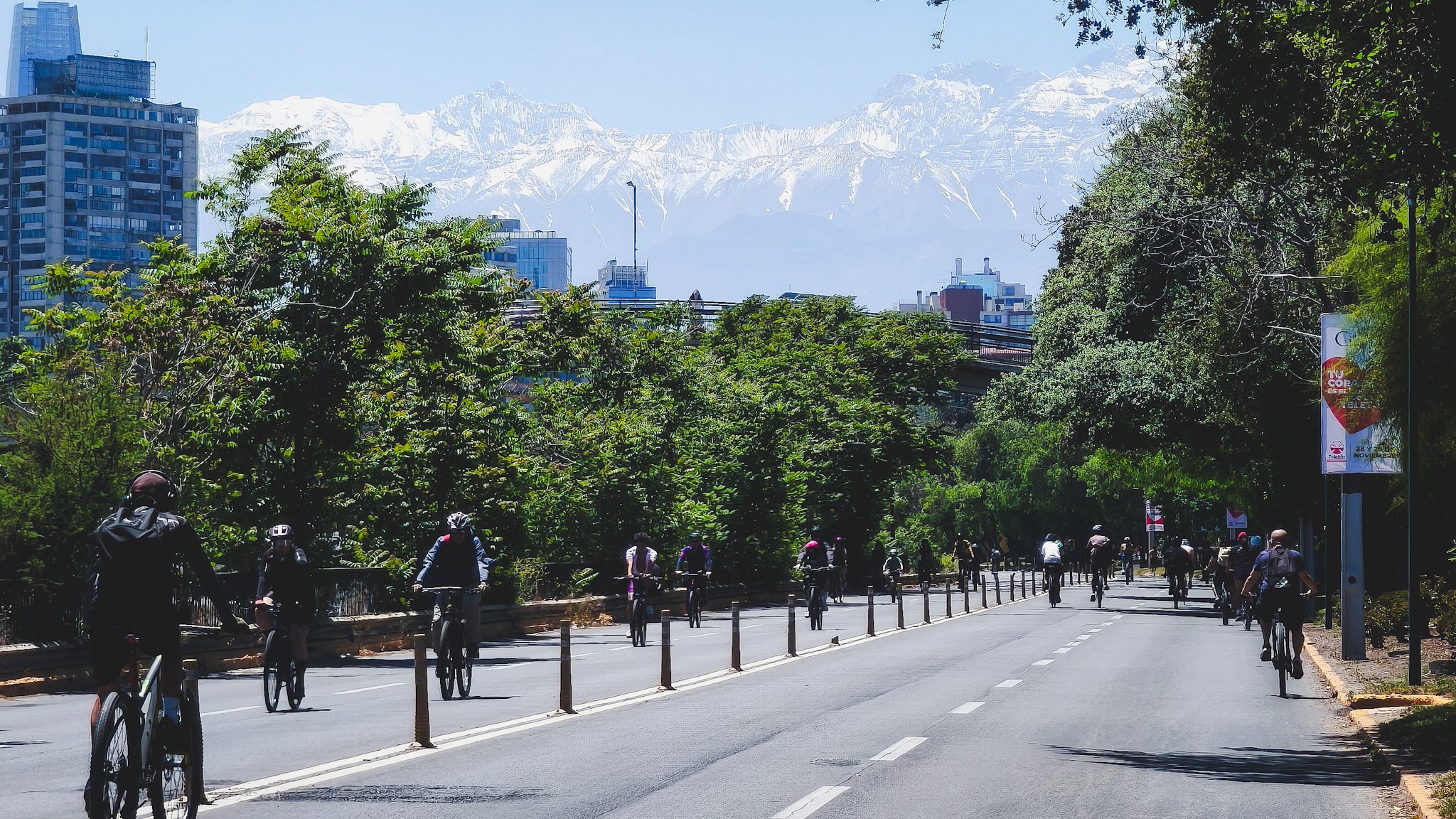
👉 For examples of routes that work for different training goals, see my Santiago curated running routes guide.Safety awareness matters more in unfamiliar places – keep in mind time of day, lighting, foot traffic, and have an idea of your route before you head out to avoid having to take out your phone to navigate all the time.
If you’re following a training plan, it can help to factor in running access (parks, waterfronts, or gyms) when choosing where to stay.
👉 Here’s how I factor running access into neighborhood choices in my Santiago neighborhoods guide.
Travel running often means letting go of perfect splits and focusing more on experience, consistency, and movement (and personally for me, that’s part of the magic).
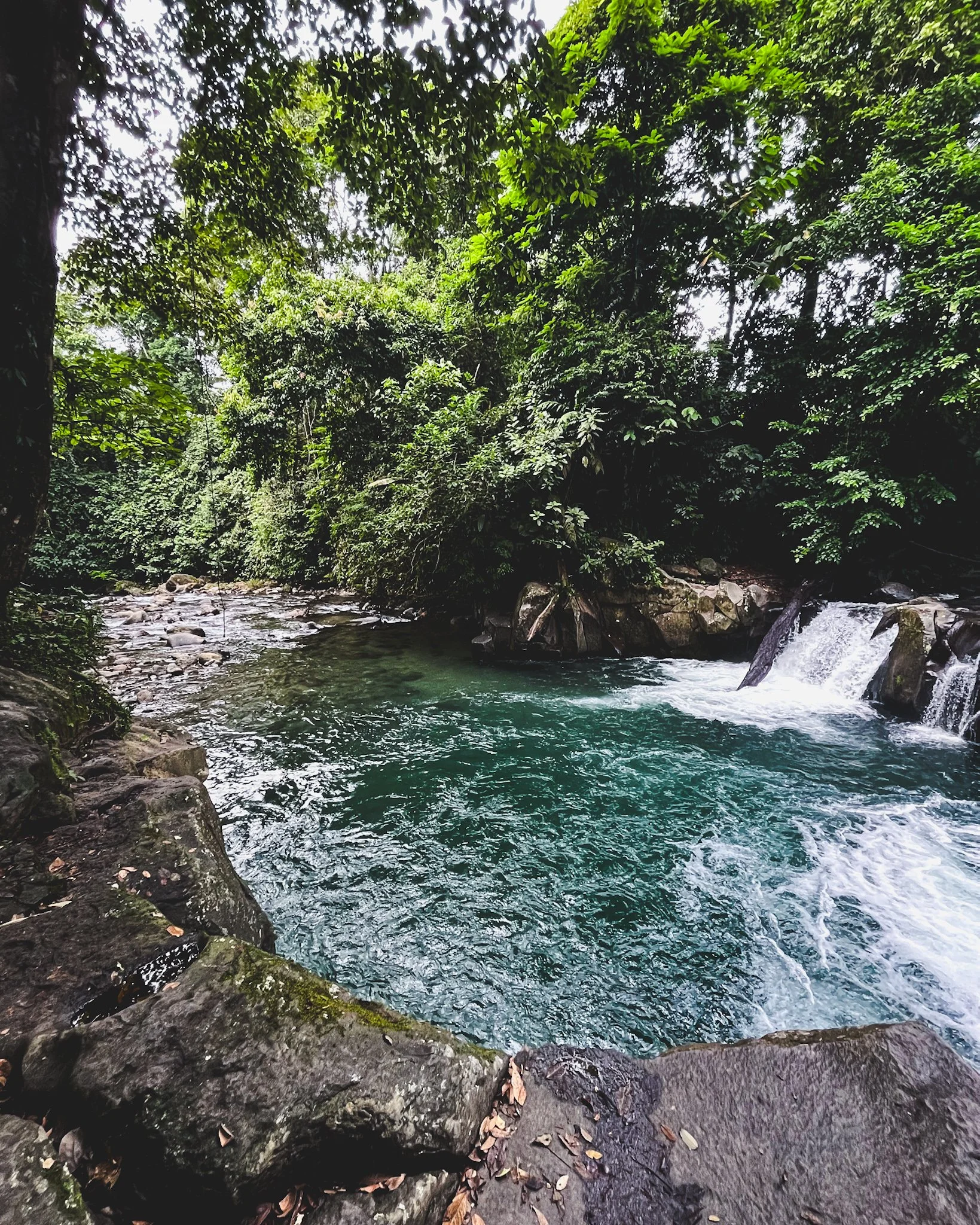
A short run I did in Arenal, Costa Rica to keep up with my marathon training took me to this little pool with a rope swing. The rope swing looked way too insecure to use, but did dip in for a cool down.
Jump Rope
Why it’s great for one-bag travel
Jump rope is one of the most time-efficient cardio workouts you can do. A rope takes basically zero bag space, and the calorie burn can be comparable to running at moderate-to-hard effort depending on pace and body size (source). It’s also ideal for busy travel schedules – you can get a legit workout in 10–15 minutes in the morning, and do a whole day of sightseeing. Jump rope has actually become the main practice I keep coming back to on the road.
Minimum gear needed
Jump rope – beaded or PVC ropes are generally considered to be most versatile (and best for beginners) (source).
My current jump ropes are the Elite Jumps Beginner-Friendly Beaded Rope (*) and the Dope Ropes 5mm PVC Cardio Rope.
Supportive and flexible shoes for constant jumping.
Where you can do it
Outdoors: Parks, courts, quiet sidewalks, parking lots, open plazas.
In your lodging (with caveats):
Ground floor – jumping will likely be loud for the unit below. I really recommend limiting the amount you jump if you’re not on the ground floor, or do ropeless jumping workouts.
Rooftops, patios, courtyards, or gyms are ideal if available.
Best for
Cardio + HIIT intervals.
Coordination (especially if you do freestyle/tricks).
Time optimization (big payoff in short sessions).
Not ideal for
Those who prefer low-impact workouts.
Travelers with sensitive joints and no access to a forgiving surface.
Anyone who feels self-conscious jumping in public (I am in this camp, though I’m working on it haha).
How jump rope while traveling feels different than at home
The main requirement is space + surface. If you have a go-to jumping spot at home, travel can mean doing a searching for:
Enough clearance (ceiling height, nearby people, furniture).
A surface that won’t destroy your shins (avoid hard tile when possible).
Noise considerations (especially in apartments/hotels).
If space is tight, a helpful workaround is doing “no-rope” jumps (same timing, no rope) or packing a travel-friendly jump rope mat to absorb some sound and give you cushion.
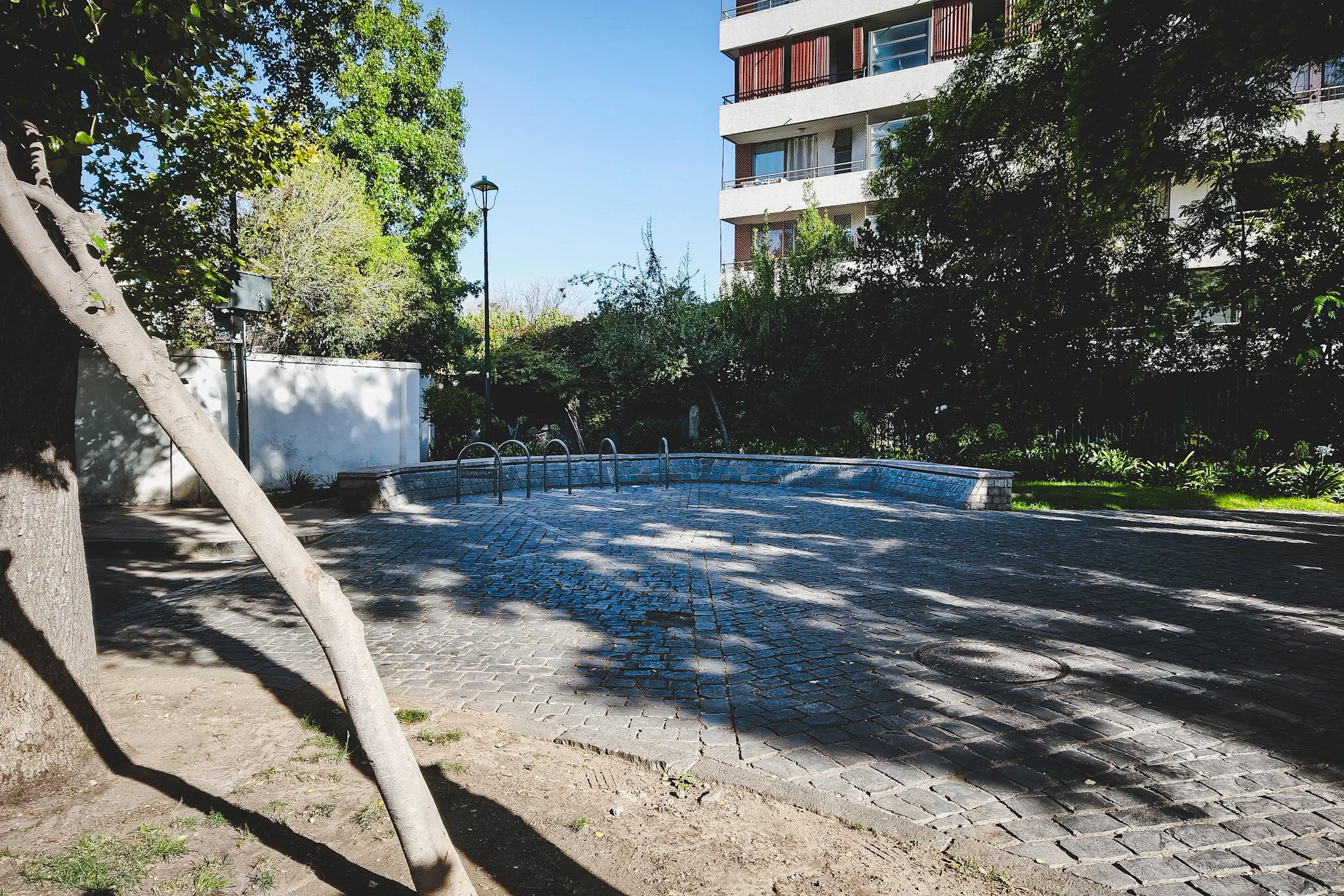
A corner of a quiet park in Santiago, Chile, where I did a quick jump rope workout. The stone ground was not ideal so I wouldn’t make this a default corner for jumping, but it worked in a pinch (and with cushioned shoes).
Yoga
Why it’s great for one-bag travel
Yoga is one of the easiest workouts to do inside your lodging, which removes variable outdoor factors (safety, weather) that come with traveling. It’s also ideal for travel recovery — loosening stiff hips, hamstrings, and upper back after long flights or bus rides. And if you’re someone who feels ungrounded in new places, yoga can be amazing for resetting your mind and nervous system.
Minimum gear needed
Strictly none — you can do yoga on a bare floor or on a towel. That said, a few travel-friendly items can dramatically improve the experience (especially on slippery floors):
See the one-bag packing tips section below for more details.
Where you can do it
Outdoors: Parks, beaches, quiet grassy areas — anywhere you want a bit of space to move.
In your lodging: Any area where you can reach arms overhead and sideways, and step forward/back without bumping furniture.
Best for
Flexibility + recovery from travelling (slower, gentler flows).
Light cardio and bodyweight strength (if you choose faster, strength-focused flows).
Mental clarity and grounding (very true for me at least).
Not ideal for
Pure cardio and endurance training (though it pairs perfectly as recovery from it).
How Yoga while traveling feels different than at home
The biggest difference is gear and surfaces. If you practice at home, you probably have a mat you love, and it’s likely too bulky for one-bag travel. So on the road, you’ll be improvising (towel on tile, carpet).
That’s totally workable, but it can change things like grip (hello, slipping in down dog), comfort on knees, and how much you enjoy the session. And that’s why tiny, packable gear can be a quality-of-life upgrade if yoga is a core part of your routine.
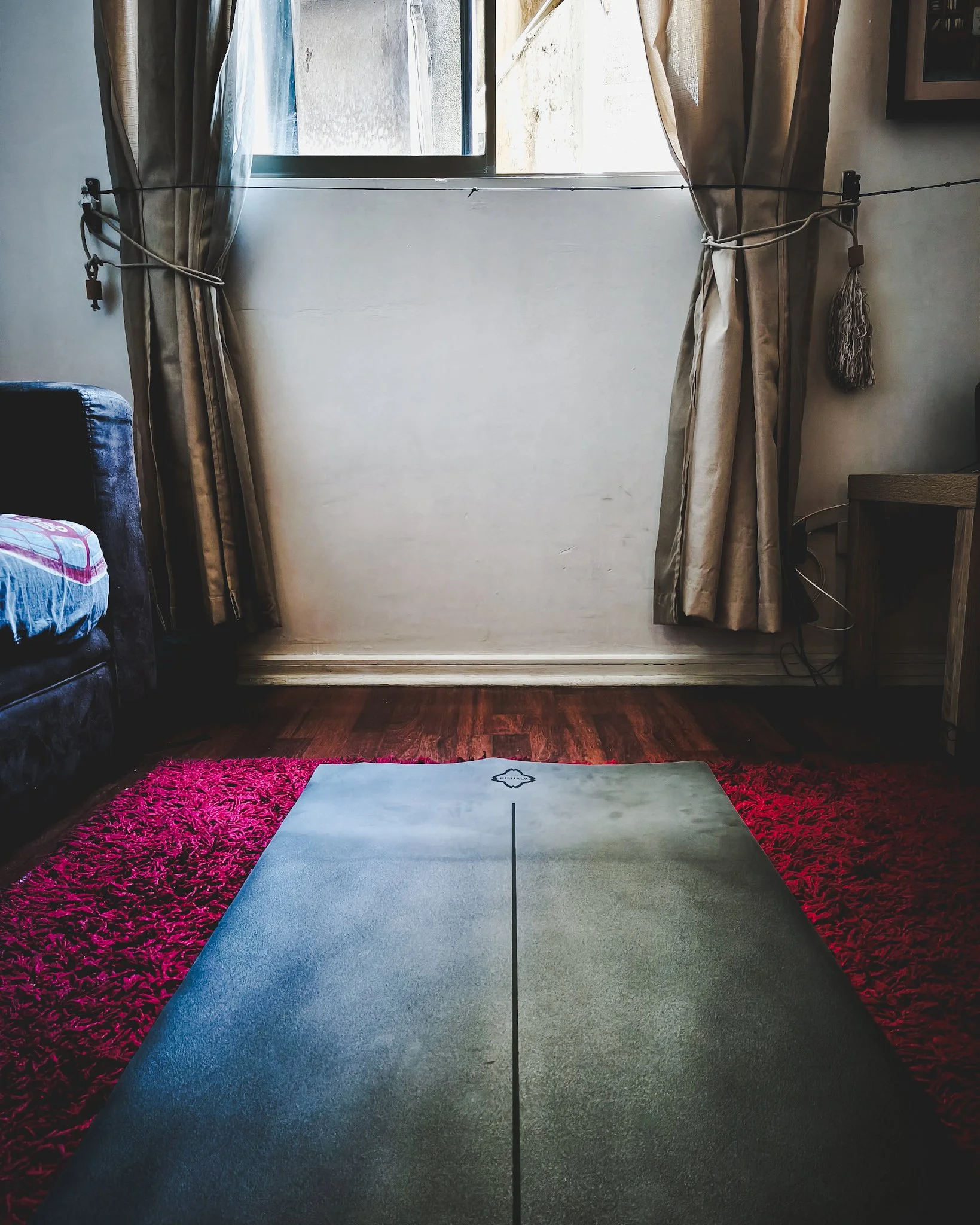
My yoga setup in one of my Airbnbs in Santiago, with my portable travel mat. The rug was not too thick and provided nice additional cushioning. When the window lets in sun and breeze (which was rare in this one), it feels super nice.
Walking / Hiking
Why it’s great for one-bag travel
Walking is the ultimate travel workout because it’s already built into your day — you can turn sightseeing into low-impact cardio without needing extra time, a gym, or any equipment. In an urban setting, it’s also my favorite method of transportation, since walking lets you take in your environment way more than being stuck in a crowded subway or whizzing by in a car. And if you’re in an area with trails, hiking lets you venture into areas that cars can’t take you and get a bit more intense of a workout.
Minimum gear needed
Comfortable walking shoes.
If hiking: trail-friendly shoes with good grip (especially if it’s wet or rocky).
Where you can do it
Outdoors: Anywhere — city neighborhoods, waterfronts, parks, stair-heavy areas, trails, nature reserves.
Indoors: With treadmills or stairmasters (if available).
Best for
Low-impact cardio and endurance.
Exploring your destination (and discovering the good stuff between landmarks).
Recovery days between harder workouts (running/jump rope).
Not ideal for
Travelers who want a short, high-intensity workout (walking is more daily consistency than quick burn).
Destinations where it’s unsafe or unpleasant to walk outdoors (poor sidewalks, extreme heat, heavy pollution, or safety concerns).
Hiking routes that require technical gear or navigation if you’re not prepared.
How walking / hiking while traveling feels different than at home
The main difference is that travel walking is often incidental — you’ll rack up steps without trying while sightseeing. That’s great, but it can also mean if you could be doing way more mileage than your body is used to, so you’ll feel more impact from being under-fueled or wearing the wrong shoes.
On hiking days, variables matter more than at home: weather changes, trail conditions, elevation, and how easy it is to get back if something goes wrong. A little planning makes it safer and way more enjoyable.
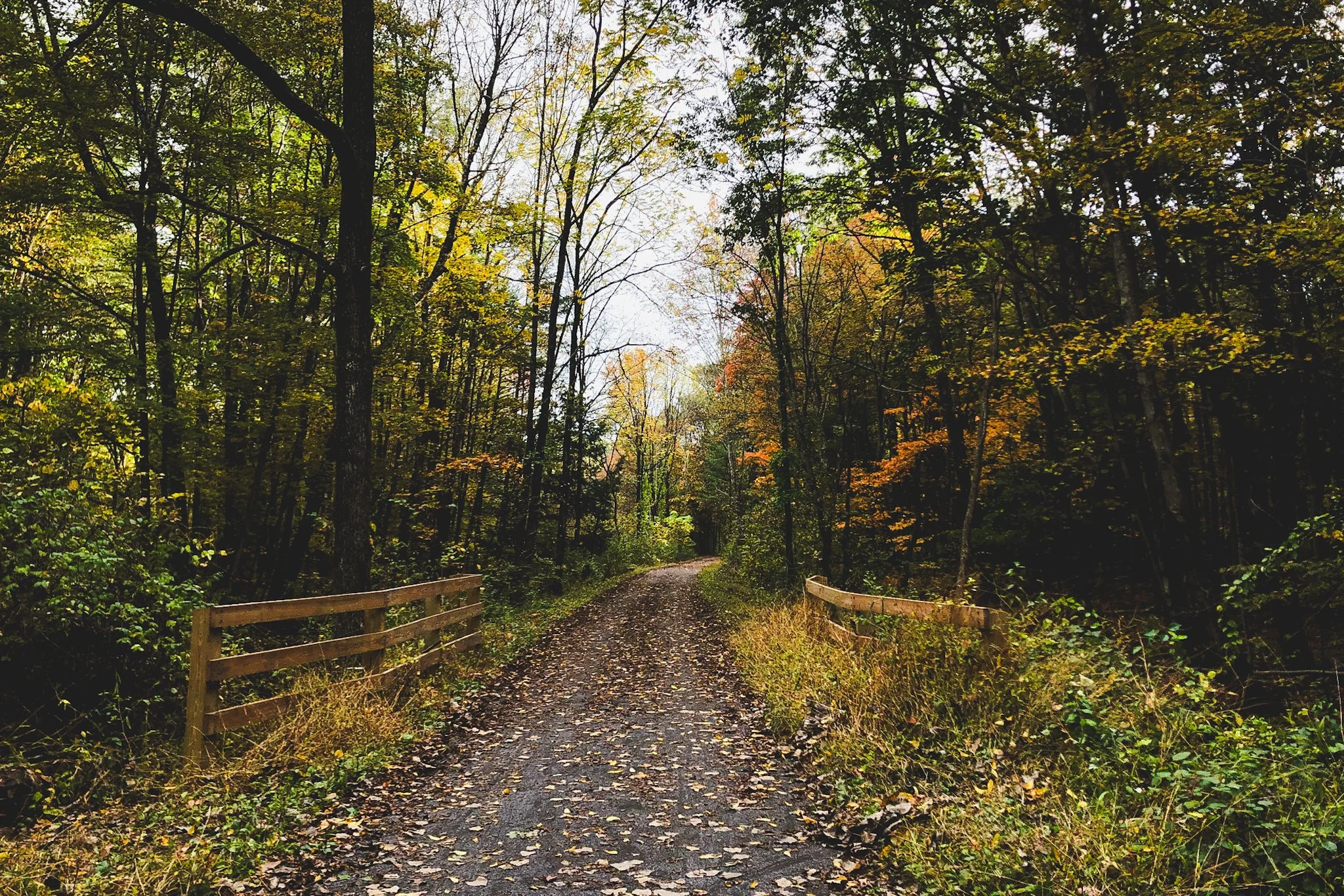
A little backdoor trail in upstate New York, where I spontaneously went once when I was yearning for autumn foliage in California. This curbed that yearning.
One-Bag Packing Tips
Multi-purpose shoes let you mix it up with minimal gear
Shoes are one of the bulkiest parts of any packing setup, which is why I try to pack as few pairs as possible. That’s also why multi-purpose shoes are one of the MVPs for one-bag traveling.
The same principle applies to these workouts: if you want to run, jump rope, and walk/hike on the same trip, the easiest way to make that realistic is to bring one pair that can handle all three.
I’ve found trail runners with light-to-moderate tread to be the sweet spot. They’re built for running, grippy enough for trails, supportive for jumping rope, and still comfortable on concrete for sightseeing. For example, the Nike Pegasus Trail Runners (*) is designed as a trail running shoe with traction that grips on uneven terrain but still comfortable on street roads.
If you want the deeper rationale + how I decide what second pair (if any) to bring, check out: My Two-Pair Shoe Strategy for One-Bag (Carry-On Only) Travel.
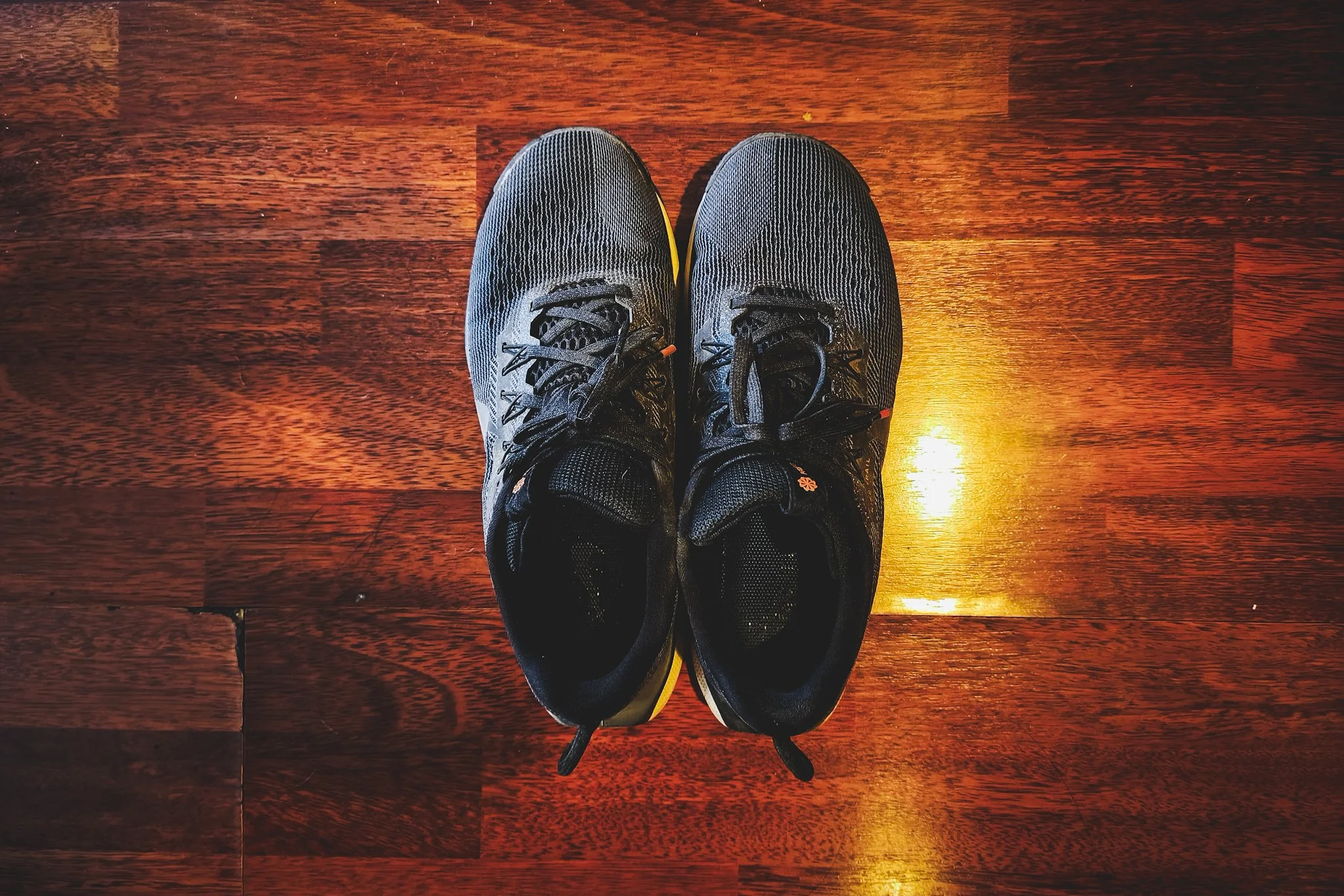
My “one-shoe”: The Nike Pegasus trail runners, which serves as my running, hiking, jump rope, and daily sightseeing shoe.
Travel yoga gear can vastly improve your experience
For one-bag travel, a normal yoga mat is usually a no-go — it’s way too bulky and heavy (trust me, I’ve tried bringing one on a trip and it basically felt like I was doubling my gear).
But doing yoga on a towel or bare floor can be slippery or uncomfortable, especially if you’ve got sensitive knees or sweaty hands. But lucky for us, there is travel-friendly yoga gear that packs small and makes a huge difference.
Here are the 2 travel solutions I’ve found most useful:
1) Grippy yoga gloves + socks: Yoga Paws SkinThin Non Slip Yoga Gloves and Yoga Socks (*)
If your main issue is slipping (especially in down dog), grippy gloves/socks can be a game-changer. These YogaPaws gloves and socks are designed to add grip without needing a mat.
For me, this solved my biggest travel yoga issue: when I practiced without my grippy home mat, I slipped enough that it totally broke the experience. These made yoga on imperfect surfaces feel doable again, and they take up barely any space.
Best for: slick hotel floors, sweaty hands, minimalizing pack volume and weight, quick yoga sessions without a mat.
2) Foldable travel yoga mat: Decathlon 1.3mm Foldable Anti-Slip Yoga Mat
If you want more of a real mat feel without packing a full-size yoga mat, a foldable travel mat is the sweet spot. The goal is to optimize for packability and weight while still meeting your needs for grip and comfort (especially for knees/wrists).
This is the one I use because it actually folds down small, adds a clean surface between me and the floor, feels more stable than a towel alone, and is anti-slip. Some mats marketed for travel don’t actually pack that light or small, so I always check weight and foldability first.
Best for: anyone who wants a mat option that still works for one-bag travel, or who wants more comfort/grip than gloves alone.
Note: The availability of my particular mat can be region-dependent (I bought mine in Chile), so if you can’t find this exact one, use it as a reference for thickness + foldability.
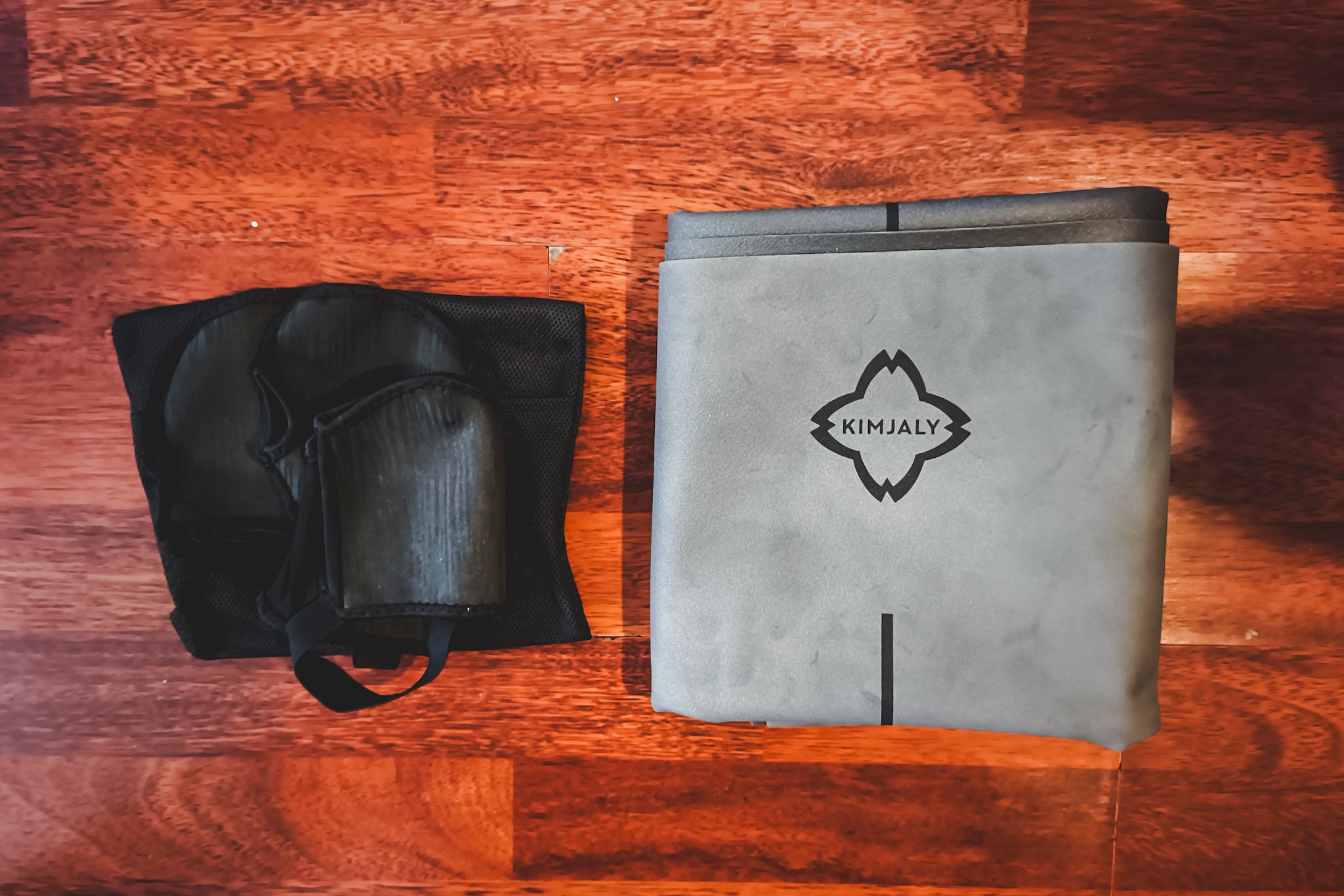
My Yoga Paws grippy gloves and socks (on top of their baggy) and my folded Decathlon travel yoga mat.
Pack bulky/sweaty items at the bottom or in side pockets
The idea is to balance the weight in your bag, use the space efficiently, and separate dirty (smelly) gear with your clean stuff:
Heavy/bulky items (like shoes) ride best at the bottom, close to your back.
Sweaty/dirty gear stays easier to manage if it’s separated from clean clothes (side pockets or a dedicated compartment). I use a dedicated shoe bag (*) to separate my shoes from my clean stuff.
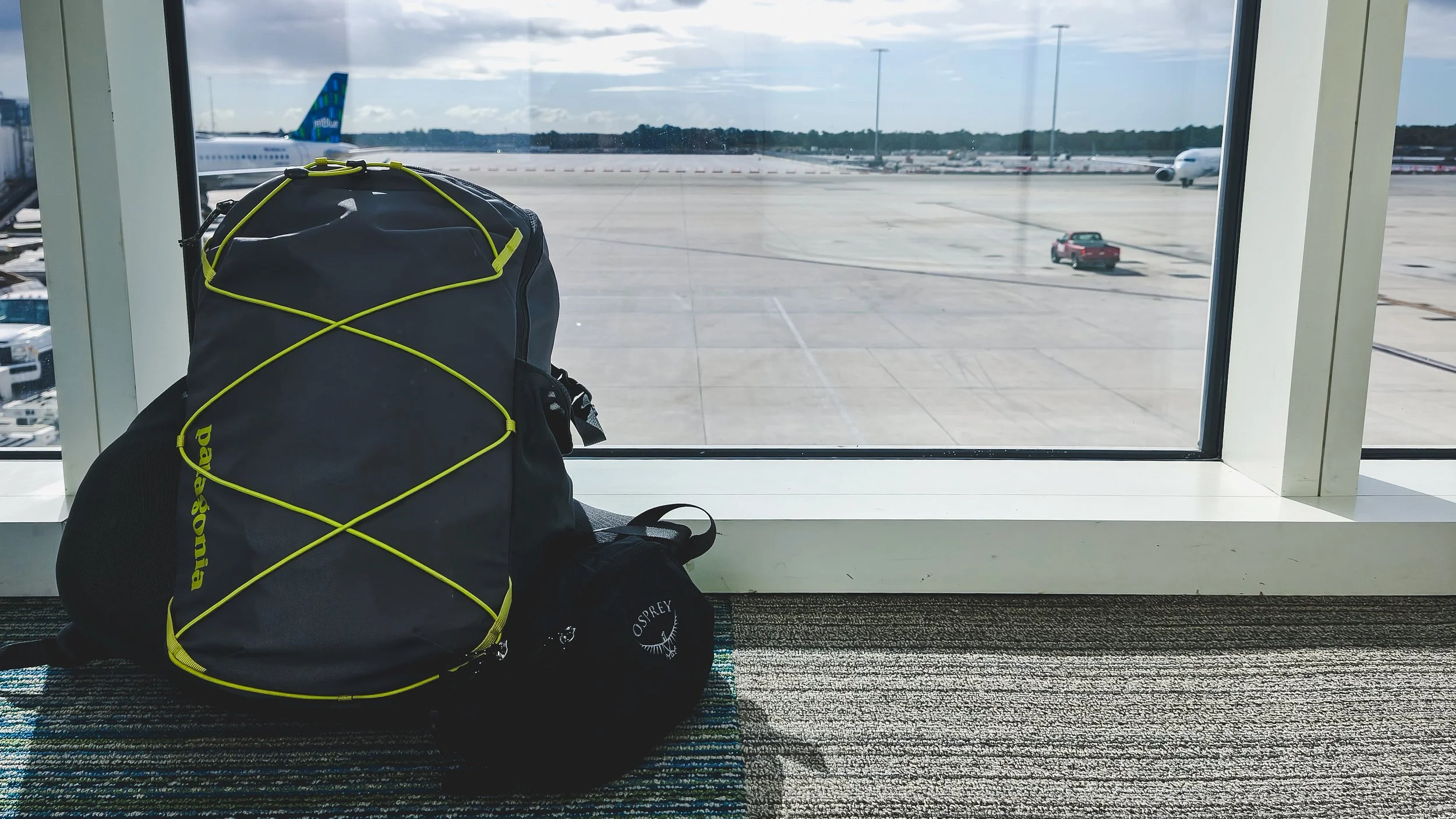
For more details on how I pack my one-bag, see How I Pack My Patagonia Refugio 30L for One-Bag Travel (Exact Layout + Why).
Running Workout Templates for Travel
These are designed to take into account unfamiliar routes, limited time, and sightseeing mixed with training. I use a variation of them during my travels.
🗺 Explorer Run (Great for arrival day)
Run toward a landmark, park, or waterfront and loop back. Great for shaking off travel stiffness while getting to know your area.
20–40 min easy pace
🏙 Landmark Intervals
No watch needed — the city sets your intervals! Map out the route before you go though.
5 min easy warm-up
Run faster to the next landmark (intersection, statue, bridge)
Jog easy to the next
Repeat 8–12 times, cool down after
🌅 Sunrise Tempo
Early mornings are cooler and quieter (especially more crowded destinations), but be aware of safety. Ideally done at a park to avoid stopping at traffic lights.
5 min easy
10–15 min comfortably hard
5 min easy
⏱ Quick Hotel Run (Treadmill or short loop)
Done in under 20 minutes when your schedule is packed.
3 min easy
1 min fast / 1 min easy × 5
3 min cool-down
Jump Rope Workout Templates for Travel
Designed for small time windows and limited space. I do the coordination one specifically a good amount since it provides a different type of training compared to running. And the other two I also do especially without rope as a quick workout at home.
⏱ The “Busy Day” Burner (10 minutes)
Choose a simple bounce you can maintain consistently:
40 seconds jumping / 20 seconds rest × 10 rounds
🔥 Quick Morning HIIT (12–15 minutes)
Perfect before you head out for the day.
3 rounds:
60 sec easy jump
30 sec all-out jump
60 sec rest/walk
🧠 Coordination Mini-Session (10 minutes)
This is awesome when you want to train some coordination and get some movement in without feeling wrecked.
Alternate 1 minute each, 3 rounds:
Basic bounce
Alternate-foot step
High knees (light)
Side-to-side step
And/or any other footwork or combos you want to do!
Yoga Flow Templates for Travel
These are designed for tight spaces, stiff travel bodies, and nervous system resets. I love the third flow as strength training and a little bit of cardio, and the first and second flows especially for combatting travel fatigue.
✈️ Post-Transit “Unwreck Your Body” Flow (10 min)
Great after flights, trains, long car days: these posts stretch out your legs, spine, and back.
Cat-cow (60 sec)
Upward facing dog (45-60 sec)
Downward facing dog (45-60 sec)
Low lunge (each side 45–60 sec)
Half split (each side 45–60 sec)
Pigeon pose (each side 45-60 sec)
Seated spinal twist (each side 45–60 sec)
Thread-the-needle (each side 45–60 sec)
😵💫 Jet Lag Reset Flow (7-10 min, low effort)
When you’re tired but wired: these poses reset your nervous system while improving circulation.
Child’s pose (1 min)
Seated forward fold (1 min)
Legs up the wall (3–5 min)
Supine twist (1 min each side)
1 minute slow breathing lying down (box breathing or long exhales)
💪 Strength + Sweat Flow (12–20 min)
When you want a workout but don’t want to leave your lodging: this flow gets your heart rate up and gives you a strength exercise. You can do it as slow or fast as you like.
Repeat 3–5 rounds:
3 sun salutations (A or your preferred version)
Chair pose (30–45 sec)
High plank (30–45 sec)
Low plank to cobra/up dog (optional)
Down dog (5–8 breaths)
Walking / Hiking Workout Templates for Travel
These are designed to fit naturally into a travel day and allow you to sightsee while working out.
🏙 Destination Walk (45–90 min, sightseeing pace)
Pick 2–3 anchor points (for example, market → viewpoint → cafe) and walk the whole route. This turns exploration you’re already doing into a real workout that doesn’t feel like one.
⛰ Hill or Stairs Walk (20–40 min)
Find a hilly neighborhood or a big set of stairs. Walk up at a strong pace, take it easy on the way down, repeat 3–6 times. This uses your environment to your workout advantage (and a unique experience if the city is known for its hills!).
⏱ Post-Meal Walk (10–20 min)
A short walk after lunch or dinner is great for digestion, energy, and keeping your body from stiffening up after sitting. Plus, it’s a great way to get to know your neighborhood more, or take in the area around your restaurant.
🥾 Half Day Hike (2–4 hours total)
For trail destinations. Choose a well-marked route, start earlier than you think you need to, and aim for steady effort you could maintain for hours (not a sprint).
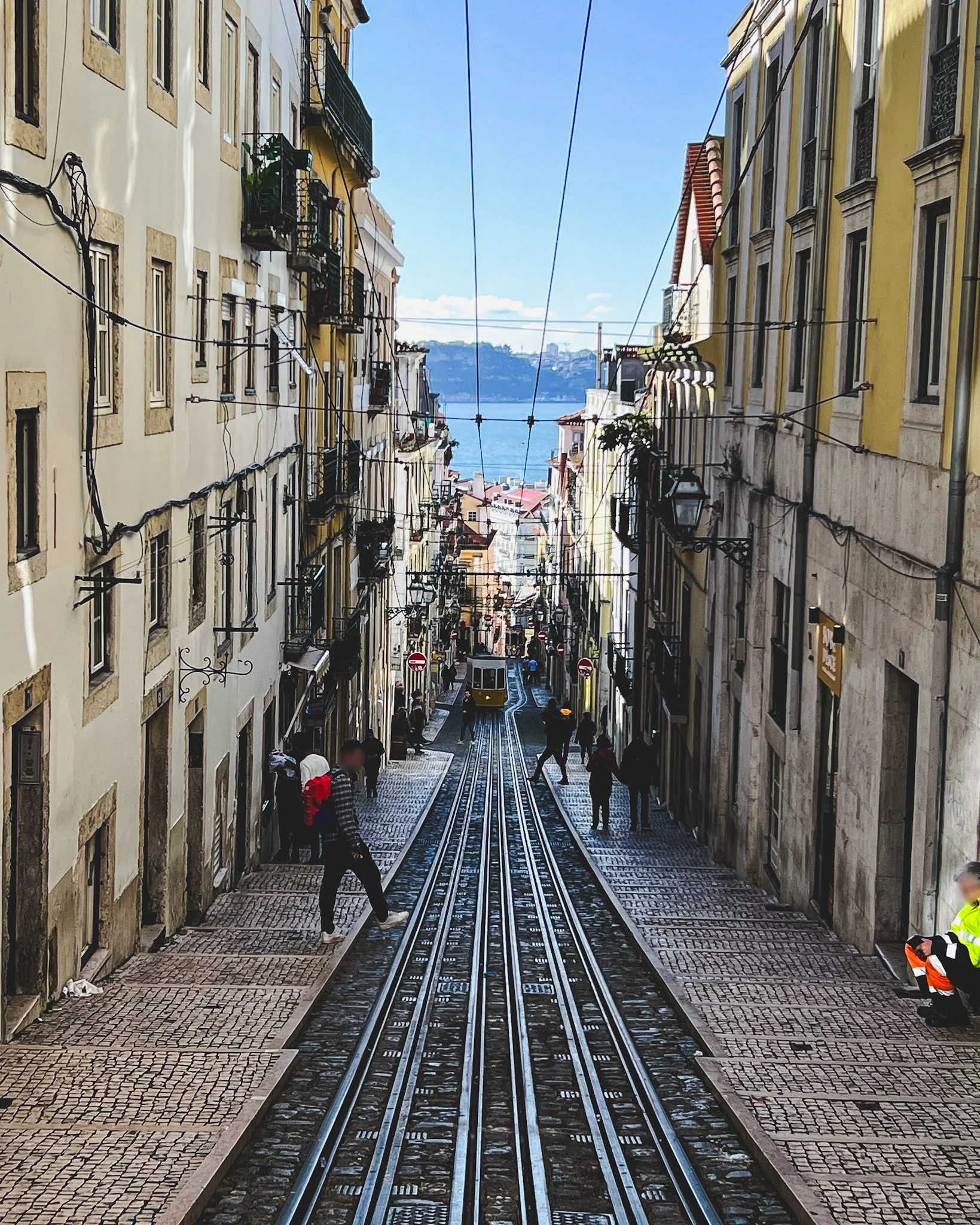
Hilly street in Lisbon, Portugal. Perfect for some quick hill repeats.
Thanks for reading — happy exercising!
Have a question about this?
Shoot me a message or leave a comment below — I read everything, and I’m always happy to help if I can!