My Two-Pair Shoe Strategy for One-Bag (Carry-On Only) Travel
AFFILIATE DISCLOSURE: This post contains affiliate links. Links marked with (*) may earn me a small commission if you purchase, at no extra cost to you. (I only recommend things I personally use and love!). As an Amazon Associate I earn from qualifying purchases.
Shoes are one of the biggest space hogs in travel packing – they’re bulky, awkwardly shaped, and somehow always multiply when you start overthinking your packing. Before I started one-bag traveling, I’d pack separate pairs for walking, running, going out, and whatever else I anticipate doing. But then most of the time, I would wear only a couple of pairs anyways, and the just-in-case ones would remain untouched, taking up space in my luggage that otherwise could be used for souvenirs (or just cut out of my packing volume).
As I started becoming serious about one-bag travel, I experimented with many different shoe strategies, and one pattern gradually became clear: two pairs of shoes is really what I need for most travels, as long as each pair serves separate but multiple purposes. I have finally landed on a strategy of two specific pairs of shoes, socks, and packing that have worked for me across travel situations.
TL;DR (but do read on for the why + details!)
The 3 rules I follow
Choose versatile, multipurpose shoes over occasion-specific ones (this is the key).
Limit to two pairs of shoes, unless a trip has a true requirement (formal event, serious trekking, snow/ice) and I can’t replace one of the two regular pairs.
Wear the bulkier pair in transit; pack the flatter/lighter pair.
My two-shoe setup (for most trips)
1 pair of multi-terrain (light trail) running sneakers in a neutral color – the do-it-all shoes for walking, sightseeing, exercising, hiking.
1 pair of packable flip-flops that are comfortable and waterproof – the wet-area and downtime shoes for showering, swimming, lounging.
For trips with specific occasions or climates, I swap out one (or both) of dedicated shoes (see section on occasion-specific swaps below).
The supporting items
3 pairs of merino wool socks for comfort, odor control, and packing fewer pairs.
1 dedicated shoe bag to separate shoes and their dirt from everything else in my pack.
This shoe setup is one part of my broader one-bag (30L) approach to full-time, four-season travel. If you want the whole system and everything else I pack, start here: My One-Bag (30L) Packing List for Indefinite Four-Season Travel (2025).
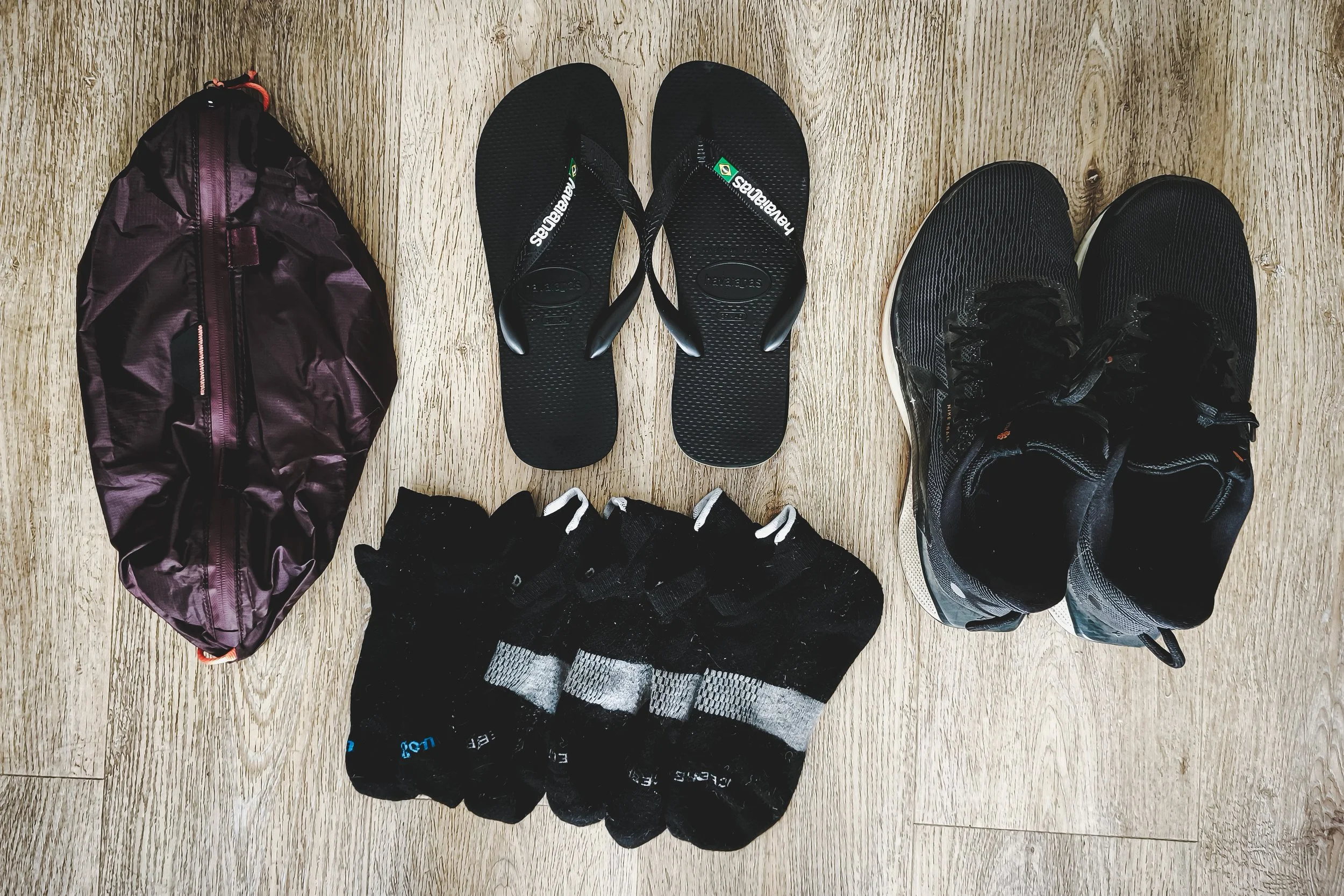
The two pairs of shoes (trail runners and flip-flops) that I pack for most of my travels, along with 3 pairs of merino wool socks and my favorite shoe bag where the flip-flops live.
The 3 rules I follow
These are the rules I follow in my overall shoes strategy that allowed me to reach my current set-up:
Choose versatile, multipurpose shoes over occasion-specific ones.
This is the key – if a shoe only works for one narrow scenario, most of the time it’s difficult to justify the space it takes in my pack. I’d rather find shoes that are broadly applicable and can work (maybe imperfectly, but suffices) for that scenario.Limit to two pairs of shoes.
For most travels, I’ve found that two pairs of shoes are really enough if they complement each other (I talk more about how that works below in my two-shoe set-up and swaps). For travels where I consider adding a third pair dedicated to specific occasions, the bar is high, and I only do so when I can’t replace one of my regular two pairs.Wear the bulkier pair in transit; pack the lighter pair.
This rule saves a lot of space in my pack, since the lighter pair usually tends to be a lot less volume and weight (e.g. flip-flops or ballet flats vs. trail runners).
Overview of my two-shoe setup (+ supporting items)
The shoes: Trail runners and flip-flops
For most trips, I bring the same two pairs of shoes in my 30L one-bag setup: trail runners and flip-flops.
The key is that each shoe is multipurpose yet service separate spheres, so together, they cover most travel realities:
Trail runners: the “real shoe” for cities, long walking days, workouts, and the occasional trail.
Flip-flops: the “wet shoe” for showers, beaches, and letting your feet breathe.
Anything beyond that is usually an itinerary-specific swap (boots for real trekking, dress shoes for more polished settings, etc; I get into that below).
The supporting items: Merino wool socks and shoe bag
Besides the shoes, I use merino wool socks while traveling to reduce the number I pack. Merino wool is naturally odor resistant (actually so much better than cotton or synthetics in my experience), quick-dry, and temperature regulating.
I also use a dedicated shoe bag to pack my second pair of shoes to keep dirt separate from all my clean stuff.
Deep dive: Trail runners (my do-it-all shoes)
Current pair: Nike Pegasus Trail Running Shoes (*)
When I pick trail runners for travel, I’m looking for a very specific middle ground. I want them to be athletic enough to run in, steady enough to hike in, but subtle/urban-stylish enough to wear in cities.
What I look for in travel trail runners:
City-friendly look: They pass as regular sneakers (not overly outdoorsy) so I don’t stand out in cities and feel more stylish in them.
Moderate tread: Enough grip for dirt and gravel, but not so aggressive they feel clunky on pavement.
Balance breathability and durability: Comfortable in heat, but sturdy enough for rough paths and some bad weather.
The trail runners is what I wear for:
Big walking days
Travel days (because they’re the bulkiest)
Runs/workouts
Light hikes and mixed terrain
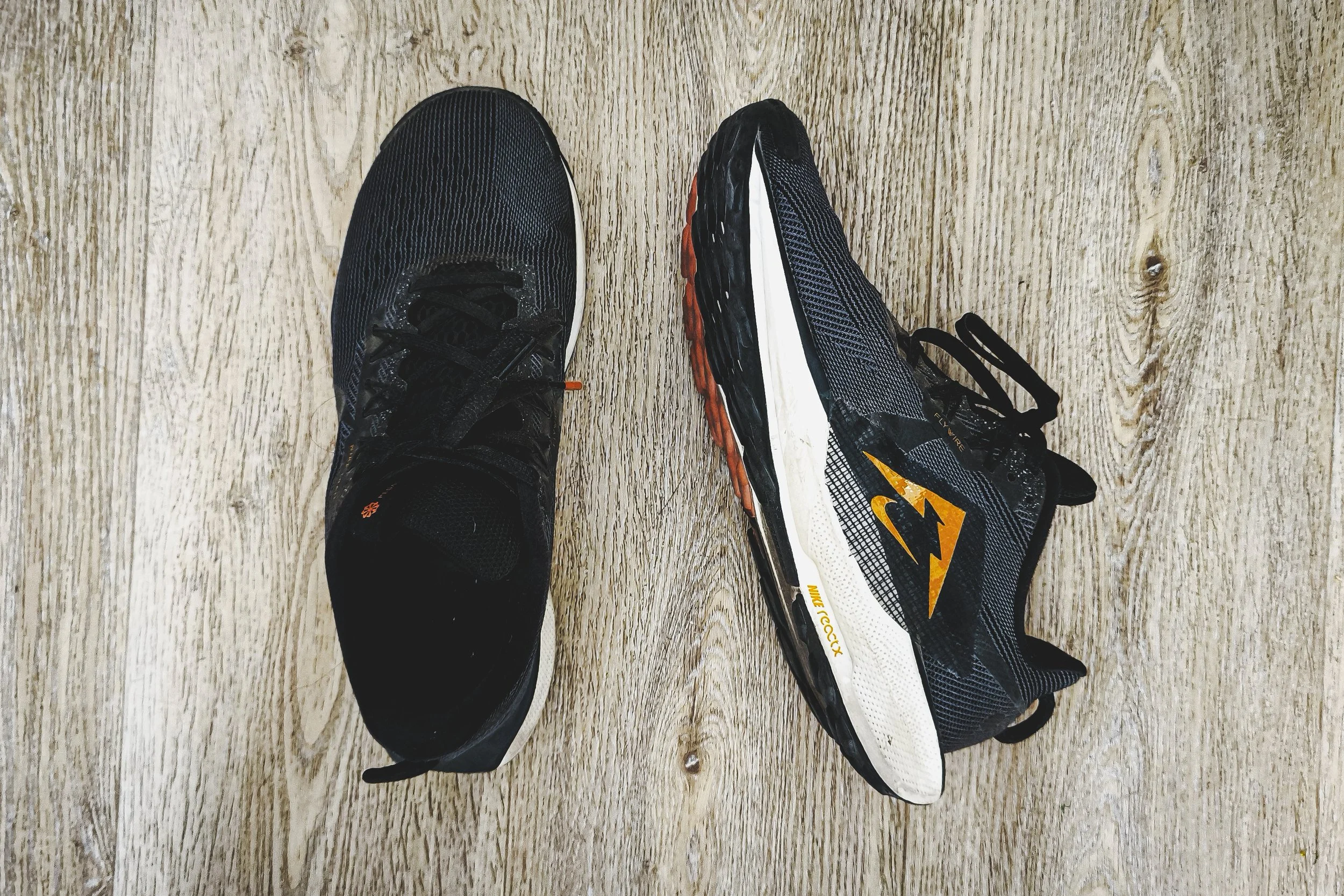
My current pair of trail runners, the Nike Pegasus Trail. I’ve really liked them since they fit all my criteria – they fit my urban style, have allowed me to go from road to trail, and they feel sturdy yet breathable in hot weather.
Deep dive: Flip-flops (my wet-area + downtime shoes)
Current pair (for the past several years now): Havaianas Brazil Logo Flip Flops (*)
What I look for in travel flip-flops:
Lightweight and packable: They’re the pair that’s packed in my bag.
Fully waterproof and quick-drying: Since they’re what I use for anything that involves water.
Comfortable and sturdy enough to actually wear: I don’t want flip-flops to only work for specific occasions; I want to be able to wear them walking around as well.
Flip-flops earn their spot because they serve purposes that trail runners don’t:
Shared showers (e.g. hostel or campgrounds)
Beach days
Anything else involving water
Quick errands when my feet need a break
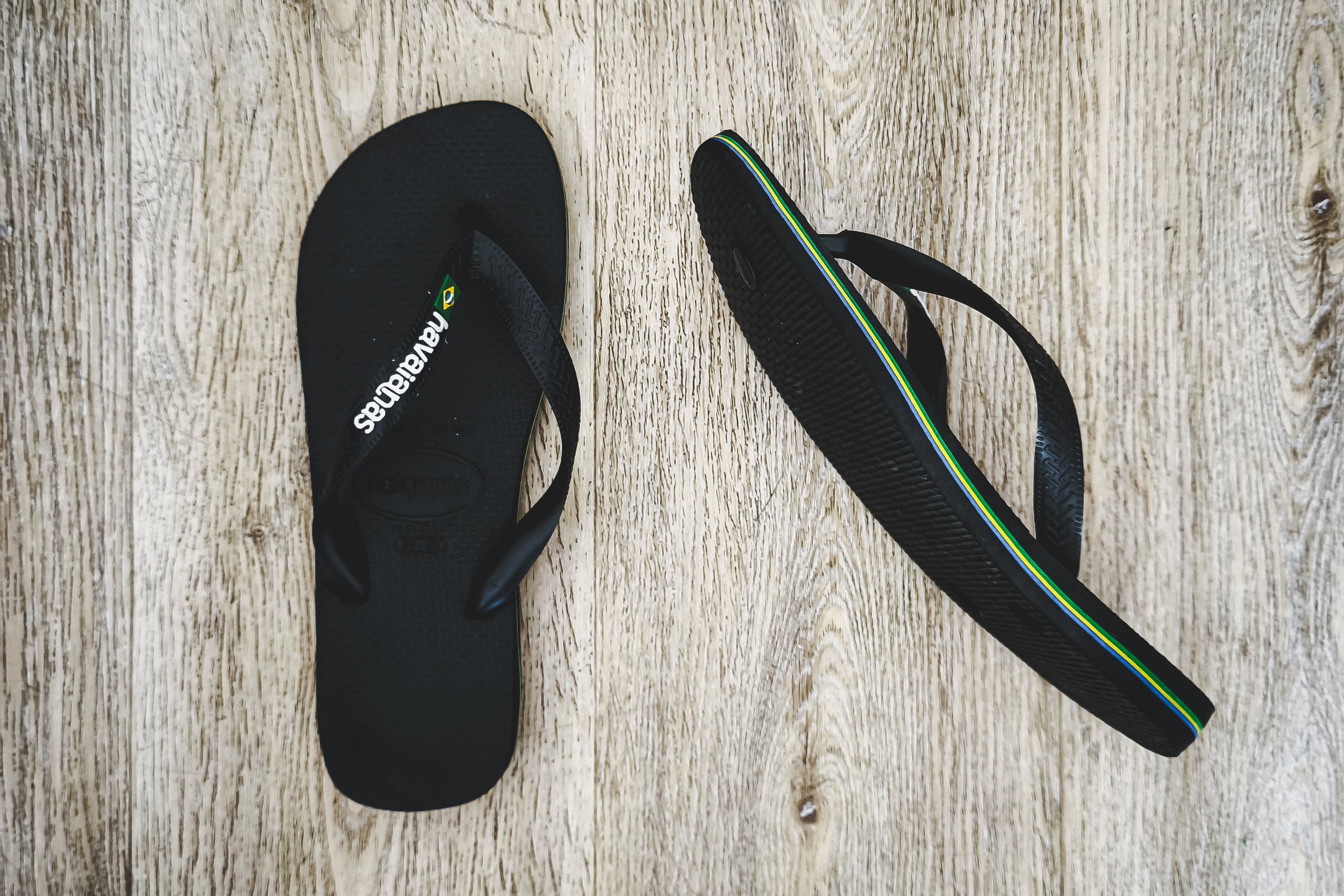
I’ve been using this pair of Havaianas flip-flops for a couple of years. They’re completely waterproof and super packable, yet still comfortable enough to walk around. Also they were clearly a local favorite in Rio de Janeiro – so many people were wearing them in the city!
Deep dive: The supporting pieces
Merino wool socks
Current pair: Icebreaker Merino Sport Socks (*)
Merino socks are the best travel socks I’ve found because they:
Are temperature-regulating, which means they stay comfortable across temperature swings.
Resist odor way better than cotton or most synthetics.
Dry faster so I can wash them quickly and feel less gross when they’re not perfectly dry.
Let you pack fewer pairs because I can re-wear them without them getting too disgusting.
I usually pack 3 pairs. That gives me a clean pair, a worn pair, and a buffer pair for laundry timing or wet weather.
Shoe bag
Current bag: Peak Design Shoe Pouch (*)
A dedicated shoe pouch is one of the 8 items that most make my broader one-bag system work because it:
Keeps dirt and grime off everything else (I hate the idea of shoes getting all my other stuff dirty).
Makes packing easier and faster (the packed pair goes into the shoe bag and the bottom of my pack).
If you don’t have a “real” shoe bag, a lightweight stuff sack or even a big plastic freezer bag works too – the point is to keep your shoes separate. But I do really like my current shoe bag because it’s volume-efficient and perfectly sized for the bottom of my pack, with sturdy fabric that fully contains dirty shoes.
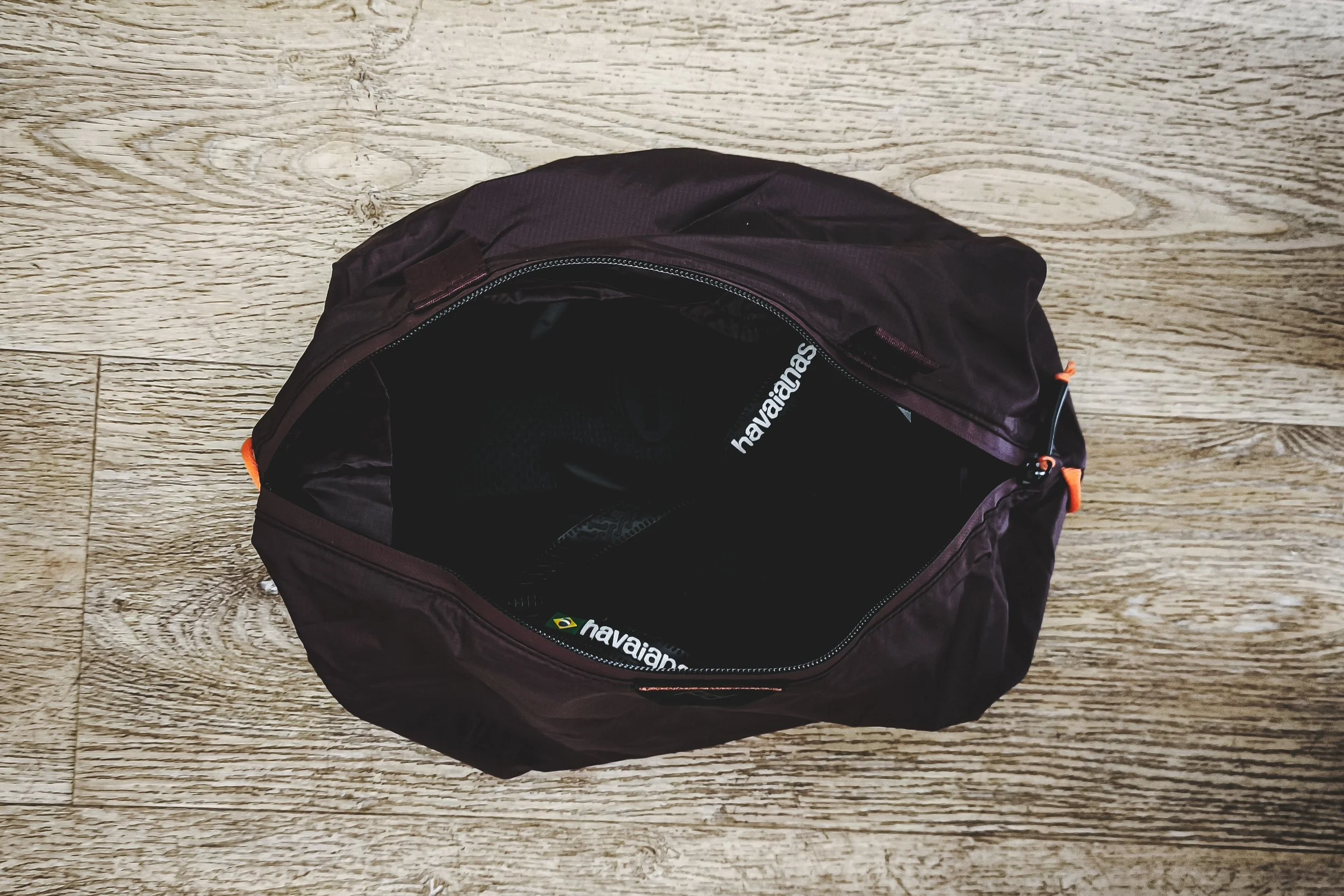
My Havaianas flip-flops fit perfectly inside the Peak Design Shoe Pouch, and together, they fit just right on the bottom of my bag.
Pros and cons of my set-up
First, I want to say that this isn’t a perfect setup, but it is the setup that, after much experimentation, covers the most ground with the volume and limitations of my 30L one-bag. If I travel with a larger bag, I would consider bringing more shoes to cover more settings, but I find the constraints to be worth it for the freedom of small-bag travel.
Pros
Versatile and flexible. With just these two pairs of shoes, I’ve been able to:
Walk 20,000 steps a day sightseeing in cities
Go from city exploring straight to an afternoon swim at the beach
Climb sand dunes
Hike mountain trails
Keep up with running training on city streets and dirt paths
Light and easy to carry. My flip-flops take up almost no space and add barely any weight to my pack. And the merino wool socks cut down on the number of socks I have to bring.
Cons
Dialing in the right pairs takes effort. It took some research and trial-and-error to find shoes that truly fit my criteria, especially the trail runners.
Rain and snow can be limiting. This setup works best in dry-to-mixed conditions; for sustained rain or cold/snowy trips, I make a swap (see the weather modifications section below).
Modifications for occasion-specific travels
My trail runner + flip-flop setup has worked across a lot of destinations and trip styles, but it’s designed for versatility, especially when I’m traveling indefinitely or don’t know exactly what conditions I’ll face. If I’m packing for a trip with a clear purpose or a single dominant environment, I tweak the lineup so each pair earns its spot. But, I still try to keep it to two pairs only.
If the trip is only cities
Main shoe: Keep the trail runners as my daily walking shoe, or swap in a simpler sneaker that doesn’t need multi-terrain grip.
Second shoe: Replace flip-flops with a “nice” packable option (e.g., ballet flats) for more polished settings (nights out, shows, etc).
If it’s hot/humid or a beach-focused trip
Main shoe: Swap trail runners for walking-friendly sandals for maximum breathability (or keep the trail runners if I still want closed-toe support).
Second shoe: Keep flip-flops for the beach and wet areas.
If it’s cold, rainy, or snowy
Main shoe: Replace flip-flops with weather-proof footwear (waterproof boots, insulated boots, or snow boots depending on conditions).
Second shoe: Keep trail runners for workouts/runs (or switch to road runners if it’s all pavement).
If it’s heavy on hiking/trekking
Main shoe: Replace trail runners with dedicated hiking shoes/boots.
Second shoe: Keep flip-flops for camp downtime and showers.
If the trip features a destination race
Main shoe: Replace trail runners with dedicated running shoes.
Second shoe: Keep flip-flops for showers and versatility for water activities, or add a main walking shoe.
I used this exact setup for a race weekend in Viña del Mar, where packing light made it much easier to handle packet pickup, transit, and staying near the start line without extra luggage.
A couple prior setups I’ve tried that weren’t ideal
1) One “do absolutely everything” sneaker (and nothing else)
For a while, in the spirit of extreme minimalism, I went on the hunt for one magic pair of shoes that could handle everything. That search led me to try some ultra-multipurpose travel shoes (such as from the brand Tropicfeel).
I wanted to love these shoes, but I found the trade-offs were real: the more “versatile” they tried to be, the less well they performed in any one role. They were stylish and worked well for walking, but they didn’t have enough support to feel good for running or workouts. And because they aren’t truly waterproof like flip-flops, they still took a while to dry after getting wet. In practice, I ended up missing more purpose-built footwear, and that pushed me back toward the two-pair system.
2) Adding packable flats for polished occasions
Because I do a lot of city travel, I experimented with adding a third pair of shoes — packable flats — in my regular lineup for the more polished moments (nice dinners, shows, etc). It made sense in theory since flats are lightweight, pack flat, and immediately dress things up.
But after a few trips, I realized I’m just not that fancy (xD), and my travel style reflects that. Most of the time, I’d choose more casual settings, and I much prefer walking in sneakers. The flats rarely got worn.
So now I treat “polished shoes” as an occasion-specific swap, not a default part of my regular lineup.
Quick recap
Overall, my current setup of trail runners, flip-flops, merino socks, and shoe bag is probably the one I'll be using for a while, but I will be updating here when things get inevitably refined over time!
Thinking beyond shoes for one-bag packing? Check out my entire packing list here!
Have a question about this or planning something similar?
Shoot me a message or leave a comment below — I read everything, and I’m always happy to help if I can!