One-Bag Laundry: My Portable System for Washing Clothes Anywhere
AFFILIATE DISCLOSURE: This post contains affiliate links. Links marked with (*) may earn me a small commission if you purchase, at no extra cost to you. (I only recommend things I personally use and love!). As an Amazon Associate I earn from qualifying purchases.
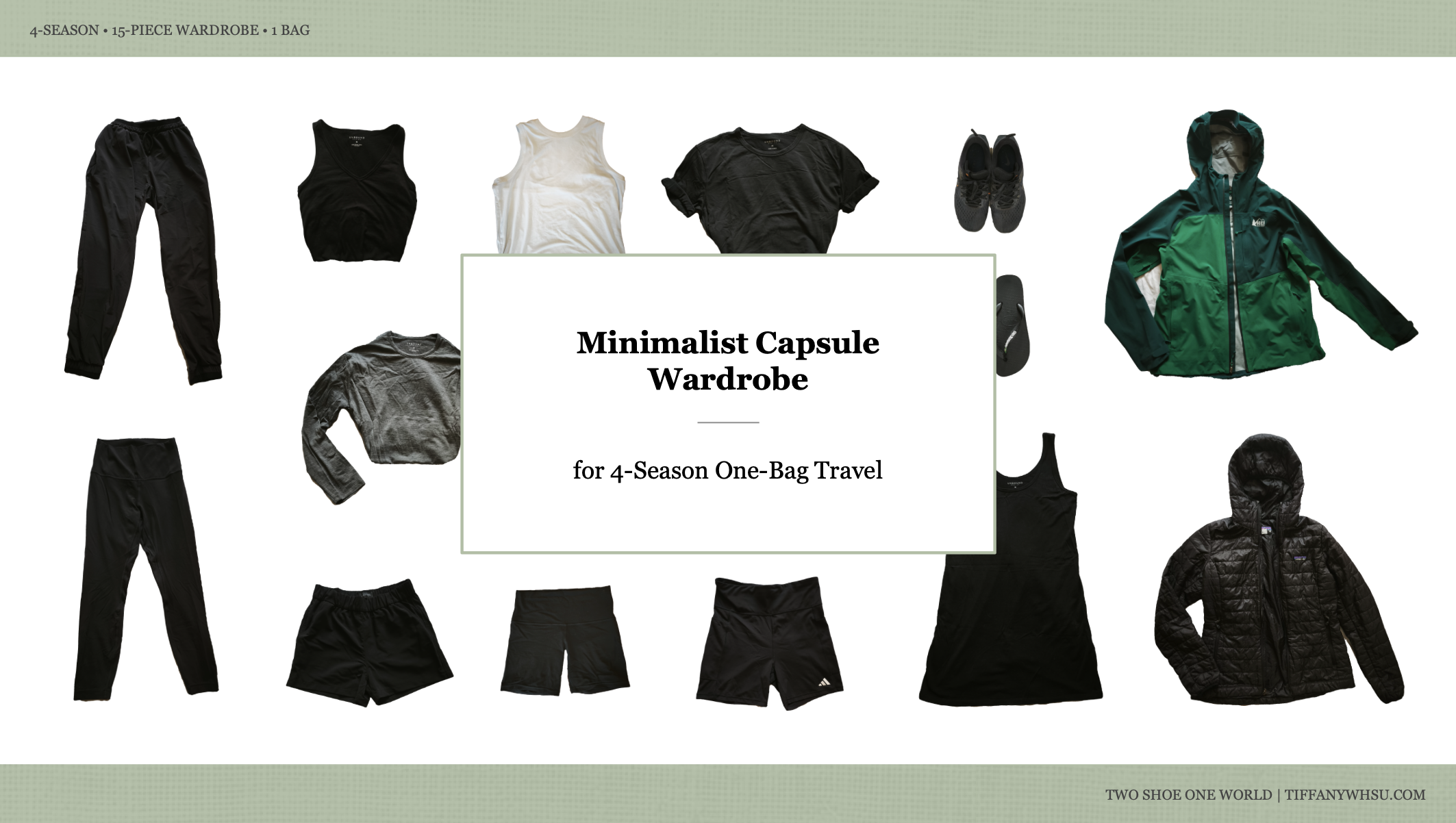
As a one-bag traveler, one of the constraints is clothing – I limit myself to at most a week’s worth of clothing (see my travel capsule wardrobe here), and it often lasts less when I’m staying active and sightseeing. This means that, as long as a trip is longer than a few days, I will need to do laundry.
This has been a persistent factor to consider when I plan for trips. Usually, this meant booking lodging that has laundry, but oftentimes, those places are harder to find and cost more. And then, I discovered the Scrubba wash bag. On a recent trip where I had no easy access to laundry for a month, I put it to the test. And boy oh boy, did it work.
In this post, I’ll break down the 3 items in the kit, exactly how I wash and dry clothes on the road, how this setup compares to other laundry options, and why I choose doing laundry over packing more clothes. If you’re curious about how I balance doing chores like practical tasks like laundry while traveling, I wrote all about it in my post on planning trips around energy, not just time.
Part of my one-bag system: This laundry system included in my overall packing list for indefinite, four-season travel. Steal the packing list here →
What Is This Laundry System + When To Consider It
This laundry system consists of three items: a waterproof wash bag, a portable clothesline, and detergent (I prefer detergent sheets). You can use practically anywhere, as long as you have clean water and anchor points to hang your clothesline. And if you don’t have good anchor points, you can skip the clothesline and hang items wherever they’ll actually dry.
To be clear: if my lodging has a washer and dryer, I’ll use them. But a lot of the time, it doesn’t. Here are 3 situations to consider this system.
1. You don’t have easy access to laundry
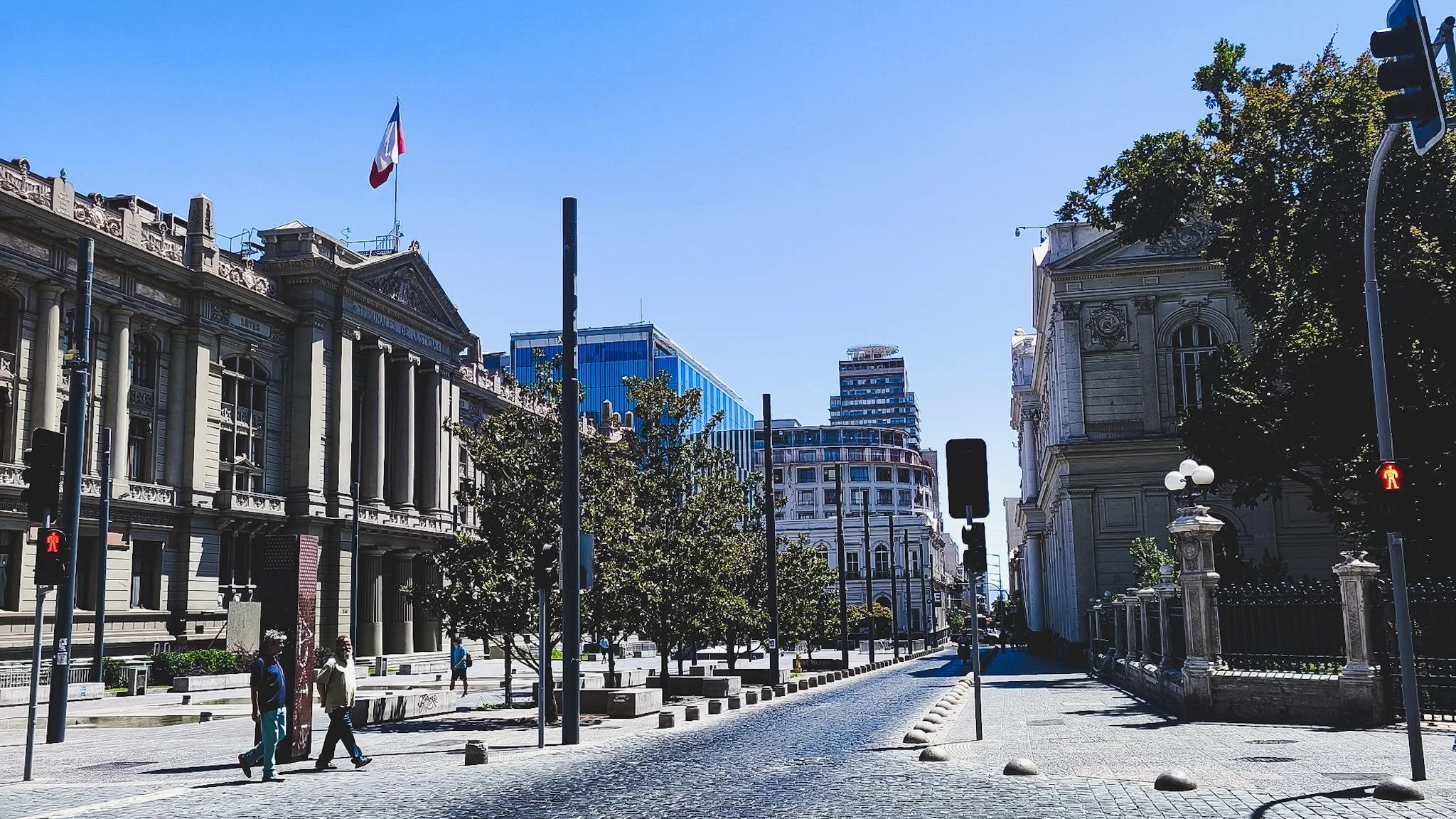
This laundry system has been my go-to method when I can’t find lodging that gives me easy access to laundry or don’t want to pay the premium for one that does. It’s saved me both time and money compared to finding a laundromat, trekking over there, and waiting around (doing laundry in an unfamiliar place on a travel day just kind of sucks). In Santiago, for example, not needing in-unit laundry helped widen my housing options and keep accommodation costs lower, which I wrote more about in my slow travel post.
As I mentioned in the intro, I used this as my only laundry method for a full month, and it totally delivered. I’ve personally used it only in cities, but it’s also worth considering for long thru-hikes if you’re trying to bring fewer clothes and you’re okay with hand-washing along the way.
2. You’re willing (and able) to hand-wash regularly
The max volume of my favorite wash bag (the Scrubba, which I’ll get into later) is roughly one small load: the equivalent of 2 T-shirts, 2 pairs of underwear, and 2 pairs of socks. In my experience, one load takes about 20 minutes start to finish. You can probably take less time if you’re not so meticulous about rinsing and wringing as me.
You’ll have to find a good cadence in terms of how often you do laundry and the number of loads you do each time. I usually do 2–3 loads at a time (about 40–60 minutes total) every 3–5 days. I know that’s not an insignificant amount of time, but I treat it as a little bit of time to myself with a podcast or audiobook, and that makes time go fast!
3. You want a system that works anywhere
Since this system really only relies on the gear (and access to clean water), it’s genuinely flexible. This means that as long as you carry the gear, you don’t need to think about and plan how you can do laundry – and that is pretty freeing at least for me!
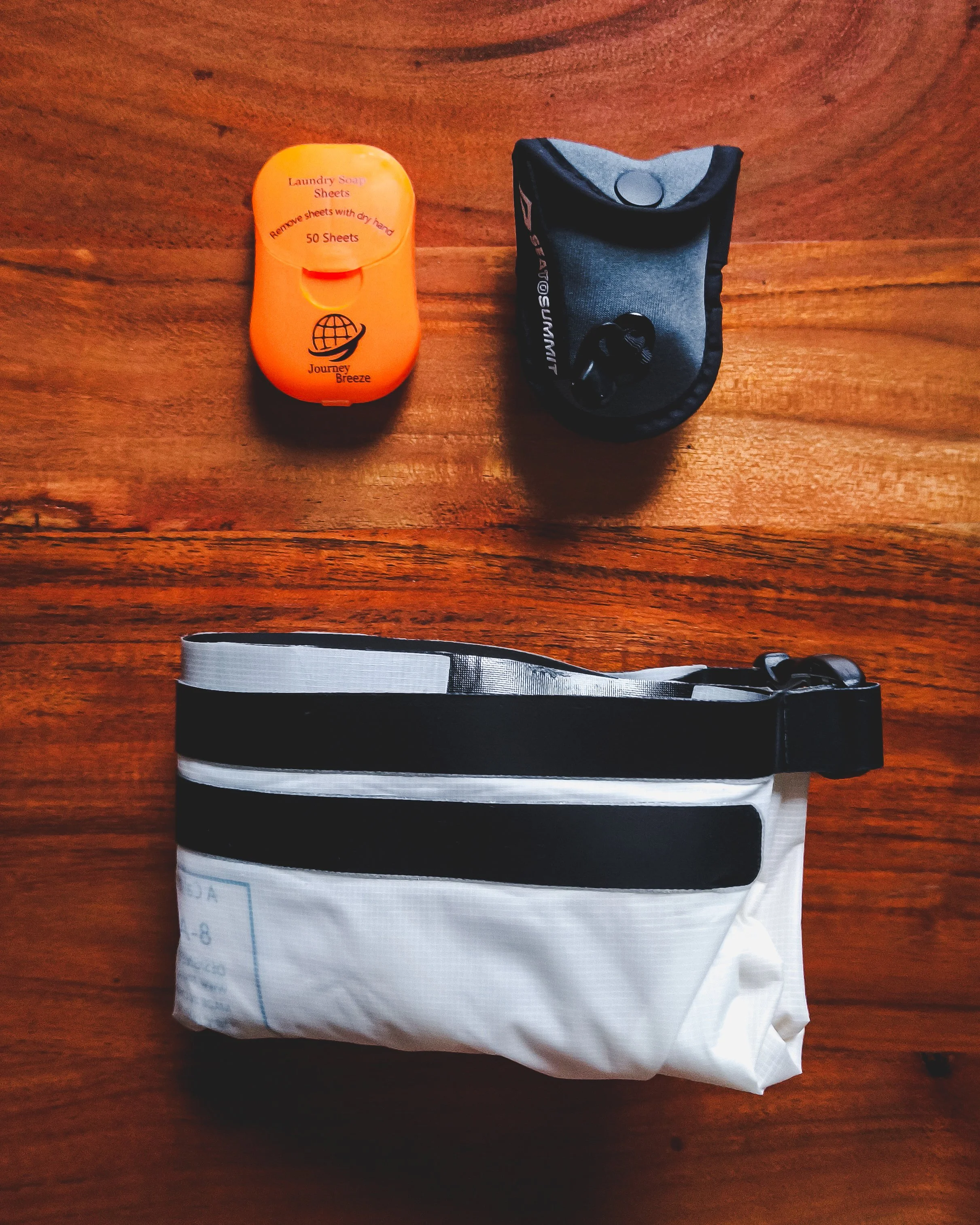
The whole system: Detergent sheets, packed clothesline, and the Scrubba wash bag folded down to about the size of a water bottle.
Laundry Gear + Mini Reviews
Here are the three exact items in my laundry gear and my mini reviews for each.
🧺 Wash bag
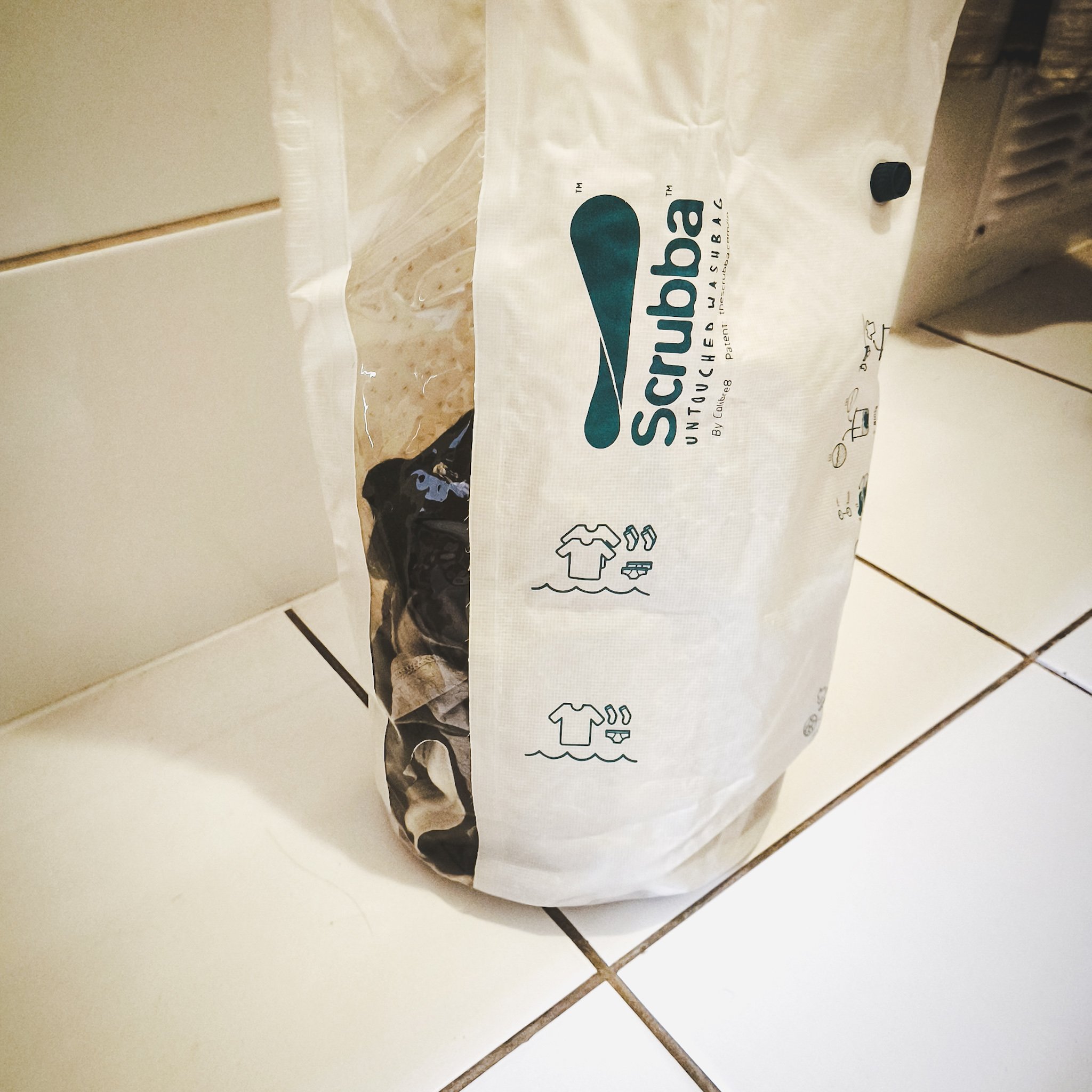
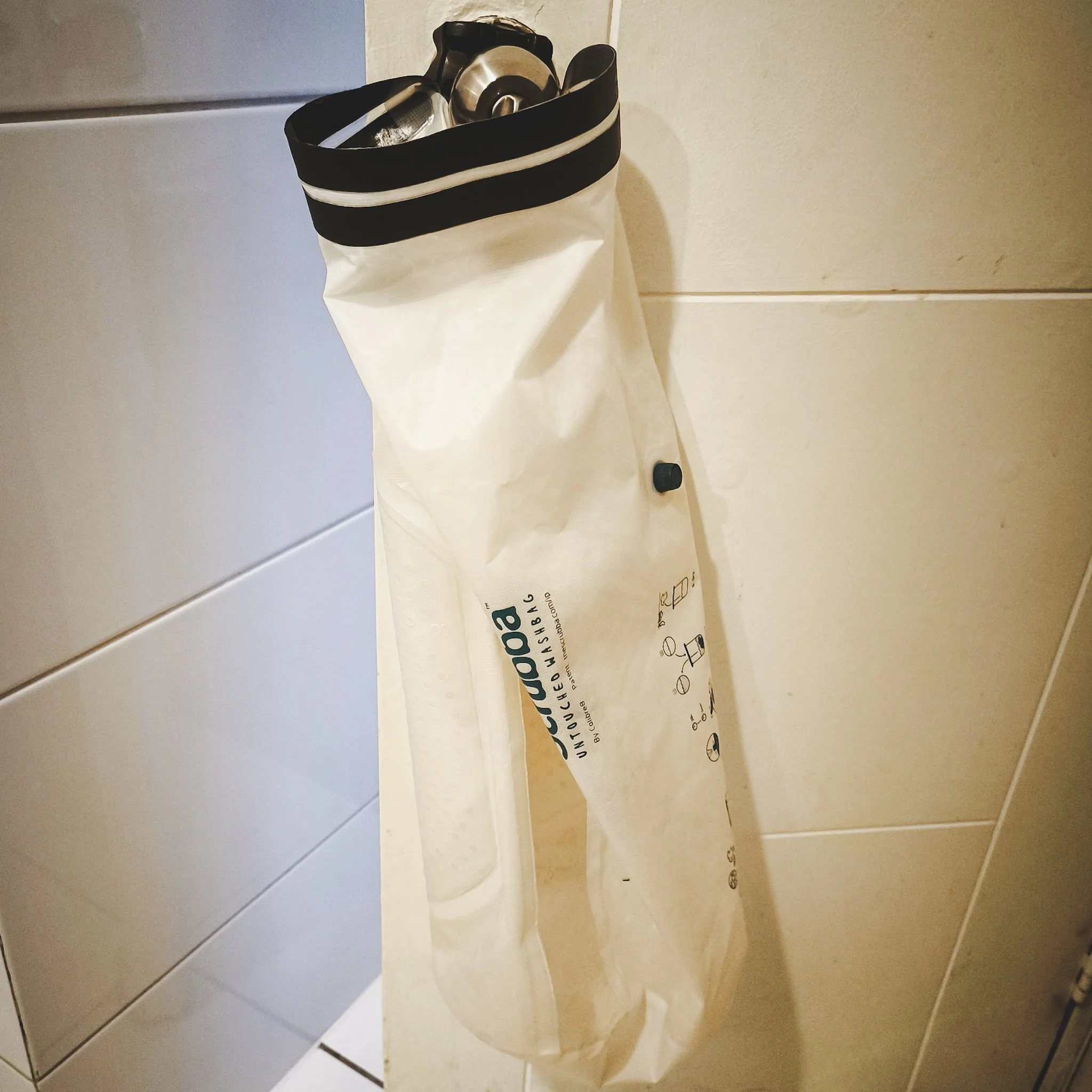
My ride-or-die: Scrubba Untouched Wash Bag (*)
What: A waterproof hand-wash bag in a durable 40-denier nylon.
Packed size: About a 500 ml water bottle.
Weight: 150 g / 5.3 oz.
Review:
This is the star of the show. Unlike most travel wash bags, this one has internal bumps that mimic a washboard, so you can scrub clothes more effectively.
The material feels tough — I can scrub hard and toss it around without worrying about damage. The roll-top closure keeps it mostly waterproof, though I’ve noticed minor leaking even when rolled properly. It’s never enough to affect washing, but I recommend using it in a tub or putting a towel underneath if washing on the floor.
Additional considerations:
The wash bag comes in a few colors – most commonly a bright green (the original) and white (the “untouched” version, meaning not bleached or dyed). I own the white version since I wanted a less processed bag, but it does get a little stained over use.
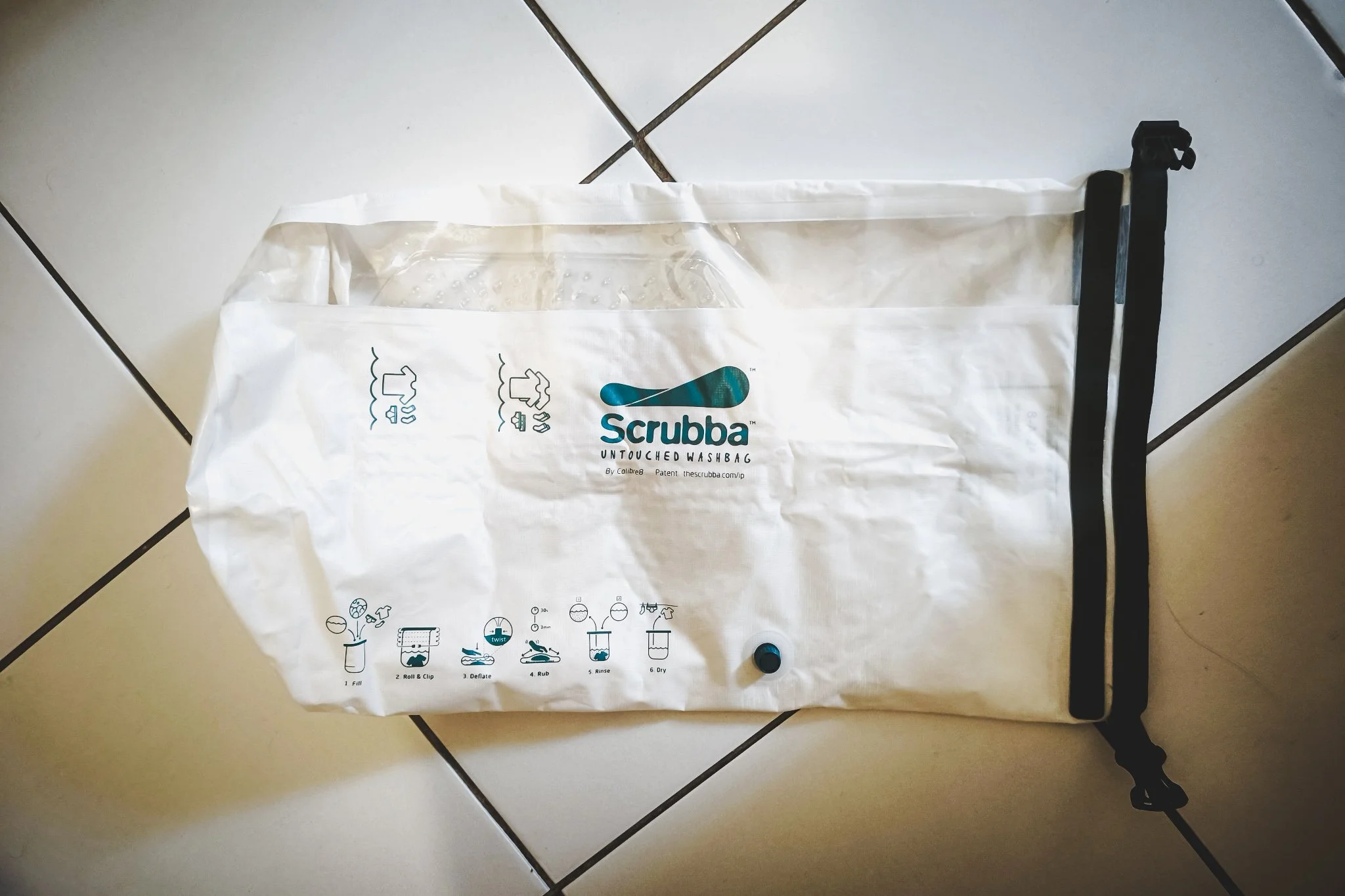
The Scrubba wash bag is my portable “washing machine” – it’s waterproof with built-in scrubbing bumps to actually get clothes clean.
🪢 Portable clothesline
Current one: Sea-to-Summit Lite Line (*)
What: A non-stretch, length-adjustable (max 3.5 m / 11.5 ft) clothesline with beads to hold clothing in place.
Volume: About a mandarin orange.
Weight: 40 g / 1.3 oz (next to nothing).
Review:
My favorite part about this clothesline is how absolutely tiny it packs into itself. And the smart design of having the storage as part of the wrap anchor means no separate item to pay attention to (or lose). Its utility outsizes its tiny size, and once set up, the clothesline performs as it promises and the clothes stay put with the little beads.
The line does sag a bit with the weight of wet clothes, but pulling it very taut helps.
There’s a little bit of a learning curve, mainly in terms of figuring out how the hooks work and how to shorten / lengthen the line, but nothing you can’t figure out in 10 minutes or a video.
Additional considerations:
You’ll need two sturdy anchor points (not wobbly chairs), which takes a bit of creativity in some rooms.
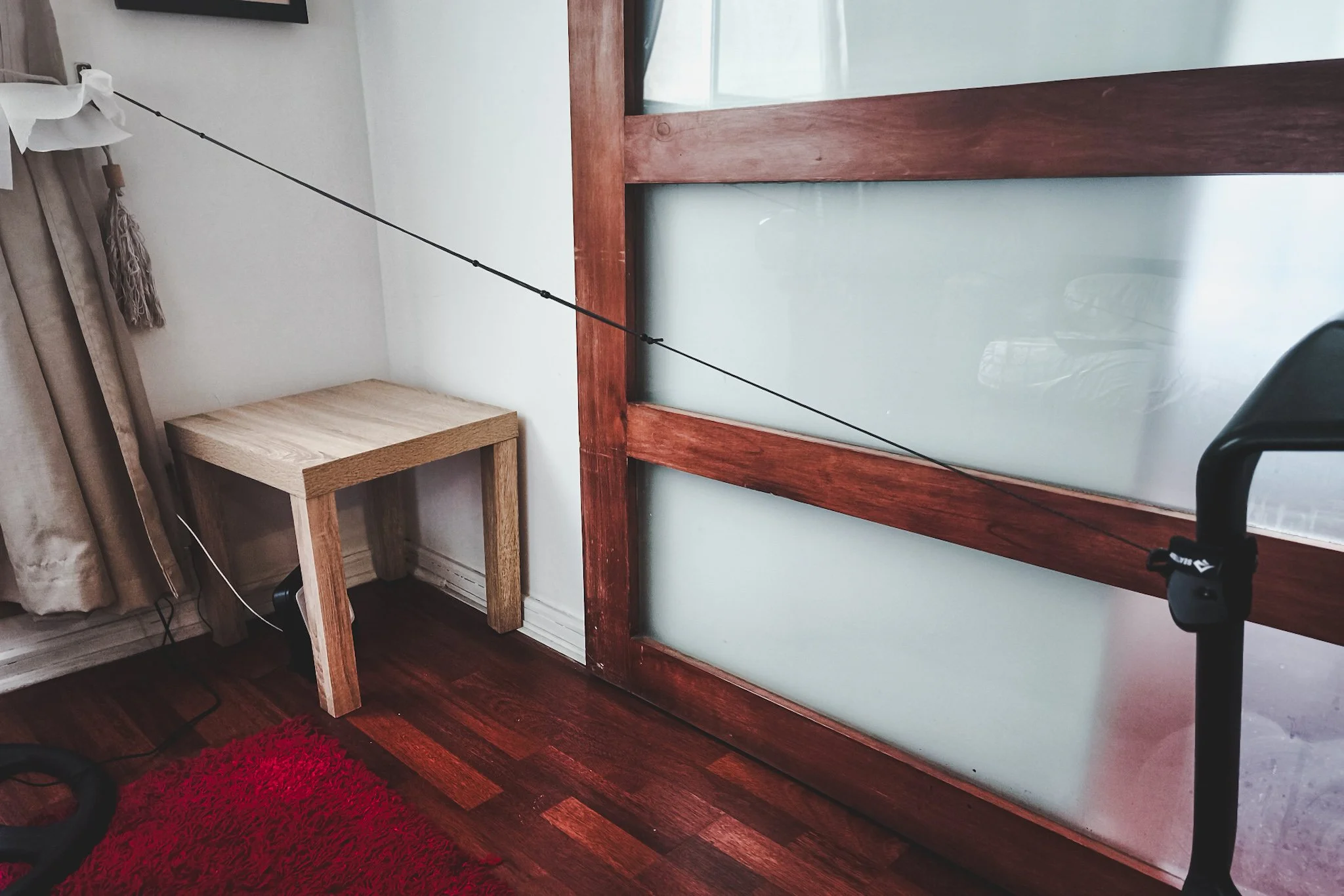
The tiniest clothesline that works almost anywhere – in this Airbnb I had to use a bit of creativity to set it up, using a curtain hook and a kitchen stool. This pic shows half of the line.
🧼 Portable detergent sheets
Current one: Journey Breeze Travel Laundry Detergent Sheets (*)
What: Travel sized detergent sheets (50 count) in a convenient plastic packet (comes with a plastic pouch for protection).
Volume: About a pack of floss.
Weight: 20 g / 0.7 oz (next to nothing).
Review:
I love traveling with little detergent sheets vs. liquid detergent since they’re much more portable and won’t leak and create a mess. These clean well, though I use 4–5 sheets per load (instead of the suggested 1–3) to get the lather I like. They have a light rose scent in the package, but it’s barely noticeable on clothes.
They’re pricier per load than regular detergent, but still far cheaper than laundromats (and worth it for the convenience).
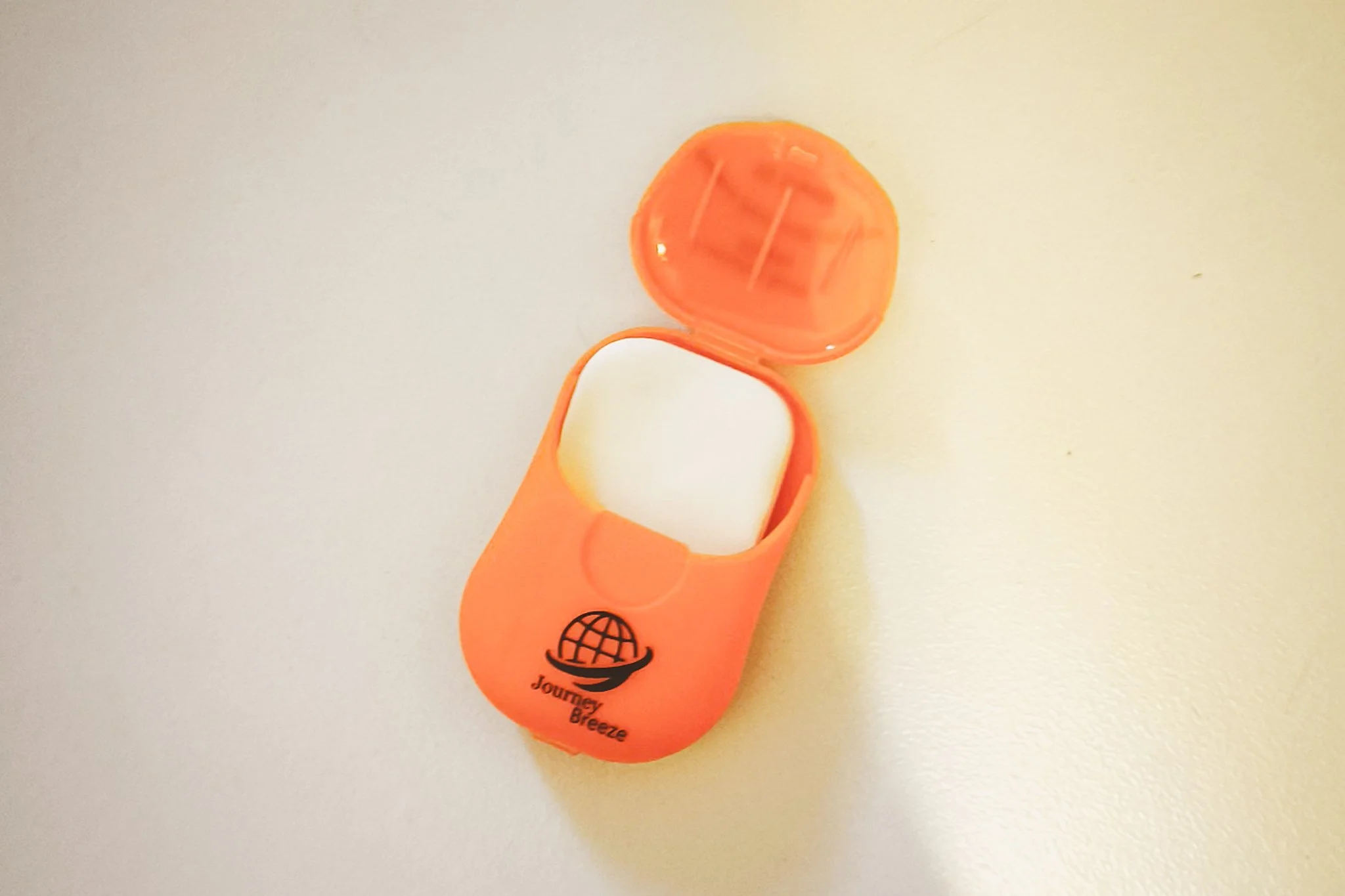
Ultra-packable detergent sheets — it takes no space in my bag and is powerful enough for travel laundry.
Washing Procedure + Tips
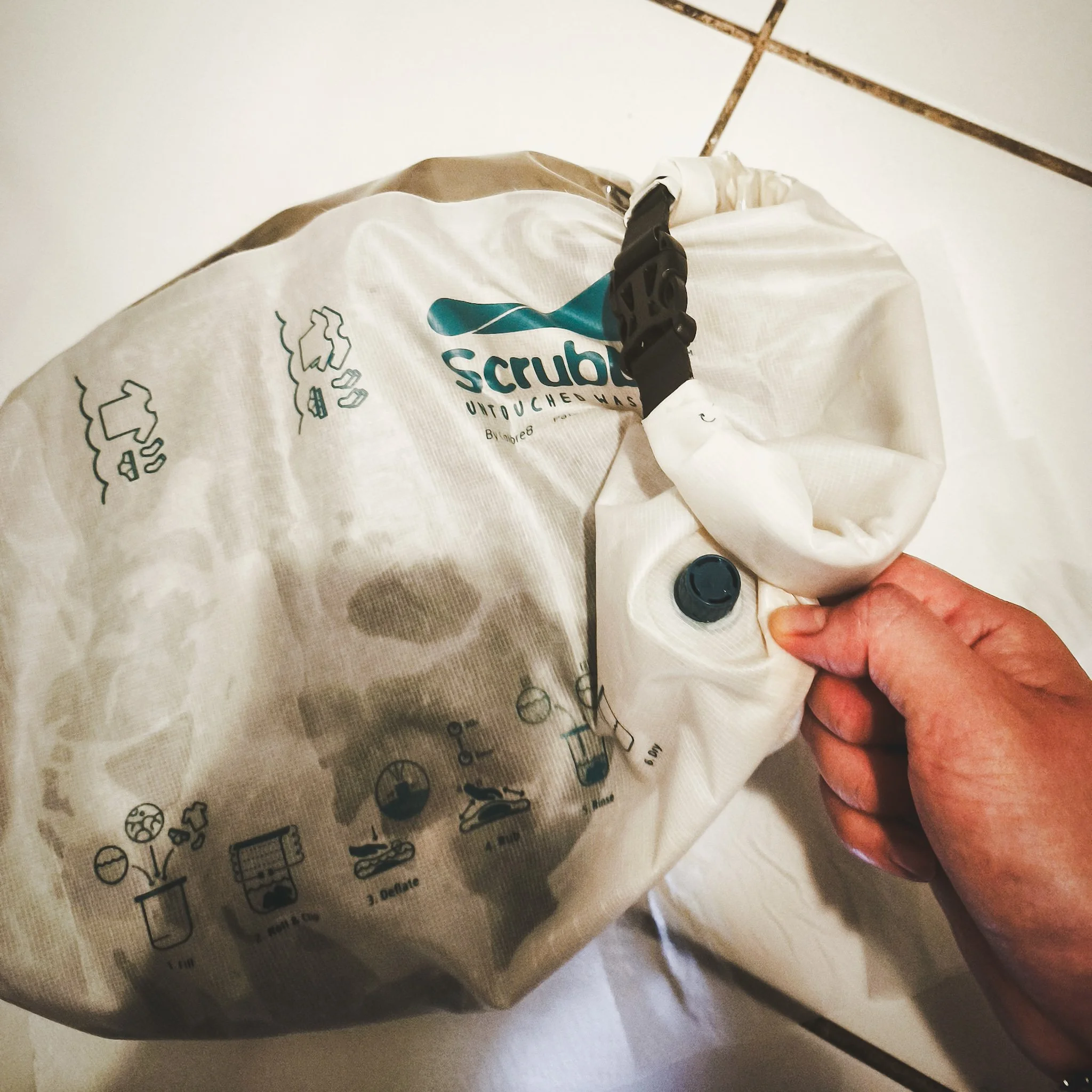
Step 1: Add clothes + detergent
Put clothes in first, then detergent sheets so water can dissolve them evenly.
Max load guideline: About 2 T-shirts, 2 underwear, 2 pairs of socks.
Other equivalent loads I’ve done:1 fleece or sweatshirt
1 pair of pants + 1 T-shirt + socks
3 tank tops + 1 running shorts
Step 2: Add water to the water line
Fill to the line marked on the bag. Warm water works best to dissolve detergent and lift oils/stains.
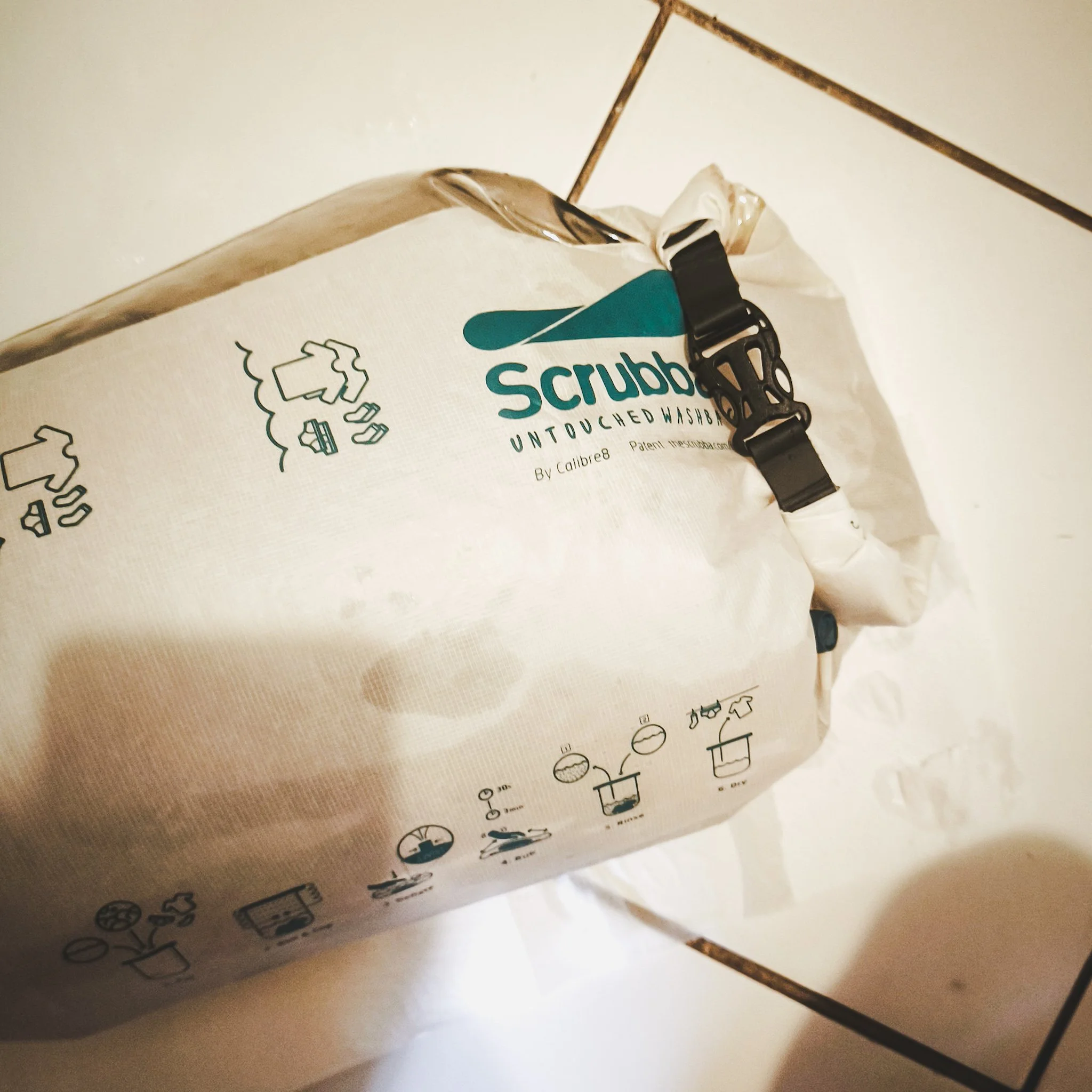
Step 3: Seal the roll-top and clip closed
Roll along the guide lines, pushing out excess air as you go. Clip the buckles on the opposite side of the fold for a better seal.
Step 4: Vent air to deflate the bag
Lay the bag flat (smooth side up), open the valve, and press air out. Don’t worry about perfection — just try to reduce the big air pockets. Venting is to decrease the air impeding your scrubbing in the next step.
Close the valve when you’re done.
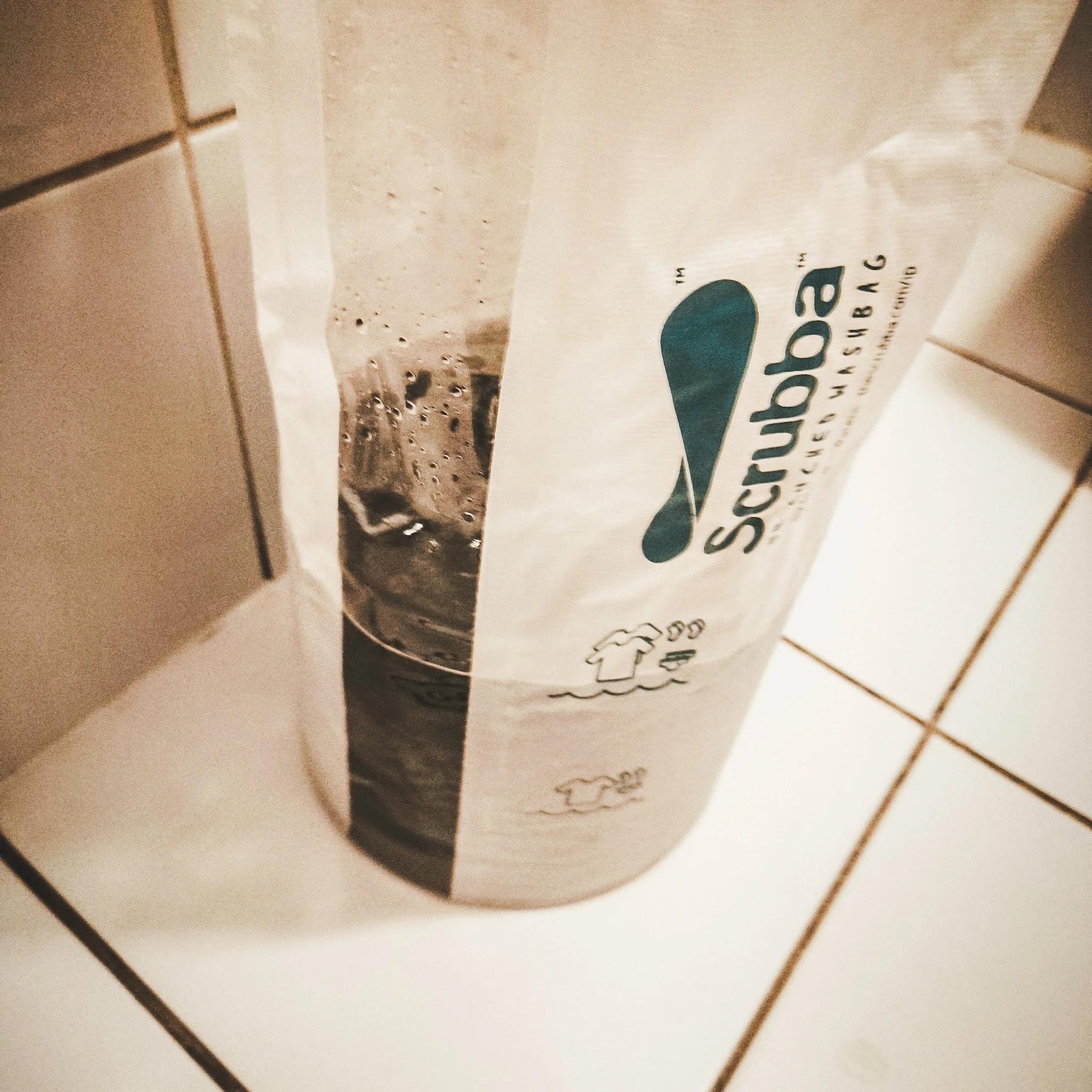
Step 5: Scrub clothes (4-5 minutes)
Time for exercise! Scrub in all directions so clothes rub against the internal bumps. I go for 4–5 minutes (longer than the official 30 sec–3 min), which I’ve found cleans better.
Step 6: Rinse clothes with clean water
Dump the dirty water, refill with clean water, and swish/rub the clothes inside the bag to rinse out more detergent. Remove clothes, rinse individually if needed, wring, and hang.
Step 7: Rinse the bag and hang to dry
Rinse inside and out (turn it inside out if needed). Wipe it down and hang it open to dry (you can clip the buckles to create a hanging loop).
Drying Tips
Air-drying takes some planning. Here are some tips to help dry your clothes faster:
1. Choose fabrics that dry fast
Quickest: Synthetics + athletic fabrics, merino wool.
Slowest: Denim, heavy cotton, thick knits.
If you do wash slow-dry items, accept they may take 24+ hours and plan accordingly.
2. Remove as much water as possible after washing
Wring hard, then twist the item in a different way and wring again.
If you have a towel, you can lay the item flat on it, roll it up like a burrito, then twist/squeeze. This helps pull out water.
3. Create airflow (it matters more than heat)
The fastest setup is near moving air: a fan, open window, or breezy balcony.
Cracking a window and turning on a fan make a huge difference if indoors.
In humid places, airflow is even more important. But in those places, assume drying will take longer and plan accordingly.
4. Spread out the fabric and space items out
Spread out the item as much as you can so more of the fabric “touches” air.
When hanging, put at least a finger-width between items so moisture can escape. If you’re using a clothesline with beads, use the beads to keep items separated.
5. Flip items halfway through
Anything folded over a line dries slower on the inside because it gets less airflow. Once the outside feels mostly dry, flip or reposition the item so the damp side gets more air and dries faster.
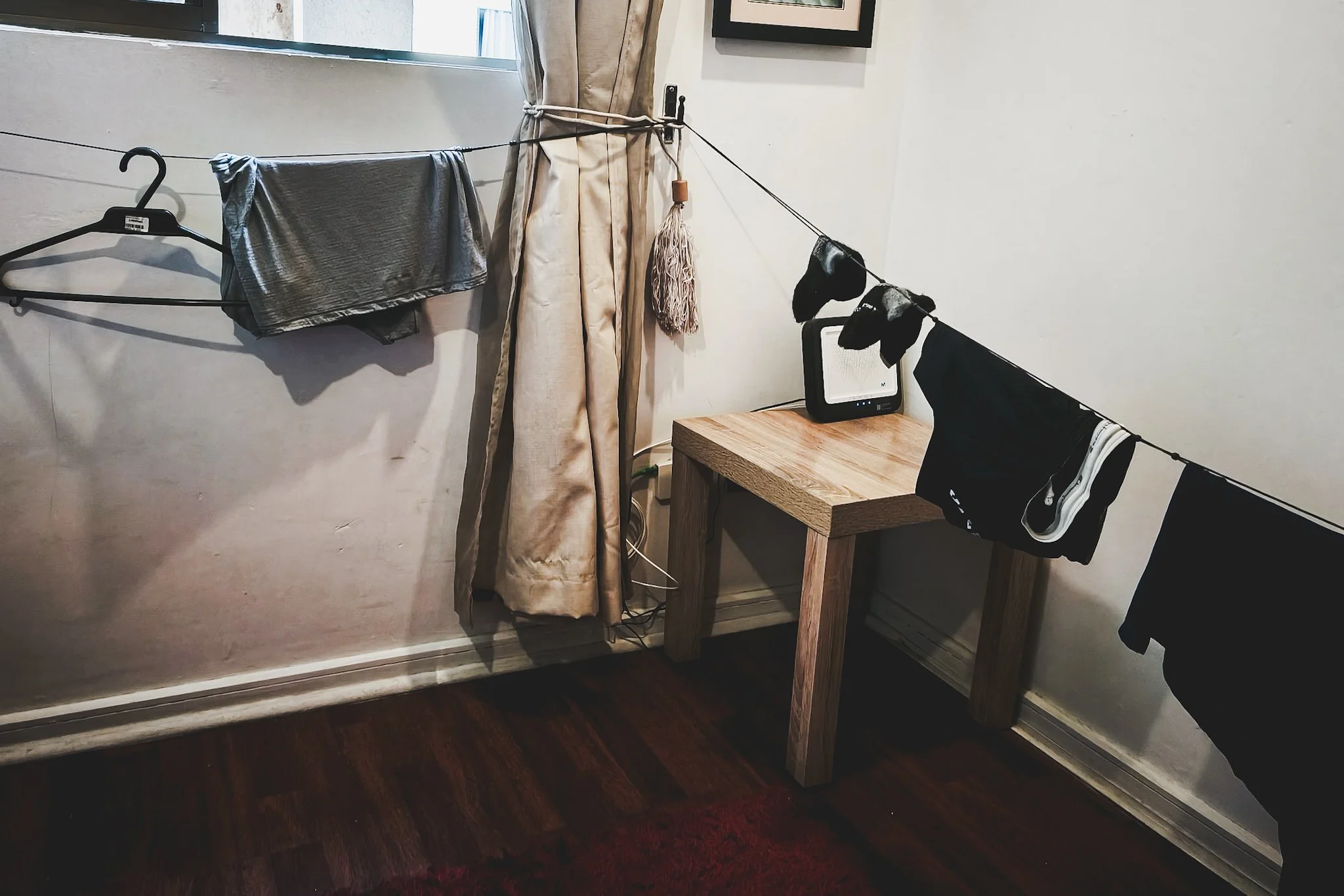
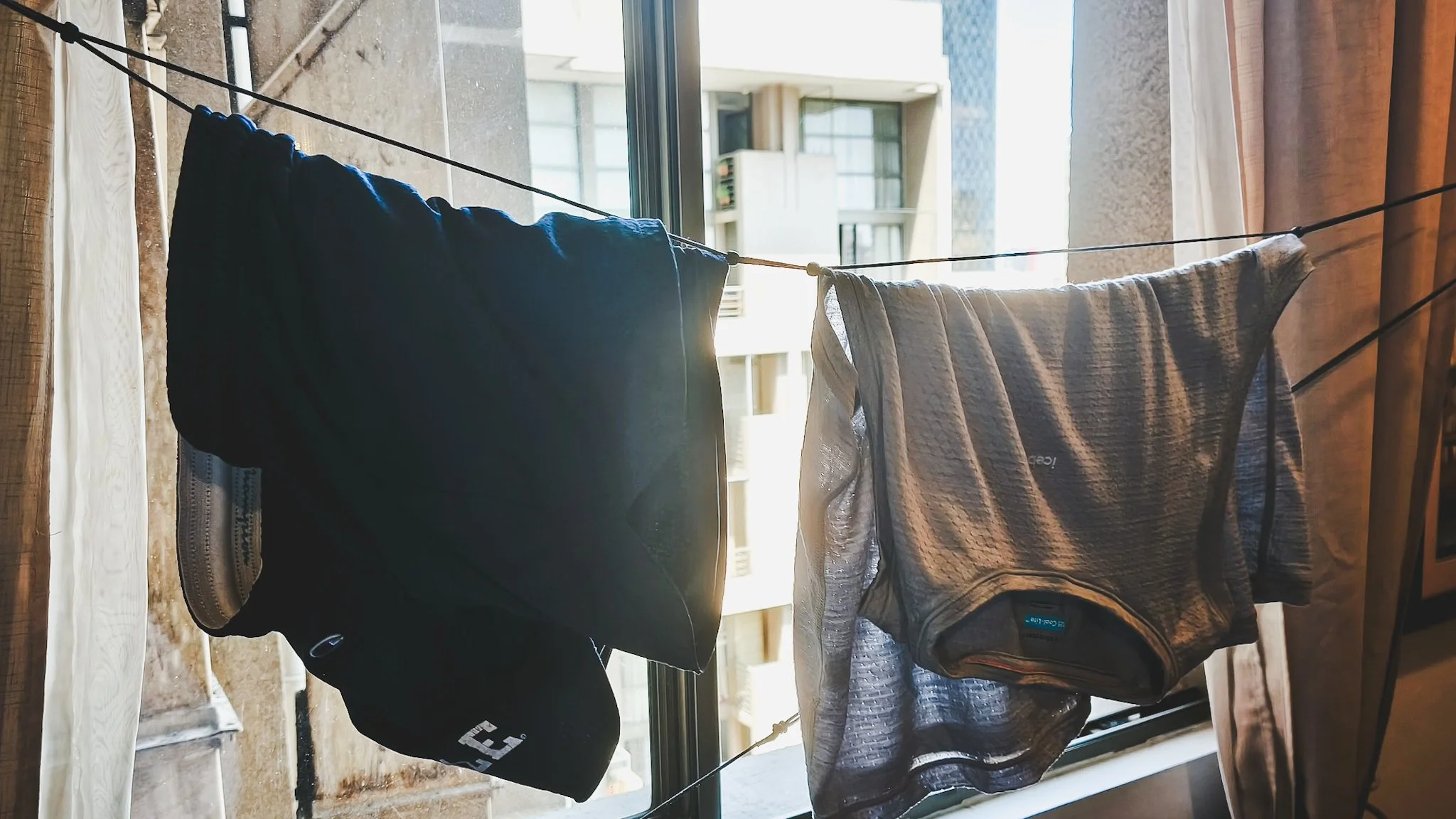
Clothes drying on the clothesline, set up with some space in between. In this Airbnb, there was no way to get the clothesline right next to a window, but there was a fan to create airflow. I added a hanger to increase the hanging space.
Pros and Cons vs. Other Laundry Methods
Below is how the portable wash-bag system stacks up against the other common options.
Washer + dryer in your lodging
Pros: Lowest effort, fastest, handles bulky items easily.
Cons: Lodging with laundry often costs more (it’s a premium amenity), and it’s not always available.
Portable wash bag + clothesline (this system)
Pros: Works almost anywhere, cheapest (after upfront costs of the gear), no laundromat errands, more control over detergent/handling.
Cons: Manual effort, plus you need time/space to air-dry; bulky items take longer and may require multiple loads.
Laundromat self-service (wash + dry)
Pros: Great for big loads and fully dry clothes on the spot.
Cons: Costs add up, plus the hassle/time of finding one, getting there, and waiting.
Laundromat drop-off service
Pros: Lowest effort since someone else does everything.
Cons: Usually the most expensive option. Plus, require time/effort to find a reputable laundromat, and quality/handling can vary.
Sink hand-washing
Pros: Free and available in a pinch.
Cons: More annoying and less effective; harder to rinse well, messier, and less hygienic.
Why Not Just Pack More Clothes?
Fair question 😄
Once I committed to one-bag travel (see my full packing list here), the biggest thing I had to unlearn was packing like I might suddenly become a new person on vacation (What if I randomly go to a fancy dinner when I don’t even do that at home? What if I try out this new colorful style this vacation?).
Clothes used to be the #1 space hog in my bag, mostly because I packed a bunch of “just in case” pieces that actually never make it out of the bag. Over time, I got better at noticing what I actually reach for and stopped packing for imaginary scenarios. Now I bring roughly a week’s worth of clothes no matter how long the trip is, and plan to do laundry when I need to. If you’re curious what that week’s worth of clothes looks like, see my travel capsule wardrobe and the logic behind it!
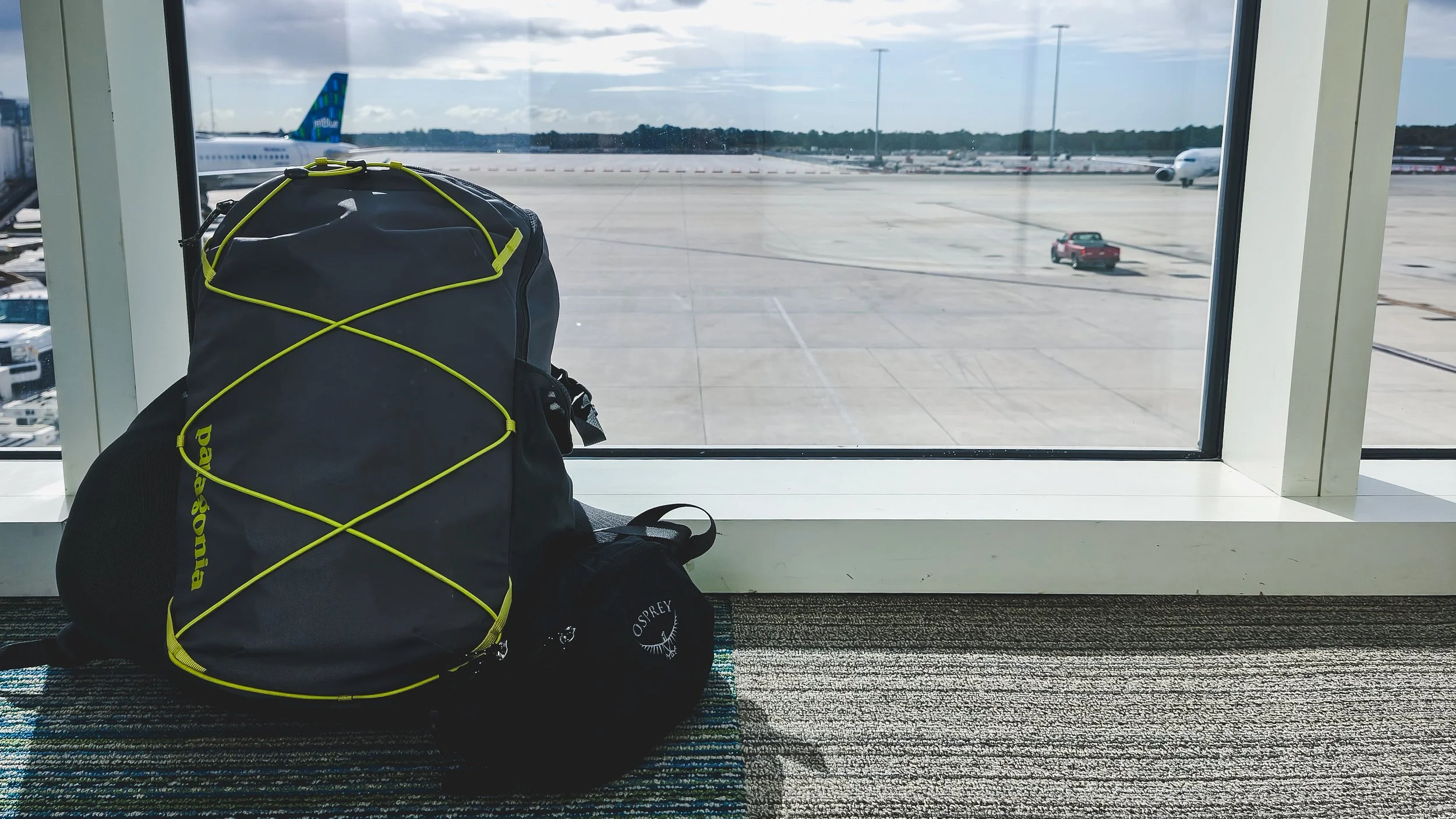
That trade-off has been totally worth it. Traveling with just an everyday backpack has given me flexibility I wouldn’t have with bulkier luggage — like exploring Panama City during a layover instead of dragging luggage around or babysitting my suitcase in the airport. That’s the kind of flexibility I’m optimizing for. The wash bag is one of the pieces of gear that makes that trade-off possible, which is why I included it in my list of the 8 items that most make my one-bag setup work.
So yeah – for me, laundry is totally worth it in exchange for the freedom of moving through the world lighter.
Have a question about this or planning something similar?
Or do you have some chaotic third system I need to know about?
Shoot me a message or leave a comment below — I read everything, and I’m always happy to help if I can!